
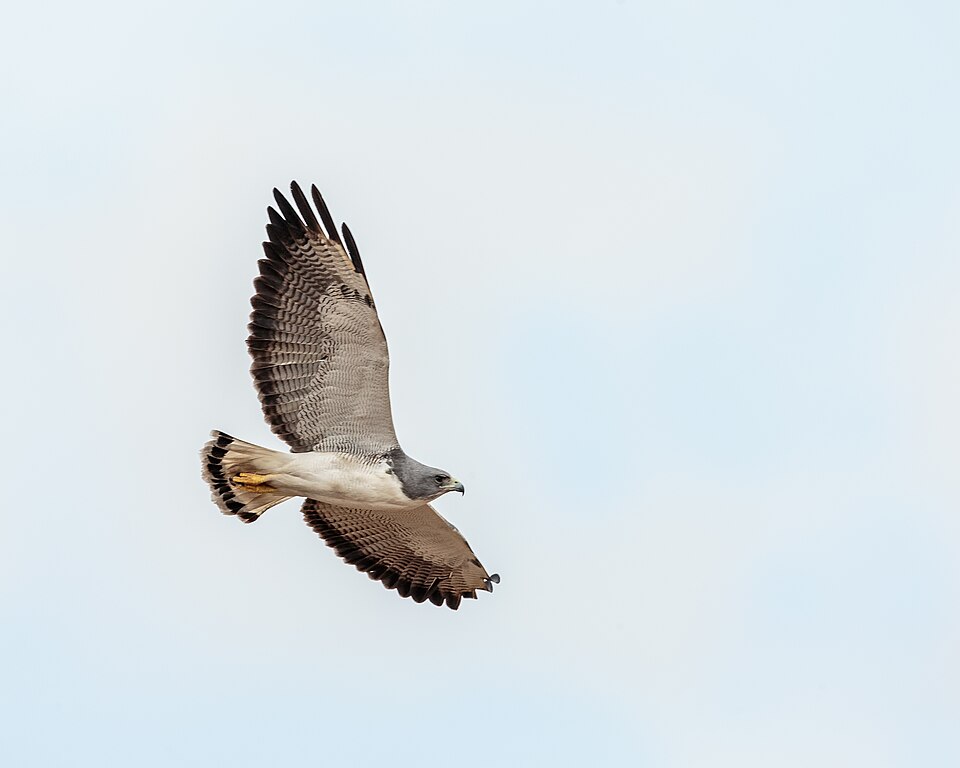
The White-tailed Hawk (Geranoaetus albicaudatus) is a large, stocky bird of prey found in tropical and subtropical environments across the Americas. Adults are easily recognized by their grey upperparts, white underparts, and a short white tail bearing a narrow black band near the end. A rusty-red shoulder patch is a key field mark when the bird is perched with wings closed. Classified as Least Concern in AviList v2026, this species thrives in open, semi-open arid habitats where it hovers to scan for prey.
Learn to identify
Adult White-tailed Hawk in flight, seen from below.
Learning lesson · openly licensed photographs, labelled by BirdBot; labels checked against the cited sources and approved by AI

White wing linings: white coverts contrast with the grayer flight feathers. Short white tail: the tail is white and very short. Black tail band: a narrow black band near the tail tip. Perched adults show rusty shoulders and a smooth gray back.
Young birds are very dark and lack the white tail and rusty shoulders.
Sources: Audubon Guide to North American Birds: White-tailed Hawk · Wikipedia: White-tailed hawk (revision 1380711896)
Photo: Dominic Sherony, CC BY-SA 2.0, via Wikimedia Commons; labels added by BirdBot.
The adult White-tailed Hawk presents a clean, high-contrast pattern. The upperwings are dark, mixed with grey near the bases of the blackish primary remiges, while the underwing is whitish with indistinct brownish barring on the coverts that extends onto the flanks and thighs. The iris is hazel, the cere is pale green, and the beak is black with a horn-colored base. Feet are yellow with black talons.
Immature birds are significantly darker than adults and may appear nearly black in poor light, particularly if they have little white below. The rusty shoulder patch is absent in younger birds. The tail changes from brown with several dark bars to greyish with a hazy dark band as the bird approaches maturity. In the Southern Hemisphere winter, young birds are sometimes mistaken for migrant red-backed hawks (Geranoaetus polyosoma).
The species ranges from the coastal areas of Texas and the Rio Grande Valley south to central Argentina, including many Caribbean islands in the Lesser Antilles and Trinidad and Tobago. It prefers open or semi-open regions up to 600 m (2,000 ft) elevation with few trees to obstruct flight. The hawk generally favors arid habitats and rarely occurs in areas with heavy rainfall. It is not a migratory bird, though some populations may make regional movements when food is scarce.
The White-tailed Hawk’s preferred hunting technique is to hover and observe the surroundings for signs of potential prey, gliding to another location when nothing is found. It commonly perches on bushes, trees, or telephone poles, stands on the ground, or engages in soaring. A notable behavior is gathering with other birds at brushfires to catch small animals fleeing the flames.
The diet varies with the environment. In southern Texas, rabbits make up the majority of the diet, while in the Dutch West Indies, lizards 30 cm (12 in) or more in length are preferred prey. Other food items include cotton rats, snakes, frogs, arthropods (especially grasshoppers, cicadas, and beetles), and small birds like passerines or quails. In the tropics, the species ranks among the main predators of small monkeys known as marmosets. It may take chickens if no other food source is available and is also known to feed on carrion.
Breeding pairs build nests from freshly broken twigs, often from thorny plants. Nests are typically placed 1.5–5 m (5–15 ft) or more above the ground in a tree or yucca, preferably in an elevated location offering good visibility. The interior is cushioned with dried grasses; green twigs of mesquite or other aromatic plants are often added, perhaps to deter parasites. Like many Accipitridae, white-tailed hawks tend to reuse nest sites, which can reach sizes of up to 1 m (3 ft) across over the years. Clutches contain one to three eggs (usually two), which are white and often lightly spotted with brown or lavender.
The call is a high-pitched cackling ke ke ke... with a tinkling quality that reminds some observers of the bleating of a goat or the call of the laughing gull.
The White-tailed Hawk is listed as Least Concern (LC) in AviList v2026. While it may disappear from unsuitable locations following habitat fragmentation, it has a wide range and is not considered to be a globally threatened species by the IUCN.
To observe this species, look for open, arid landscapes with scattered perches such as telephone poles or isolated trees. The hawk’s hovering behavior is a strong indicator of active hunting. Observe from a distance to avoid disturbing the bird, especially when it is perched or hovering. If you encounter a nest, maintain a significant buffer zone; adults become airborne and observe intruders from above when approached.


