
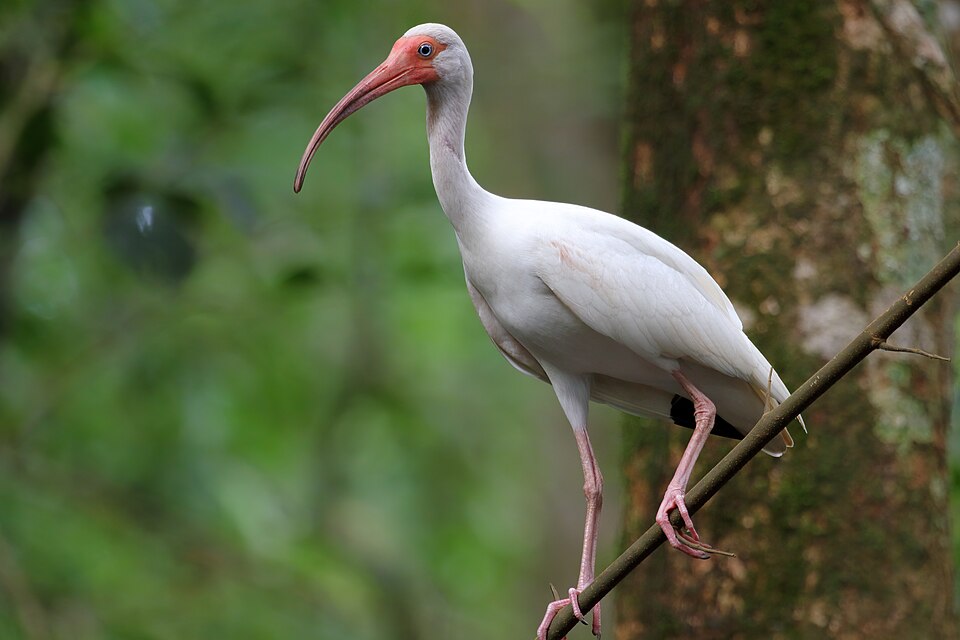
The American White Ibis (Eudocimus albus) is a large, white wading bird with a long, downward-curving bill and black wing tips. It inhabits coastal and inland wetlands with shallow water, foraging by tactile probing for insects, crustaceans, and small fish. Highly sociable, it lives in colonies ranging from 500 to 15,000 birds and is currently listed as Least Concern on the IUCN Red List.
Learn to identify
Adult American White Ibis raising its wings while wading.
Learning lesson · openly licensed photographs, labelled by BirdBot; labels checked against the cited sources and approved by AI
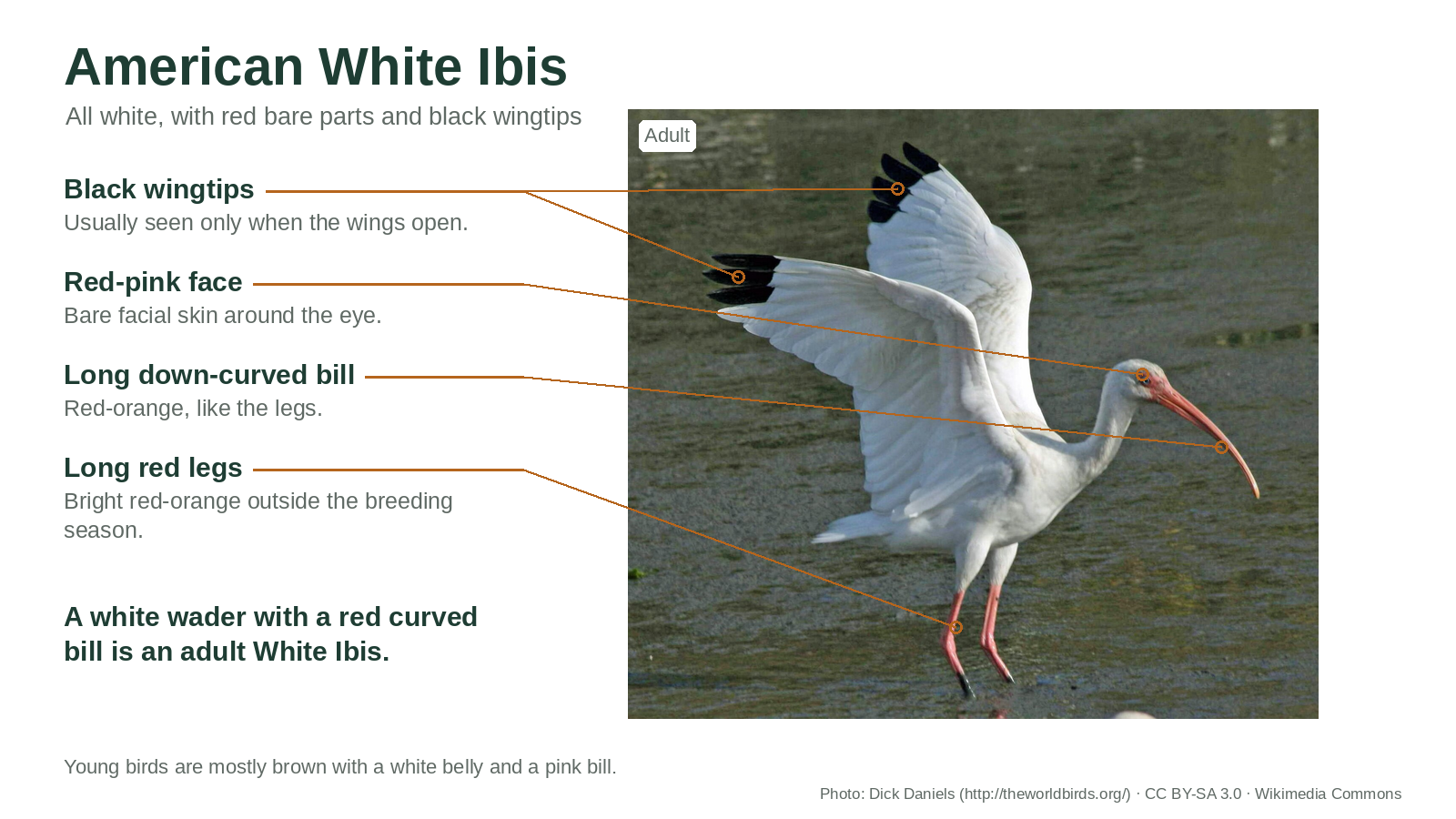
Black wingtips: usually seen only when the wings open. Red-pink face: bare facial skin around the eye. Long down-curved bill: red-orange, like the legs. Long red legs: bright red-orange outside the breeding season. A white wader with a red curved bill is an adult White Ibis.
Young birds are mostly brown with a white belly and a pink bill.
Sources: Audubon Guide to North American Birds: White Ibis · Wikipedia: American white ibis (revision 1383538234)
Photo: Dick Daniels (http://theworldbirds.org/), CC BY-SA 3.0, via Wikimedia Commons; labels added by BirdBot.
Adult American White Ibises are white wading birds with black wing tips and a long, downward-curving bill. The species exhibits sexual dimorphism, with adult males averaging about 1,050 grams and females about 750 grams. Males also possess longer bills and wingspans; male bills are on average 22% longer than females, a difference only half attributable to body size (Wikipedia; doi.org/10.1675/1524-4695(2007)30[199:sfsbdi]2.0.co;2). The wingspan ranges from 56 to 68 cm.
During the breeding season, both sexes develop red faces and legs. The bill may show pink coloration that fades to a black tip later in the season. Females display a red gular pouch for about 10 days during the displaying phase. Juveniles hatch with a pinkish-white, relatively straight bill that elongates and curves over the first two weeks. Their plumage is initially brownish-gray and does not become completely white until adulthood.
White Ibises require shallow water for feeding and are found in coastal and inland wetlands, ponds, and lakes. They are primarily coastal during summer and winter but move inland as the breeding season begins. Their location is highly sensitive to water levels; they may shift to fields or wetlands when floodwaters exceed 20 cm in depth, as deeper water prevents them from reaching the substrate where their prey lives.
According to AviList v2026, the species' range includes coastal and lowland areas of western Mexico and the southeastern USA (expanding northward), extending southward to Costa Rica, the Greater Antilles, Panama, and the Pacific coast from Colombia to far northwestern Peru.
White Ibises are highly sociable and practice a colonial lifestyle, often found in groups of 500 to 15,000 birds. These large colonies provide protection from predators, as groups can gather to alleviate threats. The birds forage in large groups, often exceeding 5,000 individuals, primarily in the early morning or late evening, except during the nesting period.
Foraging is characterized by tactile probing. The bird thrusts its bill into the wetland substrate at a slow pace, using non-visual tactile clues to locate prey. Once found, the prey is swallowed by a rapid forward lunge of the head. In flight, they form V-shaped skeins, a behavior that is essential for juvenile survival; those unable to develop this pattern exhibit higher mortality rates.
Research on South Carolina salt marshes reveals nuanced trade-offs within these large flocks. Central birds in flocks of 15 or more probe more frequently but scan their surroundings less often than peripheral birds. While central birds take fewer steps, the disturbance created by the surrounding flock prevents them from using the quick-stepping technique used by solitary or small-flock birds to capture fiddler crabs before they retreat into burrows. Consequently, capture rates remain similar across social groupings, but the behavioral strategy shifts from rapid interception at the edges to persistent probing in the center (doi.org/10.2307/1368649).
White Ibises are monogamous and breed once a year, typically from March to April. The breeding season involves five stages: display, copulation, egg production, incubation, and chick rearing. Nests are constructed from twigs, usually in the crook of a tree trunk, though ground nests have also been recorded. Both parents contribute to nest building, with females placing twigs and males collecting materials.
The male is primarily responsible for incubation, which lasts about three weeks, while the female gathers food. Males are more aggressive and larger, providing protection for the nest. Hatchlings are blind for the first few days and have underdeveloped neck muscles, requiring parental warmth. The young remain in the nest for about 40 days before becoming independent and departing the colony.
White Ibises are relatively quiet but communicate with a distinctive "honking" noise to others in the colony. Newly hatched chicks produce a specific chirping or "begging" call that allows parents to distinguish their own young from the rest of the colony. During confrontations, males use visual signals such as bill chattering and horizontal thrusting as warnings.
The American White Ibis is listed as Least Concern (LC) in AviList v2026. While the global population is large and relatively stable, the species faces threats from habitat deterioration and wetland contamination. In the Florida Everglades, a significant population decline occurred between the 1930s and 1970s, potentially linked to human interruption of the natural hydrologic regime and the accumulation of toxic contaminants like mercury. Conservation efforts focus on protecting foraging locations and preserving natural water levels.
To observe White Ibises, visit shallow wetlands, ponds, or coastal marshes during early morning or late evening. Look for large groups of white birds with black wing tips moving slowly through the water. Observe from a distance to avoid disturbing the colony, as these birds are sensitive to their environment. Note their V-shaped flight formations and the tactile probing movements of their bills.
Birders in the southeastern USA should note that the species is expanding northward, making it a more common sight in new areas than in the past. In North America, breeding takes place along the Atlantic coast from southern New Jersey south to Florida and west along the Gulf Coast; the species nested in New Jersey for the first time in 2020 (Wikipedia). This range expansion means that sightings in inland wetlands further north are increasingly likely. If you have compatible camera or software, you can contribute detections to community science datasets to help track these populations.


