
Spotting a White-faced Ibis (Plegadis chihi) in a wetland often starts with the sound of a large, noisy flock moving through the reeds. These social, nomadic birds rely on rainy conditions to sustain the fresh and saltwater marshes, ponds, and flooded fields they inhabit. Classified as Least Concern in AviList v2026, they are a dynamic presence in wetland ecosystems, foraging in large groups and breeding in dense colonies.
Learn to identify
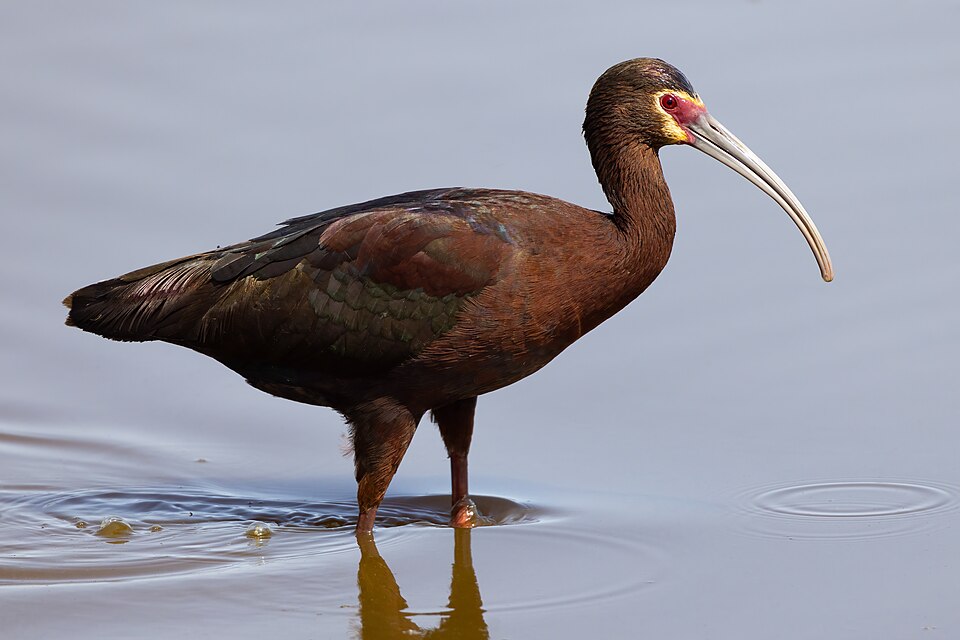
Breeding adult White-faced Ibis wading at Sacramento National Wildlife Refuge, California.
Learning lesson · openly licensed photographs, labelled by BirdBot; labels checked against the cited sources and approved by AI

Red eye: red all year; Glossy Ibis has dark eyes. Red facial skin: edged with pale feathers when breeding. Gray bill: long and gray on breeding adults. Reddish legs: often redder in the breeding season. On adults, a red eye means White-faced, not Glossy.
Immature White-faced and Glossy Ibises cannot be safely separated.
Sources: Audubon Guide to North American Birds: White-faced Ibis · Wikipedia: White-faced ibis (revision 1383332509)
Photo: Frank Schulenburg, CC BY-SA 4.0, via Wikimedia Commons; labels added by BirdBot.
The White-faced Ibis is a robust wader, measuring 46 to 56 cm in length and weighing 450 to 525 grams. Individuals in South America tend to be slightly smaller than those in North America.
There are no described subspecies.
White-faced Ibises are adaptable to both temperate and tropical climates, with a range that stretches from the Great Basin of the western USA to southwestern Brazil and central Argentina. In South America, they can be found at elevations ranging from near sea level to 4,300 m. Their preferred habitats are fresh and saltwater marshes rich in rushes and sedges, which provide both nesting materials and foraging grounds. They are also frequently observed around ponds, rivers, and in flooded pastures or agricultural fields. Because rainy conditions are essential for both foraging and nesting, their distribution is often limited to areas with reliable moisture, which also drives their nomadic movement patterns.
In North America, the species is migratory, with a winter range extending from southern California and Louisiana south to include the rest of its breeding range. It mostly replaces the Glossy Ibis west of the Mississippi River, though the two species overlap in parts of the southeastern United States.
White-faced Ibises are highly social and nomadic, often living in large groups. Their behavior is driven by the availability of moisture and food.
White-faced Ibises are primarily carnivorous, with a diet that includes insects, crustaceans, spiders, snails, leeches, and amphibians. Snails and slugs are the dominant prey group by volume, accounting for 55 to 90% of all food consumed. The composition of their diet varies with the season; for instance, they consume more insects during the spring and summer months. There is also a subtle sexual difference in foraging, with males tending to eat more snails and slugs, while females tend to eat more insects.
Nesting occurs in dense, large colonies, often in areas with favorable wetland conditions. Mating typically begins shortly after the birds return from their wintering locations, though it may be delayed or skipped entirely if conditions are not suitable. Males display at multiple potential nesting sites using ritualized bill probing and calls, while females ultimately choose the actual nesting location.
Both parents are heavily involved in nest construction and defense. They take turns building the nest and guarding it, with males typically incubating during the day and females at night. Both sexes fiercely guard the nest and the area within a meter against intruders. They shade or incubate the eggs to maintain the correct temperature, a behavior that continues for the first week after hatching. Both male and female adults feed the young by regurgitating partially digested food.
White-faced Ibises communicate through a variety of distinct sounds and visual displays. The birds use separate calls for different social contexts:
These vocal interactions are often accompanied by visual displays, particularly during courtship and nesting, which help reinforce social bonds and territorial boundaries within the colony.
The White-faced Ibis is listed as Least Concern (LC) in AviList v2026, reflecting its large geographic range and stable population size. However, their reliance on wetland habitats and rainy conditions for foraging and nesting makes them sensitive to changes in water availability and habitat quality.
The best way to observe White-faced Ibises is to look for flocks foraging in shallow water or marshes from a distance. Watch for the characteristic probing bills and V-formation flight patterns. It is important to avoid approaching nests, as both parents fiercely guard the area within a meter of the nest. Using binoculars or a telephoto lens allows you to observe plumage details and behavior without disturbing the birds or their habitat.


