
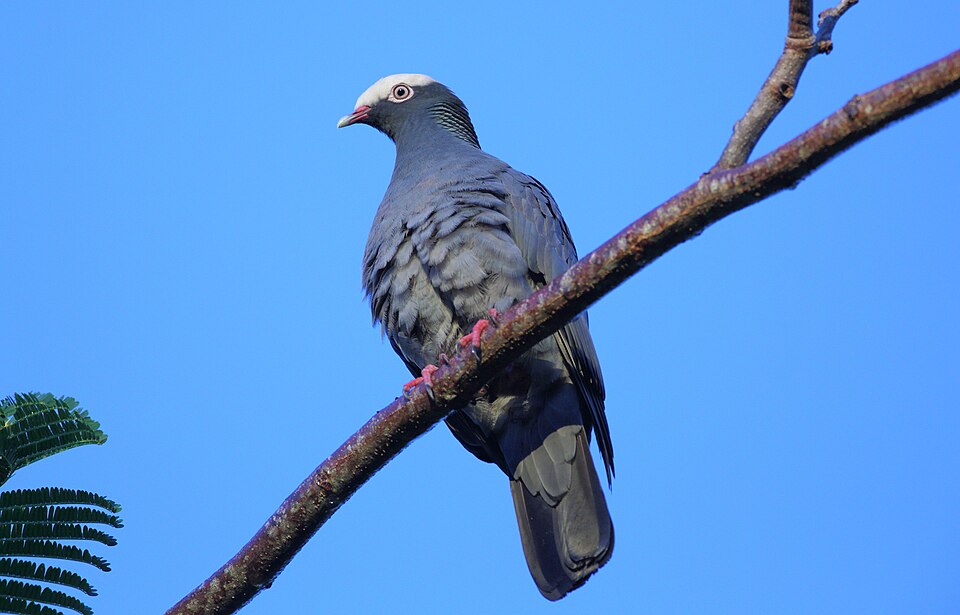
In the quiet of a Florida mangrove, a deep, resonant coo-cura-coo often reveals the presence of the White-crowned Pigeon (Patagioenas leucocephala) before its slate-gray form is spotted. This medium-sized dove, a member of the family Columbidae, is a fruit- and seed-eating species found primarily in the Caribbean and southern Florida. While it is identified by its distinct white crown and iridescent collar, its most defining ecological trait is its historical reliance on remote, tidally inundated mangrove islands for breeding.
Learn to identify
Adult White-crowned Pigeon, photographed in the Dominican Republic; the species also lives in southern Florida.
Learning lesson · openly licensed photographs, labelled by BirdBot; labels checked against the cited sources and approved by AI

White crown: striking white cap; duller and grayer on females. Iridescent neck patch: scaly collar that shines green in good light. Slate-gray body: dark slate; often looks almost black. It often looks all black, so the striking white cap is the mark to find.
Females have a duller cap; juveniles show only a little pale on the crown.
Sources: Audubon Guide to North American Birds: White-crowned Pigeon · Wikipedia: White-crowned pigeon (revision 1386485262)
Photo: ZankaM, CC BY-SA 3.0, via Wikimedia Commons; labels added by BirdBot.
Adults are roughly the size of a common rock pigeon but appear less chunky, with a relatively longer and more square tail. The plumage ranges from slate gray to almost black. A key field mark is the iridescent collar-patch, which displays a barred white pattern with green, visible only under good lighting. The crown-patch is a brighter white in males and a more gray-white in most females. Adults have a white iris and a pale-tipped red bill.
Juveniles are a less dark shade of grey, lack the nape pattern and white iris, and show only a few pale feathers on the crown. This distinction is critical for accurate identification in the field, as the juvenile plumage can be easily confused with other dark doves if the lack of a white iris and the duller crown are not noted.
The call of the White-crowned Pigeon is a loud, deep triple coo, often described as coo-cura-coo or coo-croo. This vocalization is a characteristic trait shared by its Patagioenas clade, which includes several species that vary greatly in appearance but are united by this specific call structure. Listening for this deep, resonant triple coo in coastal mangrove areas is often the most reliable way to detect the bird before it is seen.
According to the AviList v2026 checklist, the species' range extends from southern Florida and offshore islands through the West Indies to northwestern Panama. It is a resident breeder mainly in the Bahamas, Cuba, Jamaica, and Antigua. It breeds in smaller numbers in Hispaniola (the Dominican Republic and Haiti), Puerto Rico, the Virgin Islands, the Cayman Islands, Anguilla, and other Caribbean islands. It also breeds along the Caribbean coast of Central America. In the United States, it is found only in the Florida Keys, the Everglades, and the southern tip of mainland Florida.
The White-crowned Pigeon primarily lives and breeds in low-lying, coastal mangrove forests. In Florida, it has historically been documented nesting exclusively on remote, tidally inundated mangrove islands in wildlife refuges. These isolated offshore islets provide protection from predators such as raccoons. However, recent observations have confirmed nesting on the southern tip of mainland Florida and in heavily trafficked urban areas like downtown Key West and Miami, possibly due to habitat loss from hurricanes or increased predation pressure in historic nesting sites.
The White-crowned Pigeon is a fruit and seed-eating species. It travels inland from its coastal mangrove roosts to feed on the fruits and seeds of a wide variety of plants, linking its breeding habitat with inland forested areas.
White-crowned Pigeons breed in colonies or singly on isolated, tidally inundated mangrove islands. The tidal inundation of these islands limits access by terrestrial predators, providing a natural defense for nests. While this is the primary breeding strategy, recent shifts in nesting behavior have been observed, with birds nesting in urban environments and on the mainland.
The White-crowned Pigeon is listed as Near Threatened (NT) in the AviList v2026 checklist. This status is recorded in the official taxonomy and is not a new assessment or a local abundance estimate. The species' reliance on isolated, tidally inundated mangrove islands for breeding has been linked to recent shifts in nesting behavior, with birds increasingly observed in urban areas such as downtown Key West and Miami.
To observe White-crowned Pigeons, focus on the specific mangrove islands within the Florida Keys and the Everglades, where they have historically nested exclusively. In the southern tip of mainland Florida, look for low-lying coastal mangrove forests. Listen for the deep triple coo and look for the distinct white crown and iridescent collar. When observing, maintain a distance to avoid disturbing nesting sites, especially during the breeding season. Use binoculars or a spotting scope to view the birds without approaching their roosts or nests. Recording observations and contributing to community science platforms can help track population trends and habitat use.
Males have a brighter white crown-patch, while most females have a more gray-white crown. Both sexes share the same slate-gray to black plumage, white iris, and iridescent collar, but the crown color is the primary visual distinction.
Juveniles are a less dark shade of grey, lack the nape pattern and white iris, and show only a few pale feathers on the crown. Adults have a distinct white crown, a white iris, and a fully developed iridescent collar.
In the U.S., they are found only in the Florida Keys, the Everglades, and the southern tip of mainland Florida. They are most commonly seen in coastal mangrove forests and may occasionally be observed in urban areas like Key West and Miami.
The White-crowned Pigeon eats fruits and seeds from a wide variety of plants. It travels inland from its coastal roosts to forage, accessing diverse food sources in forested areas.
The species is listed as Near Threatened (NT) in the AviList v2026 checklist.


