
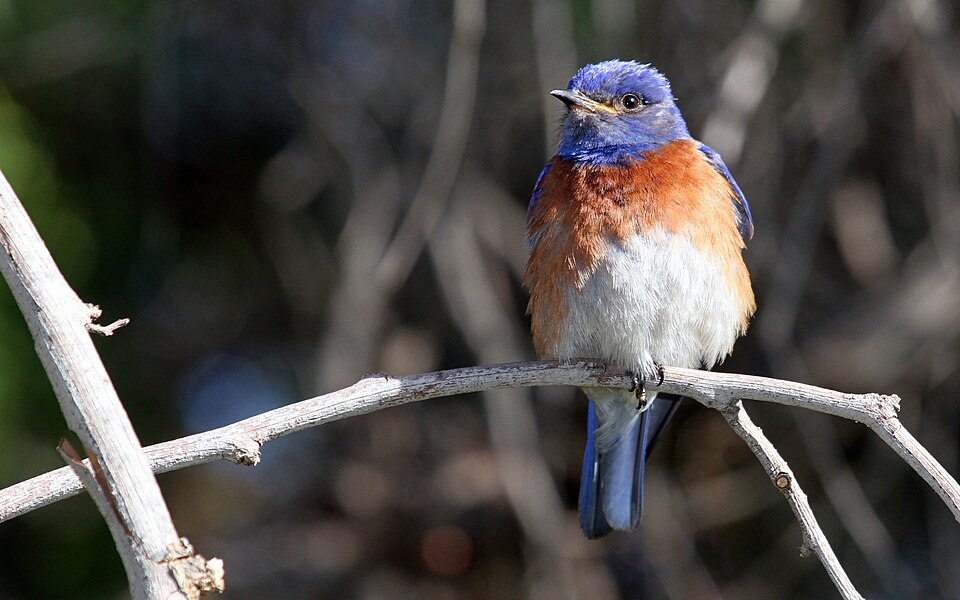
Spot a cobalt-blue flash at a forest edge? That’s likely a male Western Bluebird (Sialia mexicana). This small thrush in the family Turdidae is a master of the woodland margin, favoring burned and logged areas where perch sites are abundant. While males blaze with blue on the head, throat, and tail, females are a more subdued gray-brown. The species is a monogamous cooperative breeder that relies on cavities for nesting and shifts its diet from insects in summer to fruit, primarily mistletoe berries, in winter.
Learn to identify
Adult male Western Bluebird, photographed in Morelos, Mexico.
Learning lesson · openly licensed photographs, labelled by BirdBot; labels checked against the cited sources and approved by AI

Blue throat: eastern Bluebird has an orange throat. Orange breast and sides: reddish brown on the chest. Deep blue upperparts: wings and tail bright blue on males. A blue bird with an orange chest and a blue throat is a male Western.
Females are duller with a grey throat; juveniles are spotted.
Sources: Audubon Guide to North American Birds: Western Bluebird · Wikipedia: Western bluebird (revision 1380711634)
Photo: Amado Demesa from DF, México, CC BY-SA 2.0, via Wikimedia Commons; labels added by BirdBot.
Western Bluebirds are small thrushes ranging from 16.5 to 19 cm in length and weighing between 24 and 31 g. Sexual dimorphism is pronounced, making sex identification straightforward in the field.
Adult males display vibrant cobalt-blue coloration on the head, chin, throat, and tail. The breast is a distinct brown, transitioning to a gray-blue belly. This bright plumage is particularly noticeable during the breeding season when males are actively defending territories and courting.
Females are less dramatic, featuring a gray head, throat, and back, with a brown abdomen. Their wings and tail are a muted gray-blue. Juveniles exhibit the same general patterns as adults but with less intense coloration, which can make them challenging to distinguish from females at a distance.
Western Bluebirds prefer habitats with a mix of trees and open ground, specifically forest edges, burned areas, and logged regions where perch sites are abundant. They nest in coniferous trees (such as pines and firs) and deciduous trees (such as oaks). The species avoids open areas like meadows and can be found at elevations up to 2,900 m.
According to AviList v2026, the range is disjunct, covering open deciduous, coniferous, and riparian woodland from southern interior British Columbia and western Alberta southward across the interior western USA and coastal California to northern Baja California. A second population occurs in south-central USA from far southern Wyoming southward to Puebla and Veracruz in central Mexico. Most individuals withdraw from the northern parts of their range in winter.
Western Bluebirds are territorial during the breeding season. Outside of breeding, they often form kin groups in winter, which provide protection from predators and serve as a mechanism for males to find mates or helpers for their nests. These groups vary in size based on resource availability.
A distinctive feature of this species is cooperative breeding. Older offspring, often non-breeders, act as "helpers" at the nest. These helpers assist in feeding the young and defending the territory, which increases the survival rate of the fledglings and the genetic fitness of the helpers. This behavior is a key component of their social ecology.
The diet of the Western Bluebird is seasonal. In spring and summer, they are insectivorous, employing a "perch-foraging" strategy where they spot prey from a high vantage point and drop to the ground to pick it up. Common prey includes spiders, flies, grasshoppers, beetles, and termites. In winter, the diet shifts primarily to fruit, with mistletoe berries (Phoradendron) being a major food source. Cherries, blackberries, raspberries, and figs are also consumed.
Western Bluebirds are secondary cavity nesters, meaning they do not excavate their own holes. They rely on natural cavities, woodpecker holes, or artificial nest boxes. The nest is a loose cup of grass, weed stems, pine needles, and twigs, sometimes lined with hair or feathers.
Communication is primarily vocal. Males use a chatter call to establish territories during nest building. If a foreign male invades, the defending male produces a squawk-like call. Mates use specific calls, such as "Kew" and "Che-check," to locate each other, which is particularly important during the breeding season.
The Western Bluebird is listed as Least Concern (LC) in the IUCN Red List as recorded in AviList v2026. However, habitat changes such as logging and fire suppression can reduce edge habitat and nesting sites. The species is protected under the US Migratory Bird Treaty Act. In some areas, nest boxes have been installed to mitigate the loss of natural cavities and competition from other cavity-nesting species like House Sparrows and European Starlings.
To observe Western Bluebirds ethically, focus on forest edges or recently logged areas during the day. Watch for the distinctive perch-foraging behavior: a bird perched on a branch or fence post that suddenly drops to the ground to pick up an insect. In winter, look for small groups foraging on mistletoe berries in coniferous trees.
Next Step: Check local nest box monitoring schedules in spring (typically March–July). Many community programs, such as those at the Stanford Dish or Lake Lagunita, monitor boxes weekly and welcome volunteers for banding or data collection. Alternatively, listen for the male's chatter call at dawn in logged areas to locate a territory before you see the bird.


