
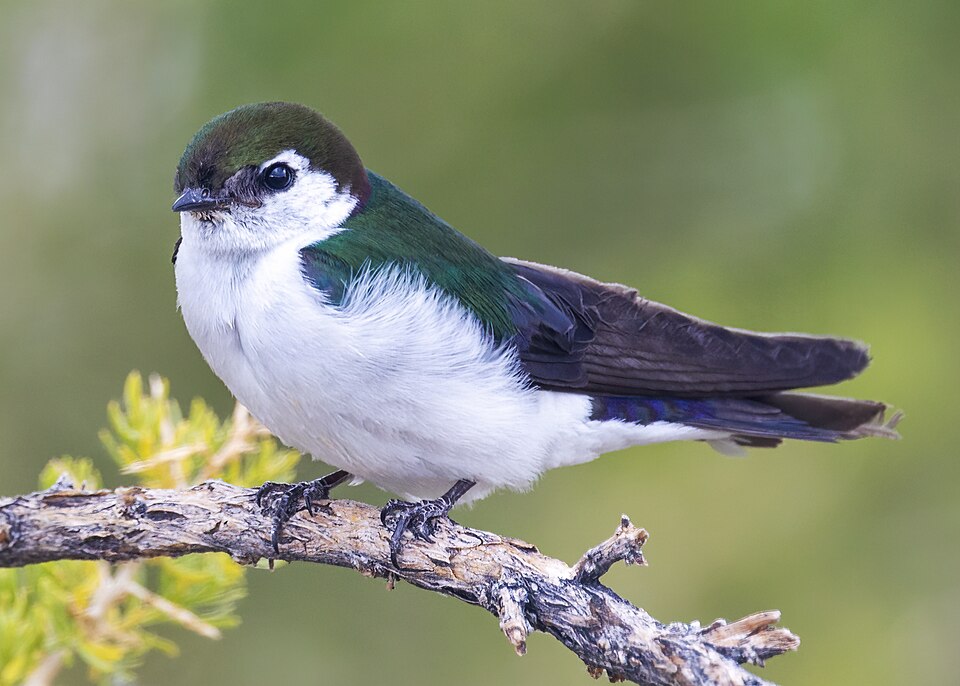
The Violet-green Swallow (Tachycineta thalassina) is a small, forked-tailed passerine in the family Hirundinidae. Adult males are distinguished by iridescent violet rumps and green crowns, while females have light-tan crowns and smaller heads. They breed in open forests and woodlands near water, feeding primarily on aerial insects, and are currently classified as Least Concern by the IUCN Red List.
Learn to identify
Male Violet-green Swallow, photographed at Mono Lake, California.
Learning lesson · openly licensed photographs, labelled by BirdBot; labels checked against the cited sources and approved by AI

Glossy green crown and back: iridescent green on the head and back. White cheeks: white extends up, partly around the eye. White underparts: continuing onto white rump side-patches. Violet rump and tail: hints of purple above the tail. On a green-backed swallow, look for white rising around the eye.
Females are duller with less white on the face.
Sources: Audubon Guide to North American Birds: Violet-green Swallow · Wikipedia: Violet-green swallow (revision 1380710919)
Photo: Polinova, CC BY-SA 4.0, via Wikimedia Commons; labels added by BirdBot.
Violet-green Swallows are small birds with an average body size of 13 cm. Their most distinctive feature is the deeply forked tail, which is significantly shorter than their wings when perched. They possess slender, pointed bills adapted for catching insects on the wing.
Sexing these birds in the field relies on subtle plumage differences:
According to AviList v2026, Violet-green Swallows breed in open deciduous to mixed coniferous forests, woodlands with rock crevices and banks, and wooded neighborhoods. Their breeding range extends from north-central Alaska eastward to southwestern Alberta and western North Dakota, southward to southern Baja California and central Mexico.
They typically inhabit open environments near bodies of water such as meadows, rivers, marshes, shorelines, ponds, swamps, and lakes. These habitats often feature mosses and vegetation that retain moisture, which supports the aerial insect populations the swallows depend on for food. In Mexico, where they can remain year-round, they utilize a wide variety of urban and rural nesting cavities, including ravine banks, dead pines, and man-made structures.
Violet-green Swallows are primarily insectivorous, targeting aerial insects typically under 5 mm in length. A food study conducted in Arizona, Oregon, Colorado, and California from March to September quantified the following diet components:
| Prey Group | Order/Super-family | Diet Percentage | Seasonal Notes |
|---|---|---|---|
| Wasps and Bees | Hymenoptera | 17.48% | Consumed every month except April |
| Beetles | Coleoptera | 10.57% | — |
| Ants | Formicoidea | 9.42% | Consumed only from May to September |
| Moths and Caterpillars | Lepidoptera | 3.12% | — |
Researchers noted an anomaly in California where swallows consumed oats and carrot seeds, likely ingested accidentally while eating ants carrying the seeds. They do not eat honeybees.
Outside the breeding season, Violet-green Swallows are highly social, forming foraging flocks that can number several hundred birds. During the breeding season, they become territorial, with both sexes guarding their nests against competitors. Despite this aggression, they may breed in groups if resources allow.
These birds engage in extensive preening and sunbathing to avoid parasites. A distinctive bathing behavior involves flying over water and gently brushing the surface with their feathers before flying upward to shake off the water. They can also use rainfall to bathe.
Violet-green Swallows typically arrive at breeding sites in late March to April. They form monogamous pairs for the breeding season, though some females have been observed mating with multiple males. Males compete for nest cavities and use calls and displays to attract females.
Once paired, they build a cup-shaped nest in a cavity using twigs, grass stems, and feathers. Nest construction takes 3 to 20 days, and the average nest cup is 7.62 cm wide. If a suitable cavity is unavailable, pairs may attempt to usurp an existing nest site. Copulation normally occurs in May, with eggs laid towards the end of June. The average clutch size is 5 eggs, which are pure white, 1.1 to 1.3 cm wide, and 1.5 to 2.0 cm long. Both sexes incubate the eggs, with males actively guarding the nest and females foraging for food. Chicks fledge approximately 22 to 24 days after hatching.
While not much is known about their songs, Violet-green Swallow vocalizations are closely associated with those of Tree Swallows but are sharper and harder. They use two primary call types:
Both call types can also serve as alarm signals for distress, food begging, anxiety, or territory proclamations.
The Violet-green Swallow is classified as Least Concern (LC) on the IUCN Red List, as recorded in AviList v2026. The species has experienced population declines of approximately 28% from 1966 to 2015. The Animal Diversity Web (ADW) account suggests that these declines may be linked to factors such as insecticide use and climate change, which can impact the aerial insect populations the swallows depend on for food.
To observe Violet-green Swallows ethically, focus on open areas near water during the day. Look for large foraging flocks outside the breeding season or watch for individuals bathing by brushing the water surface. During the breeding season, observe from a distance to avoid disturbing territorial pairs. Note the iridescent violet rump of males in good light to distinguish them from females and similar species like the Tree Swallow.
Next Step: Check local eBird hotspots for recent sightings to plan your observation. While the species primarily uses natural cavities and may usurp sites, they have been documented using artificial nesting boxes in specific regions such as Alaska; however, efficacy in other areas is not established by the provided sources.


