
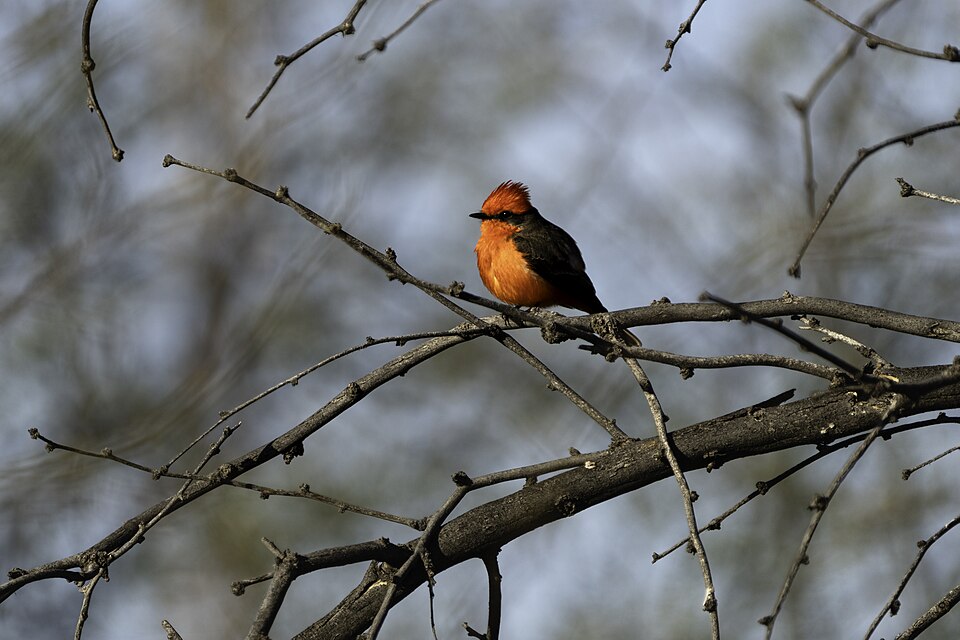
The Vermilion Flycatcher (Pyrocephalus rubinus) is a small passerine bird in the family Tyrannidae, instantly recognizable by the male's brilliant scarlet plumage and the female's subdued grayish-brown tones. As a sit-and-wait predator, it perches in open, semi-wooded habitats and sallies out to catch flying insects. This guide synthesizes current taxonomic data from AviList v2026 with detailed natural history from the Animal Diversity Web to provide a comprehensive field reference for identification, behavior, and ethical observation.
Learn to identify
Adult male Vermilion Flycatcher, photographed at Rattlesnake Springs, New Mexico.
Learning lesson · openly licensed photographs, labelled by BirdBot; labels checked against the cited sources and approved by AI

Red crown: bright red cap; can be raised as a slight crest. Dark back and wings: brown to blackish brown above. Red underparts: throat, chest and belly all red. Adult males are hard to mistake; drab females can resemble Say's Phoebe.
Females and young are grayish above, with a pink or yellow wash below.
Sources: Audubon Guide to North American Birds: Vermilion Flycatcher · Wikipedia: Vermilion flycatcher (revision 1384866180)
Photo: Judy Gallagher, CC BY 2.0, via Wikimedia Commons; labels added by BirdBot.
Sexual dimorphism in the Vermilion Flycatcher is stark, making it one of the easier flycatchers to identify in the field once you know what to look for.
Adult males are a vivid scarlet or "vermilion" color on the crown, throat, and underparts. A distinct dark-brown mask covers the face, ear-coverts, and nape. The wings and tail are blackish-brown, creating a sharp contrast with the bright body. This coloration is consistent across the breeding range and is a primary field mark for quick identification.
Adult females are much more cryptic. They are grayish-brown on the head, back, wings, and tail, with the tail being the darkest part. A grayish-white supercilium (eyebrow stripe) is visible on the face. The underparts are whitish, often with a pale red or salmon wash, and the breast and sides are streaked with gray. This plumage provides camouflage while nesting.
Immature females resemble adult females but have yellowish posterior underparts. Immature males look similar to adult females during the summer of their second calendar year, but their underparts are salmon pink or pale-orange red. This transitional plumage can be confusing, so location and behavior are helpful secondary cues.
The Vermilion Flycatcher prefers open habitats, including arid scrubland, farmland, desert, savannah, cultivated lands, and riparian woodland. It is notably absent from areas with a dense canopy of Fremont cottonwood and mesquite understory, indicating a preference for more open foraging spaces. Nests are typically placed in willows, oaks, cottonwoods, mesquites, and sycamores lining streams.
According to AviList v2026, the species has a disjunct range. In the southwestern United States, it occurs from central California to northeastern Nicaragua. In South America, it is found from Colombia to Guyana, west of the Andes to southeastern Peru, and breeds in northern Argentina, Uruguay, southern Brazil, Paraguay, and southeastern Bolivia. Southern breeders winter from southeastern Colombia and eastern Ecuador to eastern Bolivia and central and eastern Brazil.
Taxonomic Note: The detailed natural history and habitat preferences cited in this guide (from Animal Diversity Web) primarily describe the North American subspecies (P. r. mexicanus). The broader species-level range data from AviList v2026 and Wikipedia includes the South American population (often referred to as the Scarlet Flycatcher or P. r. rubinus), which inhabits similar semi-open landscapes but is distinct in its geographic distribution.
Vermilion Flycatchers are diurnal and spend little time on the ground. They are classic sit-and-wait predators, perching on exposed branches and sallying out to capture insects in mid-flight. Approximately 94% of foraging occurs within 3 meters of the ground, with the least amount of foraging over water. They often carry captured prey back to their perch and beat it before consuming it. Both sexes preen frequently and wipe their bills on branches after feeding.
The diet consists mainly of flying and terrestrial insects and other arthropods. Preferred prey includes grasshoppers, honeybees, beetles, and crickets. During the breeding season, nestlings are fed mostly butterflies and moths, with about half of their food being larval lepidoptera. Both parents feed the young, approximately 3.5 times per hour.
Vermilion Flycatchers are monogamous. Males arrive on breeding grounds about a week earlier than females, sometimes as early as February. The male performs a nest-site-showing display, flying to potential sites and calling to solicit the female's attention. The female chooses the site, usually within 205 meters of the male's preferred location, and begins construction immediately.
The nest is a shallow cup made of twigs, grasses, fibers, and empty cocoons, lined with down, feathers, and hair, and completed with cobwebs and lichens. The clutch size is typically 2-3 oval-shaped eggs, ranging in color from pure white to cream, tan, or brown, with a dark brown spot on the larger end. Incubation lasts 13-15 days and is performed solely by the female, who is fed by the male every 1.5 hours. Chicks are altricial, weighing just over 1 gram, and fledge about 13-15 days after hatching. Second broods are common.
The song is an extremely high "tic-tic-psiieh," with the last part sometimes upslurred. The call is an extremely high "psi." These high-pitched sounds are distinct and can be used to locate the bird when it is hidden in foliage.
The Vermilion Flycatcher is listed as Least Concern (LC) in AviList v2026. Historically, the species has faced threats from habitat loss due to urbanization and the use of pesticides, which can poison its insect food supply. Preservation of both dry and wet riparian areas is critical for long-term population maintenance. Human-modified habitats that open up the canopy can provide foraging opportunities, but the loss of riparian nesting sites limits reproductive success.
To observe Vermilion Flycatchers ethically, position yourself at a distance in open scrubland or riparian edges. Look for perched birds scanning for insects. Watch for the characteristic sallying behavior, where the bird darts out from its perch to catch prey and returns to the same spot. A key behavioral cue to confirm identification is the bill-wiping action; after capturing prey, the bird often returns to its perch and wipes its bill on a branch to clean it. Avoid approaching nests closely, as females are extremely vigilant and stress can impact breeding success. Use binoculars or a spotting scope to observe details without disturbing the bird.


