
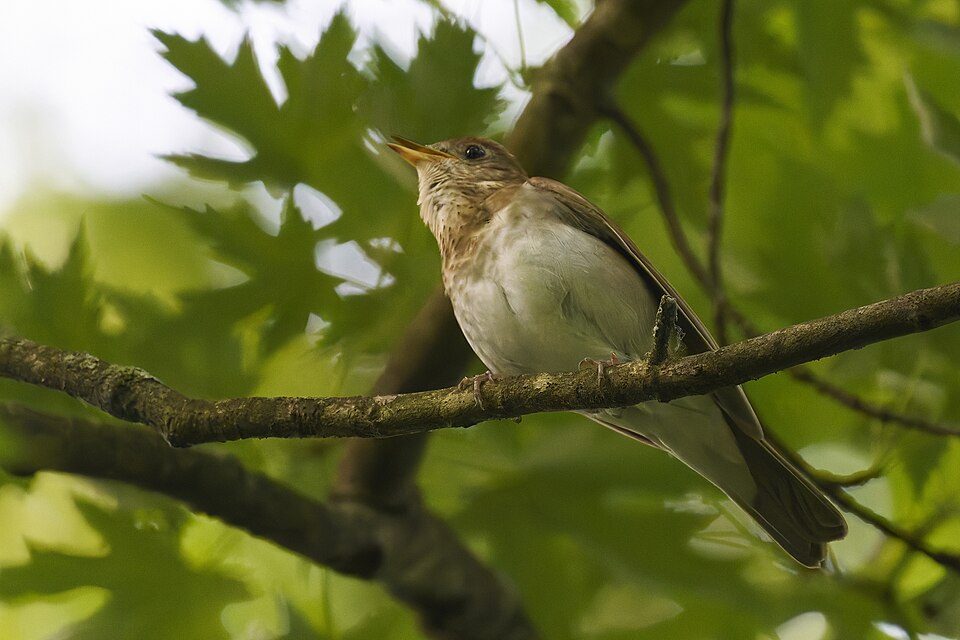
The Veery (Catharus fuscescens) is a small thrush with light brown to cinnamon upperparts, white underparts, and a tawny spotted breast. It is best identified by its pink legs, poorly defined eye ring, and distinctive vocalizations from low, concealed perches in dense understory near water.
Learn to identify
Adult Veery of the warm-toned eastern type, photographed in Central Park, New York, in May.
Learning lesson · openly licensed photographs, labelled by BirdBot; labels checked against the cited sources and approved by AI

Plain, pale face: pale and plain, with only a weak eye ring. Faint breast spots: light tawny breast with few, faint spots. Tawny-brown above: warm tawny brown from crown to tail. Often heard before seen: a breezy, downward-spiraling song.
Western Veeries are duller, with slightly more spotting on the chest.
Sources: Audubon Guide to North American Birds: Veery · Wikipedia: Veery (revision 1380727574)
Photo: Rhododendrites, CC BY-SA 4.0, via Wikimedia Commons; labels added by BirdBot.
Veeries are small, compact thrushes measuring 16–19.5 cm in length. Adults display light brown upperparts that vary by region: birds in the eastern portion of the breeding range are more cinnamon, while western birds are more olive-brown. The underparts are white, with a light tawny breast marked by faint brownish spots. A key field mark is the pink legs, which contrast with the brownish plumage. The eye ring is poorly defined, and the bird shows the characteristic under-wing stripe typical of Catharus thrushes.
In the eastern United States and Canada, the Veery is relatively easy to distinguish by its coloration. In the West, identification is more challenging due to the similarity with the Willow Thrush (western Veery, C. f. salicicolus), which is more olive-brown above. Historical accounts, such as Leander S. Keyser’s 1902 Birds of the Rockies, note that early ornithologists struggled to distinguish the two, with some concluding they had practically the same musical repertory and very little difference in coloration.
The Veery’s song is a breezy, downward-spiraling, flute-like melody, often given from a low and concealed perch. The most common call is a harsh, descending vee-er, which gives the bird its name. Other calls include a chuckle, a sharp and low wuck, and a slow wee-u.
Research by Belinsky et al. (doi:10.1371/journal.pone.0120933) identified two novel vocalizations used by veeries during agonistic interactions: whisper calls and songs lacking the introductory note. In playback experiments, the researchers compared veery singing behavior in response to simulated territorial intrusions using three variations: song alone as a control, songs with added whisper calls, and songs with introductory notes removed. Focal males responded to all stimuli by approaching the source and vocalizing, but did not physically attack a robotic mount, indicating these signals are used for agonistic interactions rather than aggressive escalation.
Veeries breed in humid deciduous and riparian forests with dense understory near water sources such as streams. The breeding range extends from central British Columbia eastward to southern Newfoundland, southward in the Rocky Mountains to New Mexico, across the northern tier of U.S. states, and southward in the Appalachians to far northern Georgia.
During winter, Veeries migrate to eastern South America, primarily inhabiting second-growth and sandy-soil forests in the Cerrado of eastern Bolivia, central to southern Brazil (Tocantins and Mato Grosso to São Paulo), and northern Paraguay. Winter range may also include parts of the Amazon basin, Mérida state in Venezuela, and the headwaters of the Orinoco River. Stopover regions during migration have been documented along the coast of the Gulf of Mexico, the coasts of the Carolinas, Cuba, Jamaica, Colombia, and Venezuela.
Veeries forage on the forest floor, flipping leaves to uncover insects. They may also fly up to catch insects in flight. Insects are the main food source during the breeding season, while fruit and berries compose most of the diet during late summer and fall.
Males have been observed engaging in behaviors similar to the polygynandrous Bicknell’s Thrush, where males may feed nestlings at more than one nest, and multiple male feeders may be present at a single nest. Veeries are occasional hosts for brown-headed cowbird eggs, and a documented case of interspecific parental care involved a Wood Thrush providing more care to Veery nestlings than the Veery parents themselves.
Veeries build a cup nest on the ground or near the base of a shrub. The nest consists of three structural layers: an outer layer of leaves and supporting branches, an inner layer of woven material, and a lining of flexible materials such as bark, roots, and seeds. Nests contain three to five greenish-blue eggs, which may or may not have brown spots. The female incubates the eggs for 10 to 14 days, while both parents feed the nestlings. Young Veeries leave the nest between 10 and 12 days after hatching.
Veeries have been displaced in some parts of their range by the related Wood Thrush.
The Veery is listed as Least Concern (LC) in AviList v2026.
To observe Veeries, focus on dense deciduous or riparian forests with thick understory near streams or wet areas. Listen for the distinctive descending vee-er call or the flute-like song from low perches. Since Veeries are secretive and often hidden in vegetation, patience and quiet observation are key. Avoid disturbing nests or foraging areas, and maintain a respectful distance to minimize stress on the birds. During migration, check stopover sites along the Gulf Coast, Carolinas, and Caribbean islands for transient individuals.
Next Step: Try listening for the veery's song during the day in dense understory near streams in the eastern U.S. or Canada.
Alternate names for this species include Wilson's thrush (named so after Alexander Wilson) and tawny thrush.
Veeries have been documented using parts of 27 plant species, including invasive or alien plants. Nests in exotic plants appear to have similar reproductive success to those in native plants.


