
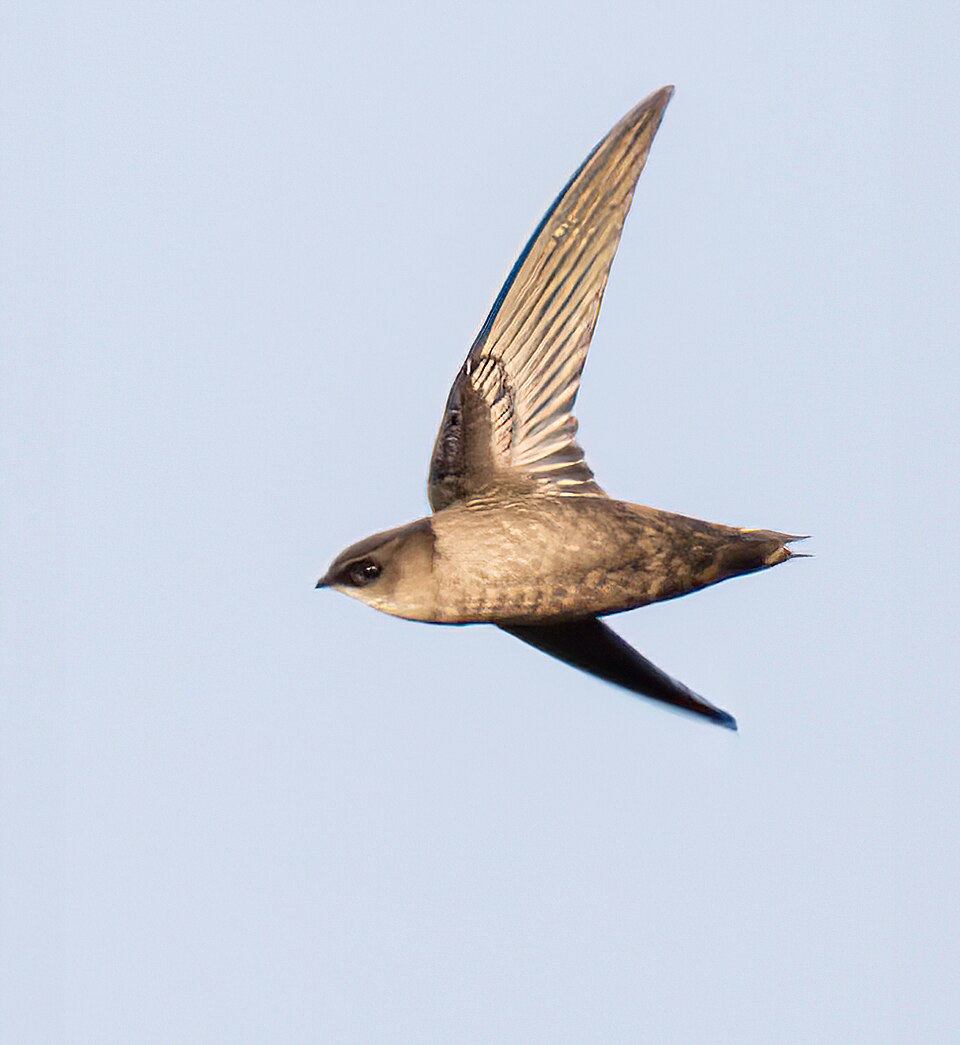
The Vaux's Swift (Chaetura vauxi) is the smallest swift in North America, characterized by a cigar-shaped body, dusky black upperparts, greyish-brown underparts, and a short, bluntly squared-off tail. It is a gregarious aerial insectivore that nests in hollow trees or chimneys and is currently listed as Least Concern by the IUCN Red List via AviList v2026.
Learn to identify
Vaux's Swift in flight, photographed at Elings Park, Santa Barbara, California, within its usual range.
Learning lesson · openly licensed photographs, labelled by BirdBot; labels checked against the cited sources and approved by AI

Paler throat: throat paler than the rest of the body. Long, narrow wings: pointed wings swept back in a crescent. Short tail: a short, stubby tail. Very like Chimney Swift but a bit smaller; range is the best clue.
Sexes look alike; the pale throat is hard to see on flying birds.
Sources: Audubon Guide to North American Birds: Vaux's Swift · Wikipedia: Vaux's swift (revision 1344353164)
Photo: Steve Colwell / Channel City Camera Club, CC BY 2.0, via Wikimedia Commons; labels added by BirdBot.
Field identification of the Vaux's Swift relies on silhouette and flight style rather than plumage, which is uniformly dusky. As the smallest swift in North America, it appears noticeably smaller than larger congeners like the White-collared Swift. The diagnostic feature is the short, bluntly squared-off tail, which contrasts with the forked or notched tails of many other swifts. Its aerodynamic build includes long, pointed wings and a short, stout bill, but the erratic flight pattern—mixing stiff wing-beats with unsteady glides—is the most reliable field cue. Juveniles can be distinguished from adults by the dusky bases to their throat feathers, a subtle detail visible only at close range or in good light.
Vaux's Swifts breed in highlands from southeastern Alaska and Montana to central California, primarily above 700 m (2,300 ft). Their range extends south through Mexico, the northern Yucatán Peninsula, to eastern Panama and northern Venezuela. In the United States, populations are migratory, wintering from central Mexico south through the Central American breeding range.
Preferred habitats include old-growth coniferous and deciduous forests, where large hollow trees provide essential nesting sites. During the breeding season, they occupy forests of coast redwood and Douglas firs, foraging in natural openings, along streams, and high above the treetops. In the Yucatán, they have been observed nesting on the sides of limestone wells. They also utilize human structures, such as chimneys and attics, particularly in areas where natural cavities are scarce.
Observing a Vaux's Swift in flight is often the first step to identification. These birds are highly gregarious, frequently forming flocks of 30 or more, and they often mix with other swift species like the White-collared Swift, particularly when weather fronts bring insect activity. Their flight is a distinctive mix of stiff wing-beats and unsteady glides, creating a fast, erratic movement that can make the wings appear out of sync. Unlike many perching birds, Vaux's Swifts do not walk or hop; they move primarily by flight. When entering a nest cavity, they fly in head-first but must turn around to alight tail-first, a maneuver that highlights their specialized anatomy for clinging to vertical surfaces.
Vaux's Swifts are aerial insectivores, feeding in flight on flying insects such as beetles, wasps, termites, and flying ants. They forage over forests and more open areas, including towns. During the breeding season, they soar above the forest canopy, swooping down to pause at trees to capture insects flying near the foliage. They are often spotted soaring 20 to 50 meters above the top of the canopy. Their diet also includes spiders, which they capture mid-flight.
Vaux's Swifts construct saucer-shaped nests from twigs or spruce and pine needles, adhering them to the inside surface of a hollow tree or chimney with saliva. These nests are typically positioned between 20 inches and 6 feet from the bottom of the cavity. The breeding season runs from March to July, during which the birds lay three white eggs. While mating is usually monogamous, the species exhibits some flexibility in breeding strategies, with reports of cooperative breeding where multiple individuals may assist in feeding a brood.
Vaux's Swifts have a more varied vocal repertoire than other species in the genus Chaetura. Their calls include a mixture of chattering, buzzes, squeaks, and chips. These sounds are often heard during communal roosting or while in flight, adding an auditory dimension to their identification.
The Vaux's Swift is listed as Least Concern (LC) in the IUCN Red List, as recorded in AviList v2026. However, they face threats from the destruction of old-growth forests, which reduces the availability of large hollow trees for nesting. Additionally, the shift from brick chimneys to insulated pipes in human structures has reduced alternative nesting sites. Conservation efforts on some National Forest lands focus on preserving old, hollow trees and replacing them when they fall.
Optimal observation occurs during spring migration and the breeding season (March to July) in old-growth coniferous and deciduous forests, particularly in the Pacific Northwest where coast redwood and Douglas fir stands provide habitat. Look for flocks soaring 20 to 50 meters above the forest canopy or swirling near weather fronts, where insect activity is high. In urban or suburban areas, watch for swifts entering chimneys or attics at dusk. Because they are gregarious and often mix with White-collared Swifts, listening for their varied chattering and buzzing calls can help confirm identification. Always observe from a distance to avoid disturbing roosting or nesting sites, and never enter nesting cavities.
Look for the smallest swift in North America with a cigar-shaped body and a short, bluntly squared-off tail. Its flight is fast and erratic, mixing stiff wing-beats with unsteady glides, and it often appears in flocks of 30 or more, especially near weather fronts.
Vaux's Swifts nest in hollow trees, chimneys, cliff crevices, and attics. They build saucer-shaped nests of twigs or needles glued to vertical surfaces with saliva.
Vaux's Swifts feed in flight on flying insects, including beetles, wasps, termites, and flying ants, as well as spiders.
Yes, populations in the United States are migratory, wintering from central Mexico south through the Central American breeding range. Resident breeding birds in the southern part of the range are sometimes considered a separate species, the Dusky-backed Swift.


