
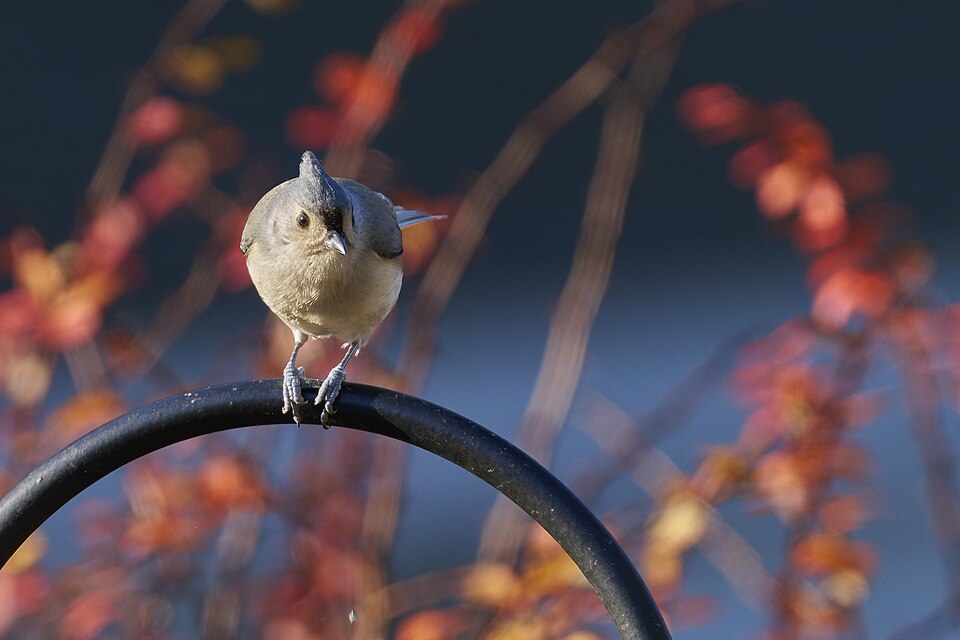
The Tufted Titmouse (Baeolophus bicolor) is a small, gray songbird with a prominent crest, rusty flanks, and a black forehead. It is a year-round resident across eastern and central North America, from southern Ontario to the southeastern United States, favoring deciduous and mixed woodlands as well as suburban gardens and parks.
Learn to identify
Adult Tufted Titmouse perched on a branch, photographed in Central Park, New York.
Learning lesson · openly licensed photographs, labelled by BirdBot; labels checked against the cited sources and approved by AI

Grey and white, with a perky crest. Grey crest: a tufted crest on the head. Black forehead: much reduced in juveniles. Pale face and front: white below the grey upperparts. Rusty flanks: orange-rust along the sides. Crest, black forehead, rusty sides. Juveniles have little black on the forehead.
Juveniles have little black on the forehead.
Sources: Wikipedia: Tufted titmouse (revision 1376696139) · Audubon Guide to North American Birds: Tufted Titmouse
Photo: Rhododendrites, CC BY-SA 4.0, via Wikimedia Commons; labels added by BirdBot.
The Tufted Titmouse is one of the most recognizable small birds in eastern North America. Its most distinctive feature is the large, pointed crest on its head, which it raises when alert or agitated and lowers when relaxed. The bird’s upperparts are a soft blue-gray, while the underparts are white. A wash of rusty or cinnamon color on the flanks is a key field mark, particularly noticeable in birds from the southern part of its range. The face features a black forehead and a black patch above the bill, contrasting with the white throat and cheek. The rusty flanks and black forehead are most visible in bright, direct sunlight.
Confusion with other small gray birds is possible, but the Tufted Titmouse’s combination of a crest, rusty flanks, and black forehead is unique. It is often compared to the Black-capped Chickadee, but the chickadee lacks a crest, has a black cap and bib, and lacks the rusty flank wash.
Tufted Titmice are highly adaptable, thriving in a variety of habitats. They prefer deciduous and mixed woodlands, where they find ample food and nesting sites. However, they are also common in suburban and urban environments, including parks, gardens, and backyards. Their range extends from southern Ontario, Canada, south through the eastern and central United States to the southeastern states. They are year-round residents and do not migrate.
Tufted Titmice are active, curious birds that flit through trees and hang upside down to search for insects. They are omnivorous, feeding on insects, invertebrates, berries, and seeds. They are known for their food-hoarding behavior, storing seeds and nuts in crevices, under bark, or in the ground for later retrieval. This behavior helps them survive periods of food scarcity, particularly in winter. During the non-breeding season, they travel and roost in small flocks.
The Tufted Titmouse is known for its distinctive vocalizations. Its most common call is a whistled “peter-peter-peter,” which is loud and clear. There are ten different known calls, generally divided into low-frequency and high-frequency groups; the high-frequency calls are often associated with aggressive behavior. These vocalizations, along with body posture, are used for communication and territory defense.
Tufted Titmice are cavity nesters, using natural cavities in trees, old woodpecker holes, or man-made nesting boxes. They do not excavate their own cavities but will take over existing ones. Breeding typically occurs from March to May. The female incubates five to eight brown-speckled white eggs, and both parents feed the young. It is not uncommon for the pair to have nest helpers, which may be their own young or other birds, assisting in feeding the nestlings.
The Tufted Titmouse is listed as Least Concern (LC) in the AviList v2026 checklist. This status reflects its wide range and adaptability to various habitats, including urban and suburban areas. Maintaining healthy woodland habitats, including mature trees with cavities, is important for supporting this species.
When observing Tufted Titmice, it is important to maintain a respectful distance to avoid disturbing their natural behavior. Use binoculars or a telephoto lens to get a closer look without approaching too closely. In urban and suburban areas, be mindful of other birders and avoid crowding around feeders or nesting sites. Providing a variety of food sources, such as sunflower seeds and suet, can attract Tufted Titmice to your yard, but ensure that feeders are cleaned regularly to prevent the spread of disease.
Next Step: On a quiet dawn in a woodland or park, listen for the distinctive, whistled “peter-peter-peter” call. This loud, clear sound is often the first clue to locating the bird before you spot its crest.


