
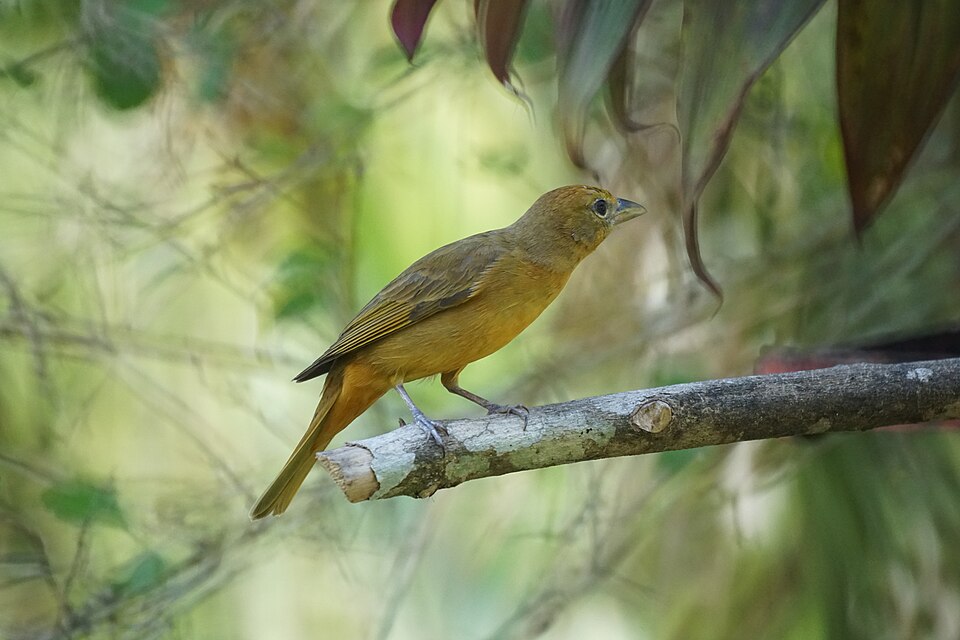
The Summer Tanager (Piranga rubra) is a medium-sized songbird in the Cardinalidae family, distinguished by its pale rose-red male plumage, olive-yellow female, and unique habit of raiding wasp nests in open woodlands.
Learn to identify
Young male Summer Tanager in patchy red-and-yellow plumage.
Learning lesson · openly licensed photographs, labelled by BirdBot; labels checked against the cited sources and approved by AI

Large pale bill: stout; Hepatic Tanager's bill is dark. Plain wings: olive and unmarked. Patchy red and yellow: adult males are rosy red all year. Red-and-yellow patchwork plus a big pale bill: young male.
Females are yellow to orangish below and olive above.
Sources: Audubon Guide to North American Birds: Summer Tanager · Wikipedia: Summer tanager (revision 1354820382)
Photo: lwolfartist, CC BY 2.0, via Wikimedia Commons; labels added by BirdBot.
While the species snapshot covers basic plumage, the critical field distinction lies in the male's color tone and wing coloration. The Summer Tanager is a paler, rose or orange-red, lacking the intense scarlet of its relative. Most importantly, its wings and tail are red, not black. This uniformity is the primary visual cue to separate it from the Scarlet Tanager in the field.
For females and juveniles, look for the conspicuous narrow yellow edging on the wing coverts. Juveniles resemble adult females, but young males often develop distinctive patches of red during their first winter, a transition that can make identification tricky for observers new to the species.
The primary confusion species is the Scarlet Tanager (Piranga olivacea). While both are red in the breeding season, the differences are distinct:
| Trait | Summer Tanager | Scarlet Tanager |
|---|---|---|
| Color Intensity | Paler, rose or orange-red | Deep, intense scarlet |
| Wings and Tail | Red | Black |
| Song | Rich and musical | Buzzy or harsh |
In the eastern portion of its range, the Summer Tanager primarily inhabits open woodlands of mixed oak and other hardwood trees. In the west, it favors riparian woodlands of cottonwoods and willows. It is also found in orchards, parks, and roadside trees. During the winter, it continues to inhabit open woodlands, tall secondary growth, gallery forests, forest edges, and shaded plantations. In Mexico, it inhabits humid evergreen and tropical deciduous forests. The species is typically found at low elevations, though it winters as high as 1,800 m in Panama.
According to AviList v2026, the species breeds in deciduous and riparian forest and woodland in the northeastern US southward to the Gulf of Mexico coast, central Florida, and the southwestern US (California, New Mexico, Arizona, and western Texas) southward to northern Mexico. It winters in various forest, woodland, and semi-open habitats from central Mexico southward to Colombia, Venezuela, Trinidad and Tobago, the Guianas, the western Amazon basin, the Andes to northwestern Bolivia, the Pacific lowlands to southwestern Ecuador, and the Caribbean islands.
Summer Tanagers are usually solitary, except during the breeding and migratory seasons. Pairs are seldom seen because they tend to conceal themselves in the tops of the tallest trees. Their flight is swift and direct, and they often sit still on a perch before moving in sudden bursts. During migration, flocks can reach up to 30 individuals, though it is unclear if they fly together or simply gather on the ground. They sometimes join mixed-species flocks at forest edges and fruiting trees. Migration generally occurs at night, as evidenced by TV tower casualties.
While primarily insectivorous, the Summer Tanager has a distinctive dietary preference for bees (superfamily Apoidea) and wasps. They frequently attack wasp nests until the wasps abandon the site, allowing the tanager to devour the larvae. Foraging occurs primarily in the tops of trees, where adult bees and wasps are caught in flight. Once caught, the tanager takes the insect to a perch and beats it against the branch until it dies. By wiping wasps on a branch before eating them, the bird removes stingers and other inedible body parts. They also consume other insects such as beetles, dragonflies, cicadas, grasshoppers, ants, caterpillars, and spiders, as well as fruits like blackberries, mulberries, and bananas, especially during migration and on the winter range.
This specialized foraging strategy, which involves both aerial capture and nest raiding, distinguishes the Summer Tanager from many other insectivorous songbirds that rely more heavily on passive gleaning or fruit consumption.
Summer Tanagers breed once annually and raise one brood per summer. They are serially monogamous, keeping one mate per breeding season but not necessarily in successive years. Males arrive on the breeding grounds in full song, usually a few days before females. Courtship involves frequent, sudden, energetic chases of the female by the male.
The female builds the nest alone, though the male often accompanies her while searching for a site. The nest is a cup of dried herbaceous vegetation lined with fine grasses, placed on a horizontal branch 2.5 to 10.5 m from the ground. The female lays 3 to 4 eggs that are smooth, glossy, pale blue or green, and spotted reddish brown. Incubation lasts 12 to 13 days and is carried out by the female only. Both parents feed the chicks after hatching, and the young leave the nest after 8 to 10 days. Adults attend the fledged young for 2 to 4 weeks.
The male's song is quite recognizable, being rich and musical, unlike the buzzy song of the Scarlet Tanager. Males sing vigorously all day during the breeding season to attract females and establish territory. Some females sing a garbled version of the male's song. Both sexes produce a loud, clicking call used in various situations.
The Summer Tanager is listed as Least Concern (LC) in the IUCN Red List as recorded in AviList v2026. The North American breeding population has remained relatively steady. The species is protected by the U.S. Migratory Bird Act. The most significant human impacts are the destruction of breeding habitat and collisions with television towers during nocturnal migrations.
The most effective way to find a Summer Tanager is to listen for its rich, musical song from the tops of tall trees in open woodlands during the breeding season. Expect the bird to be hidden in the upper canopy; listen for the song to pinpoint the tree, then scan for the pale red flash when it moves in a sudden burst. Instead of seeking out specific food sources like wasp nests—which can be dangerous to approach and may disturb the colony—focus on the bird's vocalizations. If you see a bird beating an insect against a branch, you have likely found a Summer Tanager, but maintain a respectful distance to avoid stressing the bird or its environment.


