
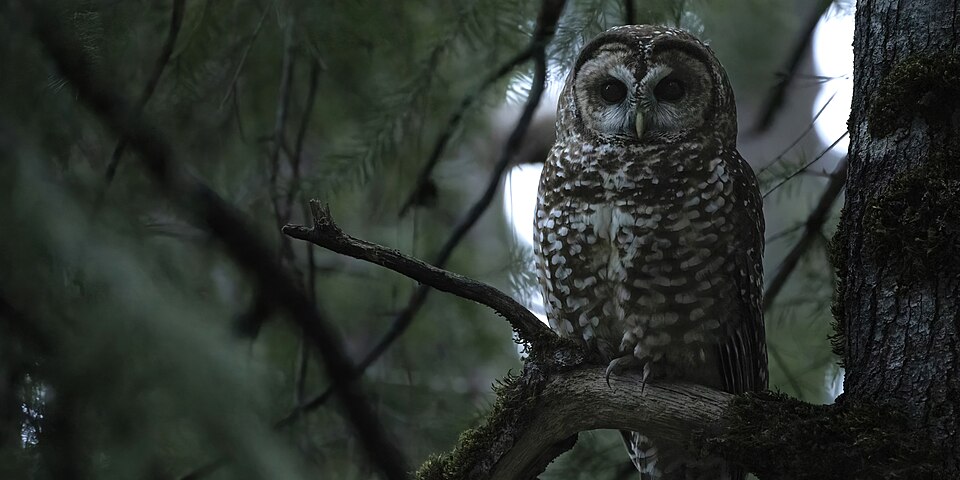
The Spotted Owl (Strix occidentalis) is a master of concealment in the humid, deep-canopy forests of western North America. This medium-sized, dark brown owl relies on cryptic plumage and strict nocturnality to thrive in ravines and canyons where light is scarce. Its presence is often betrayed not by sight, but by sound: a series of hesitant hoots or startling, dog-like alarm calls that echo off canyon walls. Understanding its behavior in these specific habitats is key to both identifying and ethically observing this elusive species.
Learn to identify
Adult California Spotted Owl perched on a stump (US Fish and Wildlife Service photo, 2018).
Learning lesson · openly licensed photographs, labelled by BirdBot; labels checked against the cited sources and approved by AI

Round head, no ear tufts: a smooth, rounded crown. Dark eyes: dark rather than yellow. White-spotted underparts: brown with white spots, not bars and streaks. Barred Owl is larger and grayer, barred and streaked below.
Spotted and Barred Owls can hybridize where Barred Owls have moved in.
Sources: Audubon Guide to North American Birds: Spotted Owl · Wikipedia: Spotted owl (revision 1380705847)
Photo: USFWS Pacific Southwest Region, Public domain, via Wikimedia Commons; labels added by BirdBot.
Spotted Owls are medium-sized birds averaging 45 cm in length with a wingspan of approximately 114.3 cm. Their weight ranges from 518 to 760 grams, with females generally larger than males. The plumage is dark brown with a round head and large dark eyes. The head and hind neck feature white spots, while the breast and abdomen display white mottling.
Plumage variation is notable across the species' range. Birds from the humid climate of the coastal range are the darkest, while those from the mountain ranges in Arizona and Mexico are the lightest with the most white spots. This difference in appearance is assumed to be an evolutionary adaptation to climate variation. The amount of coloration and white spotting also varies depending on how thick the plumage is.
Spotted Owls are found in humid, mixed coniferous forests, wooded ravines, and canyons. They can also be located in dark forest patches in the shade of deep, hanging canyon walls. The biomes they occupy include temperate forest and low boreal mountains.
According to AviList v2026, the range includes various mature and old-growth forest types from far southwestern Canada southward across the western US to southern California and (formerly) northern Baja California, Mexico. In the southern US, the range extends eastward to central Colorado, eastern New Mexico, and adjacent Texas, and in Mexico southward to southern Jalisco and northern Michoacan.
Spotted Owls are strictly nocturnal, a trait that helps them avoid the intense heat of their canyon habitats. By day, they retreat to the deepest shade, often hiding in thick cover near tree trunks where their mottled plumage renders them nearly invisible. This cryptic behavior is a survival strategy; even when a female is forced to hunt during the day to feed young, she remains motionless and alert, blending into the bark.
In the deep, narrow canyons where they reside, heat can become a significant physiological challenge. When temperatures exceed 27°C, Spotted Owls employ specific behavioral thermoregulation to survive. They retreat to the north-facing slopes of canyon walls, seeking the cooler microclimate of the dense canopy. By exposing their unfeathered legs and feet, lifting their footpads, and fluttering their wings with a partially open beak, they maximize evaporative cooling. This behavior is a critical adaptation to the thermal extremes of their preferred humid, shaded habitats.
Spotted Owls are carnivorous and prey on anything they are able to catch. Prey consists mainly of small arboreal or semiarboreal mammals, as well as birds, several species of bat, and large insects. They are skilled hunters that rely more so on acute hearing than eyesight. Hunting takes place more often through the medium strata of the forest, rather than on the forest floor or in an open field.
Catches are generally made by swooping down from a perch above and collecting the prey with sharp talons. Occasionally, smaller birds are caught on the wing in midflight. A certain technique is applied to feeding: an ear is torn off to break the resistant skin, and the spinal column is broken by a twist of the beak. Prey is always eaten head first.
Spotted Owls roost high in the trees under the shelter of the highest canopy, shielded from direct sunlight. Summer nests are found in shady places a few degrees cooler than that of the open canopy, often closer to the cool forest floor. Nests occur in a wide variety of locations: tree cavities and stumps, potholes and cavities in sandstone cliffs, rocky ledges of caves, and deep narrow canyons.
Quite often, these birds do not build their own nests. Rather, they occupy the deserted nests of hawks or ravens. If none is available, eggs are sometimes laid on bare dirt. Breeding occurs annually between nesting owl pairs; each owl is usually over the age of two years. Usually between two and three eggs are found in each clutch. The eggs are white, slightly granulated, and more oval than those of the Barred Owl. The male's responsibility is to hunt in order to feed the young, while the female primarily incubates and cares for the eggs. She will hunt, however, if the young aren't getting enough to eat. The head of the prey is eaten by parents before feeding the remainder to their young.
There are several distinct songs and calls of Spotted Owls. The territorial song or location call consists of three to four hesitant hoots. The contact call is composed of a series of terrifying whistles and a siren-like echo. Alarm or scolding calls resemble dog-like barks.
The Spotted Owl is classified as Near Threatened (NT) in AviList v2026. This status reflects the species' vulnerability to habitat changes, although it is not a new assessment or a local abundance estimate. The species receives protection under the Migratory Bird Treaty Act of 1918 and has been listed as a threatened species under the Endangered Species Act of 1973 (as amended). Regional statuses vary; for instance, in Washington it is endangered, in Oregon it is considered threatened, and in California, it is on the special concern list. Note: These regional designations are drawn from a historical natural-history account and may not reflect current state listings. Habitat destruction, including unrestricted exploitation and logging of old-climax forests, poses a threat to the continued existence of this owl in its realized niche.
Locating a Spotted Owl is an auditory exercise as much as a visual one. Because the owl is cryptic and nocturnal, visual searches are often futile. Instead, listen for the distinctive territorial song of three to four hesitant hoots, or the startling, dog-like alarm calls that may be triggered by your presence. These sounds are often more reliable indicators of the owl's location than a fleeting glimpse of dark plumage against a tree trunk.
During the day, look for indirect signs of activity, such as pellets or droppings beneath large conifers or near known perches. If you do spot an owl, it is likely a female hunting under pressure to feed young. Maintain a significant distance, avoid flash photography, and keep noise to a minimum. Spotted Owls are protected under the Migratory Bird Treaty Act and the Endangered Species Act, and disturbing them or their habitat can have legal and ecological consequences. Ethical observation means prioritizing the bird's welfare over the photograph.
Next Step: Try listening for hoots at dusk in old-growth forests in the Pacific Northwest during the breeding season.


