
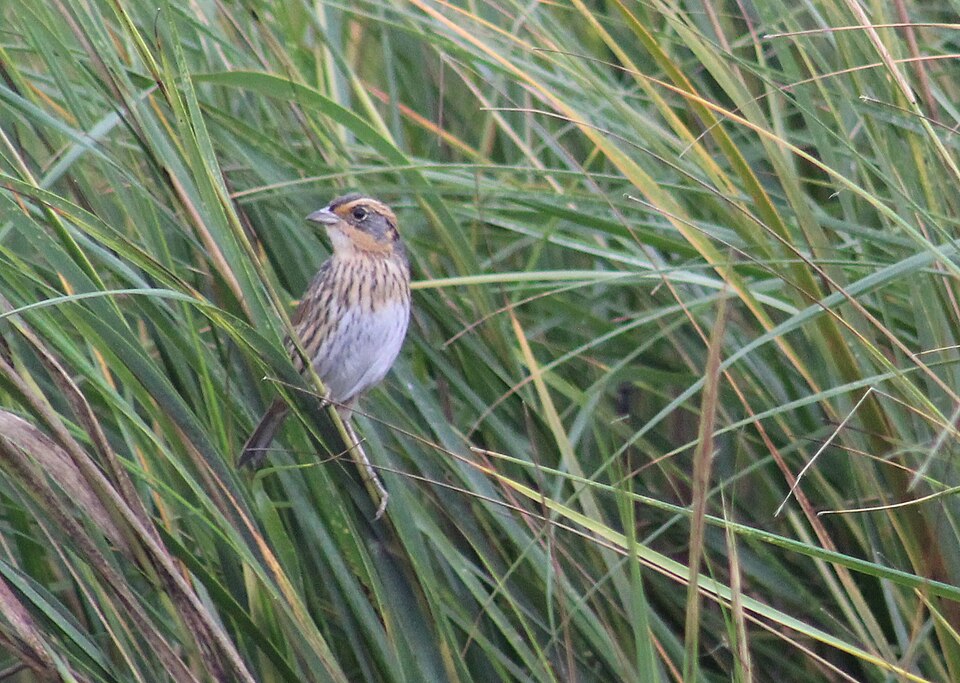
The Saltmarsh Sparrow (Ammospiza caudacuta) is a small, elusive sparrow found exclusively in tidal salt marshes along the Atlantic coast of the United States. Listed as Endangered in AviList v2026, this species faces significant threats from habitat loss and sea-level rise. For detailed plumage cues and vocalizations, see the Identification and Voice sections.
Learn to identify
Adult Saltmarsh Sparrow in an Atlantic coast salt marsh, photographed by the U.S. Fish and Wildlife Service.
Learning lesson · openly licensed photographs, labelled by BirdBot; labels checked against the cited sources and approved by AI

Bold face pattern: orange face framing a gray cheek. Heavily streaked chest: crisp dark streaks across breast and sides. Whitish underparts: white belly below the streaked chest. Nelson's Sparrow is buffier on the chest, with fainter streaks.
Nelson's Sparrow shares its winter marshes; some birds are hard to separate.
Sources: Audubon Guide to North American Birds: Saltmarsh Sparrow · Wikipedia: Saltmarsh sparrow (revision 1382491297)
Photo: U.S. Fish and Wildlife Service Northeast Region, Public domain, via Wikimedia Commons; labels added by BirdBot.
Measuring 11–14 cm in length and weighing 14–23.1 g, the Saltmarsh Sparrow is a compact bird with a stocky build suited for maneuvering through dense marsh vegetation. Adults display brownish upperparts with a distinct gray nape. The underparts feature a white throat and belly, contrasted by a pale orange breast and sides marked with brown streaking. The face is orange with gray cheeks, a gray median crown stripe, brown lateral crown stripes, and a brown eyeline. The tail is short and sharply pointed.
Distinguishing this species from the Nelson's Sparrow (Ammospiza nelsoni) can be challenging, particularly in the field. The Saltmarsh Sparrow possesses a slightly longer beak than its relative. Plumage differences are subtle: the inland subspecies of the Nelson's Sparrow typically shows fainter streaking and a brighter orange breast, while the coastal subspecies appears paler and less contrasting. The Saltmarsh Sparrow's subspecies A. c. diversa exhibits more contrasting striping on the back and a darker crown compared to the nominate A. c. caudacuta.
Field Tip: Look for the gray nape patch and the short, sharply pointed tail. Since visual cues can be subtle in dense vegetation, listen for the male's faint, raspy buzz to confirm presence.
Only males sing. The song is a complex series of raspy, barely audible buzzes, trills, and gurgles. This vocalization is distinct from the Nelson's Sparrow, which produces a louder, hissing buzz followed by a buzzy chip. However, the high-pitched contact calls of both species are indistinguishable, making visual confirmation or song analysis essential for accurate identification.
The Saltmarsh Sparrow is a tidal marsh obligate, breeding in high marsh habitats dominated by saltmeadow cordgrass (Sporobolus pumilus) and saltmarsh rush (Juncus gerardii). These high marsh areas flood less frequently than low marsh zones, providing safer nesting sites. The species breeds along the Atlantic coast from southern Maine to Virginia and winters from Maryland to northern Florida, utilizing both Atlantic and Gulf coasts.
Saltmarsh Sparrows exhibit a highly promiscuous mating system with no territorial defense or pair bonds. Males roam long distances during the nesting season, chasing and mounting females regardless of receptivity. Consequently, the majority of broods exhibit mixed parentage, with some nests containing chicks from multiple sires. Males provide no parental care; females are solely responsible for building the nest, incubating eggs, and feeding the young. Male home ranges are twice as large as those of females and may span up to 50 hectares.
Females construct open cup nests of grass, attaching them to cordgrass or rush at a height of 6–15 cm. Clutch size ranges from 3 to 5 eggs, with incubation lasting 11–12 days after the last egg is laid. Young fledge 8–11 days after hatching but remain dependent on the mother for an additional 15–20 days.
A critical adaptation to their habitat is the synchronization of breeding with the lunar tidal cycle. Nesting begins immediately following a spring tide, allowing young to fledge before the next high spring tide, which occurs every 28 days during the new moon. This timing minimizes the risk of nest flooding, which is a primary cause of nest mortality in core-range populations. Two broods are typically raised per breeding season.
Saltmarsh Sparrows forage on the ground along tidal channels or within marsh vegetation, often probing in the mud at low tide. They are opportunistic feeders. During the breeding season, over 80% of the nestling diet consists of insects, including flies, amphipods, grasshoppers, and moths, with a particular emphasis on soldier flies. In winter, adults shift their diet to consume seeds.
The Saltmarsh Sparrow is listed as Endangered (EN) in AviList v2026. Populations are declining due to habitat loss largely attributed to human activity. The primary drivers of this decline include coastal development and sea-level rise, which accelerates the inundation and loss of high marsh nesting habitat.
Recent research highlights distinct threats at the trailing edge of the range. In Virginia, predation has emerged as a significant cause of nest failure, with camera-documented evidence of red fox predation and suspected events by white-tailed deer. This contrasts with flooding, which remains a primary cause of nest mortality in core New England populations. Additionally, sea-level rise projections indicate that suitable nesting habitat in migrated marshes could be substantially reduced; when elevation constraints are incorporated, suitable habitat and projected nest success may decline by over 90% under certain metrics.
Observing Saltmarsh Sparrows requires patience and an understanding of their habitat. Check tide charts to time visits for low tide, when birds are foraging along tidal channels or probing in the mud. Focus on high marsh areas dominated by saltmeadow cordgrass and saltmarsh rush, as these birds avoid frequently flooded low marsh zones.
Listen for the faint, raspy buzzes of singing males from the high marsh edge, as the birds are often hidden in dense vegetation. Avoid disturbing nesting areas, particularly during the breeding season, as human presence can increase predation risk or cause nest abandonment. When using binoculars or cameras, maintain a respectful distance to minimize stress on these vulnerable birds.


