
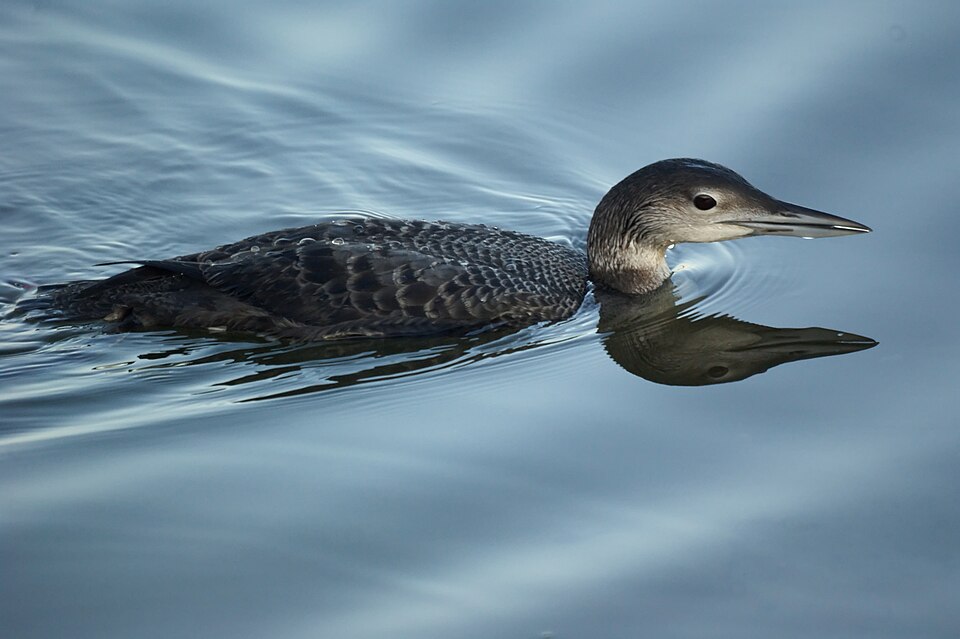
The Pacific Loon (Gavia pacifica) is a medium-sized member of the loon family (Gaviidae) within the order Gaviiformes. It breeds on tundra lakes in northern Canada and eastern Siberia and winters in open ocean or large lakes along the Pacific coast. In breeding plumage, the species is identified by a grey head, a black throat with purple reflections, white underparts, and a chequered black-and-white mantle. It is a specialist fish-eater that forages underwater, often in groups, and is sensitive to human disturbance, making remote, quiet waters the best places to observe it.
Learn to identify
Adult Pacific Loon in breeding plumage, photographed in Anchorage, Alaska.
Learning lesson · openly licensed photographs, labelled by BirdBot; labels checked against the cited sources and approved by AI

Gray head: smooth, pale gray crown and nape in summer. Slim, pointed bill: thinner than a Common Loon's bill. Checkered back: black, with rows of white checkering. The very similar Arctic Loon shows a white patch on the rear flank.
Winter birds are drabber, with a white chin and foreneck.
Sources: Audubon Guide to North American Birds: Pacific Loon · Wikipedia: Pacific loon (revision 1362782434)
Photo: Lisa Hupp/USFWS (USFWSAlaska), Public domain, via Wikimedia Commons; labels added by BirdBot.
Breeding adults resemble a smaller, sleeker version of the Common Loon. They measure 58–74 cm (23–29 in) in length, with a wingspan of 110–128 cm (43–50 in) and a weight of 1–2.5 kg (2.2–5.5 lb). The bill is grey or whitish and dagger-shaped. In non-breeding plumage, the bird appears drabber, with a white chin and foreneck.
The Pacific Loon is often confused with the Black-throated Loon and the Red-throated Loon. The following table summarizes the key field marks for differentiation.
| Feature | Pacific Loon | Black-throated Loon | Red-throated Loon (Winter) |
|---|---|---|---|
| Flank Patch | Lacks a white flank patch | Has a white flank patch | Not specified in source |
| Head/Neck Contrast | Grey head, black throat with purple reflections | Similar to Pacific Loon but with flank patch | Paler look; less contrast between crown/hindneck and throat |
The lack of a white flank patch is the most reliable field mark to separate the Pacific Loon from the otherwise very similar Black-throated Loon in all plumages. In winter, the Red-throated Loon can be distinguished by its paler overall appearance and the apparent upturn of its bill.
The Pacific Loon breeds on tundra lakes in northern Canada and eastern Siberia. According to AviList v2026, the breeding range extends from coastal eastern Siberia and northern North America eastward through northern Canada to Baffin Island and James Bay. During the winter, the species moves to open ocean or large lakes along the Pacific coast, with a range extending to Japan (Hokkaido to Kyushu) and southern Baja California. It winters at sea, mainly on the Pacific coast, or on large lakes in China, Japan, North Korea, South Korea, the United States, and Mexico.
Unlike other loons, the Pacific Loon may migrate in flocks. It has been recorded as a vagrant in Greenland, Hong Kong, Great Britain, Spain, Sweden, Finland, and Switzerland.
Pacific Loons are socially monogamous, forming pair bonds that last as long as offspring are produced, often for life. Mating behavior begins in spring and summer, involving beak-dipping and splash-diving displays. Males compete for mates by fighting with their beaks, which can result in mortal wounds to rivals.
Once a pair is established, they defend their nesting lake aggressively. Studies indicate high territory retention rates (0.92), suggesting that the population in areas like Northern Alaska may be saturated. Both parents participate in defending the nest and fledglings; if a threat approaches, one parent protects the young while the other aggressively attacks the perceived threat, sometimes diving under aquatic animals to stab them with its beak.
Pacific Loons build nests on the ground near deep lakes, constructed from piled-up vegetation and mud. The nest is located right along the shoreline and will be abandoned if receding waters cause the nest to be too far from the water's edge.
The clutch consists of one to two light buff or green eggs with brown spots of various sizes, typically measuring 76 by 47 mm (3.0 by 1.9 in). Incubation lasts 23 to 25 days. Although eggs are laid a few days apart, they usually hatch at intervals of no more than a day apart.
Chicks are completely dependent on their parents for the first 5–7 weeks. During this period, parents carry the young on their backs while swimming to protect them from predation and cold. By the eighth week, chicks develop the ability to fish independently.
The Pacific Loon is a specialist fish-eater, catching its prey underwater. It often forages in groups, swimming under schools of fish to force them toward the surface. This species generally feeds closer to the shore than other loons. The bird uses well-developed air sacs to pursue prey for extended periods beneath the surface.
The Pacific Loon is most active vocally in spring and summer. Its calls include a loud, eerie, "oo-loo-lee" wail or yodel that can travel for miles, typically heard during the breeding season. It also produces short, sharp "ark"-like calls when feeding, as well as harsh "kok-kok-kok-kok" sounds, cackles, growls, barks, and clucking noises.
The Pacific Loon is listed as Least Concern (LC) in the IUCN Red List category as recorded in AviList v2026. While the species is currently combating human pressures well, populations may decrease in the future due to the encroachment of human development on preferred habitats. Research has also investigated the magnification of chemicals in the loon's body due to pollutants, given its position near the top of the food chain.
Pacific Loons are sensitive to disturbances, especially those created by humans, and are most likely to occur in remote areas. To observe them ethically, maintain a significant distance and avoid approaching the shoreline where nests are located. Since the birds require 30 to 50 yards (27 to 46 m) of water to take off, they are often found on larger lakes or coastal waters. Listen for the distinctive yodeling calls in spring and summer to locate the birds without needing to approach them visually.


