
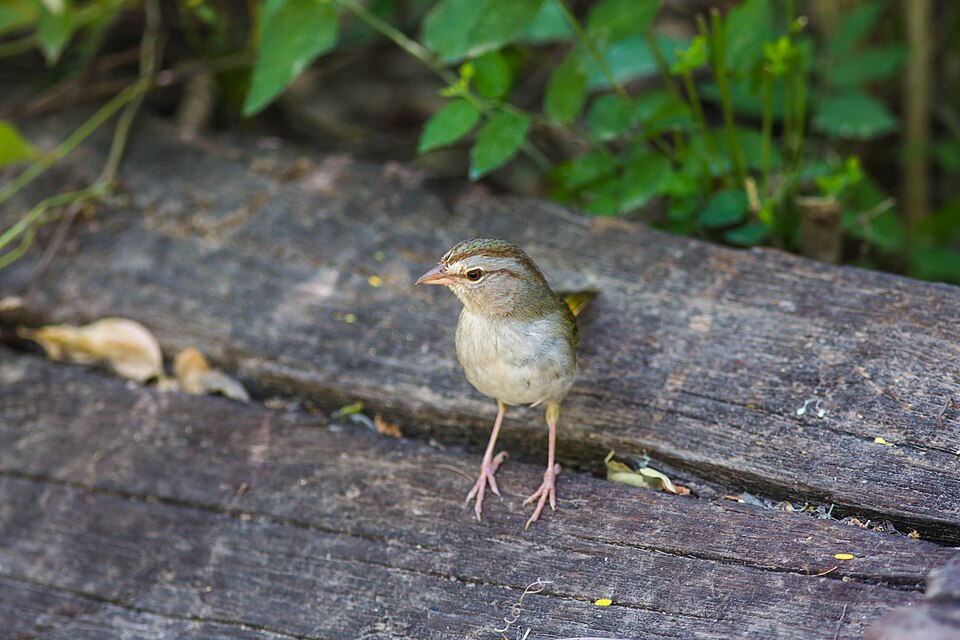
The Olive Sparrow (Arremonops rufivirgatus) is a small, secretive songbird in the family Passerellidae, found in a highly disjunct range from southern Texas through Mexico to Costa Rica. It is a year-round resident in most of its range, foraging on the ground or low in dense vegetation. Identification relies on its uniformly olive upperparts, gray face, and a distinctive accelerating, metallic-sounding song sung primarily by males before sunrise.
Learn to identify
Adult Olive Sparrow in southern Texas.
Learning lesson · openly licensed photographs, labelled by BirdBot; labels checked against the cited sources and approved by AI

Brown crown stripes: dull brown stripes on a gray head. Gray face: gray on the face and sides of the head. Olive upperparts: dull olive on the back and wings. Pale underparts: grayish to buffy white below. Look low in dense thickets, where it scratches in leaf litter like a towhee.
Sexes look alike; Mexican subspecies differ in crown and back color.
Sources: Audubon Guide to North American Birds: Olive Sparrow · Wikipedia: Olive sparrow (revision 1352050272)
Photo: lwolfartist, CC BY 2.0, via Wikimedia Commons; labels added by BirdBot.
The Olive Sparrow is a compact bird, measuring 12 to 14 cm (4.7 to 5.5 in) in length and weighing 15 to 30 g (0.53 to 1.1 oz). Both sexes share identical plumage, which is a key field cue. Adults of the nominate subspecies display uniformly olive upperparts, a brown crown with a wide olive-gray stripe, and a gray face marked by a wide buffy supercilium and a thin brown eye-line. The underparts are buffy white on the chin and throat, transitioning to white or buffy white on the breast and belly, with buff flanks and cinnamon or creamy buff undertail coverts.
The species exhibits significant subspecific variation. While the nominate form is olive-brown, other subspecies such as A. r. verticalis and A. r. sinaloae feature chestnut crowns with gray centers. All subspecies share a reddish-brown to brownish-red iris, a brownish-pink bill, and pinkish to brownish-pink legs and feet. These subtle color shifts, particularly in the crown and upperparts, are essential for distinguishing populations across its fragmented range.
The Olive Sparrow occupies a variety of landscapes, including brushy woodlands, chaparral, thorn forest, shrubby fields, and forest edges. In Texas, it favors brushy open woodlands and open brushlands. In Mexico, it occurs in chaparral, thorn forest, and the understory of tropical deciduous forest. On the Yucatán Peninsula, it inhabits both humid forest and dry coastal scrublands, while in Costa Rica, it is found on forest edges and in secondary forest.
Its distribution is highly disjunct, with several subspecies' ranges not abutting one another. The nominate subspecies ranges from southern Texas through eastern Mexico to northern Veracruz. Other subspecies are isolated in southeastern Mexico, the Yucatán Peninsula, the central valley of Chiapas, and the Pacific slope from Nicaragua to Costa Rica. This fragmentation suggests that biotic factors, such as competition with ecologically similar species, may play a role in its geographic isolation.
The Olive Sparrow is a shy and secretive bird, foraging mostly singly or in loose pairs. It hops on the ground or low in dense vegetation, rarely feeding higher in trees. Its diet includes insects, spiders, seeds, and small amounts of fruit, though detailed dietary studies are limited. The bird is almost entirely a year-round resident, with some local movements to avoid cold weather and potential migratory behavior in some Texas individuals.
Only the male Olive Sparrow is believed to sing. Its song is an accelerating series of downslurred tsip, chip, or tsew notes, often described as sounding like a metallic ball bouncing on a concrete floor. The song is most frequent before sunrise and from hidden perches. Calls include a thin, high-pitched tsit, a drawn-out tssssir, a fast twitter, and a sharp wheek wheek wheek. Statistical differences in song exist among eastern, western, and southern populations.
The breeding season varies geographically, spanning March to September in Texas, May to August in southern Mexico, and April to July in Costa Rica. Pairs often raise two broods. The nest is a large cylinder with a side entrance, constructed from twigs, grass, and straw, and typically placed within 1.5 m (5 ft) of the ground in dense shrubs or vines. The clutch consists of two to five unmarked white to pale pink eggs, incubated probably by the female alone. Nests are subject to brood parasitism by the bronzed cowbird and brown-headed cowbird.
The Olive Sparrow is listed as Least Concern (LC) in the AviList v2026 checklist. This status reflects its wide, albeit disjunct, range and its adaptability to various shrubby habitats. No specific threats, such as deforestation or agricultural expansion, are detailed in the supplied sources for this species.
Listen for the male's accelerating, metallic-sounding song from a hidden perch before sunrise. The bird is often concealed in dense vegetation, so patience and attention to sound are key. Focus on brushy woodlands, chaparral, and forest edges in its known range. Ethical observation involves maintaining a respectful distance and avoiding disturbance to nesting sites.
Target specific areas within its disjunct range: in the U.S., look in the brushy open woodlands of southern Texas (Val Verde to Calhoun counties). In Mexico, check the chaparral and thorn forest of the Gulf slope and the Pacific slope from Sinaloa to Oaxaca. On the Yucatán Peninsula, search dry coastal scrublands and humid forest edges. In Central America, look for the bird in semi-arid grasslands and scrublands in Belize and Guatemala, and in forest understories in western Nicaragua to west-central Costa Rica.


