
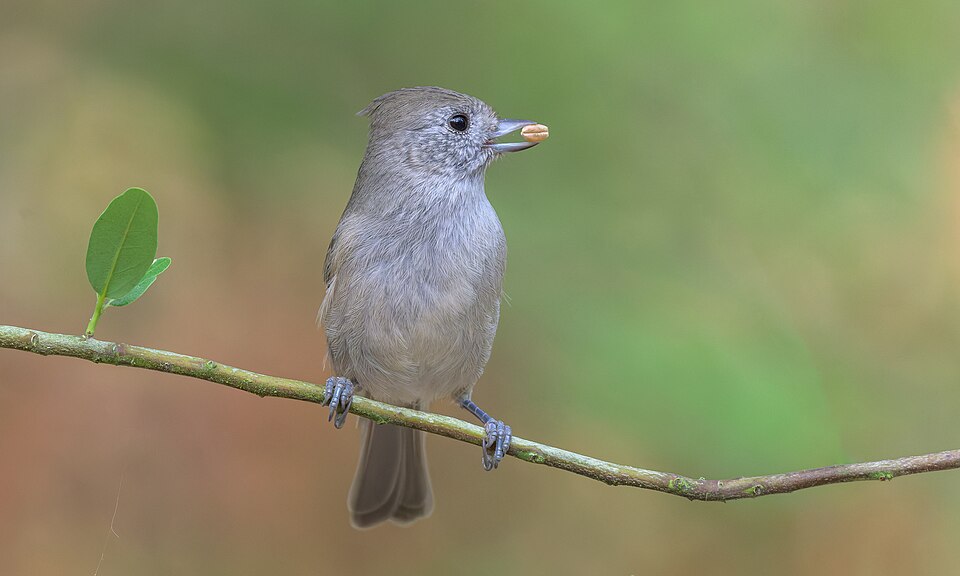
The Oak Titmouse (Baeolophus inornatus) is a small, brown-tinged gray passerine bird with a small crest and a plain face. It is a year-round resident of oak woodlands on the Pacific slope—the western side of North America, specifically the coastal regions of the Pacific Northwest and California—ranging from southern Oregon through California to Baja California. Distinguished from the similar Juniper Titmouse by its browner back and a song consisting of repeated phrases of two or three notes, the Oak Titmouse nests in cavities and is listed as Least Concern by the IUCN.
Learn to identify
Oak Titmouse in adult plumage, photographed in California in February.
Learning lesson · openly licensed photographs, labelled by BirdBot; labels checked against the cited sources and approved by AI

Short crest: a small tuft, raised or laid almost flat. Plain face: no stripes or patches on the face. Brownish-gray above: gray with a brown tinge. Paler underparts: slightly lighter gray below. Juniper Titmouse looks alike; habitat and song separate them.
The crest can lie almost flat, making the head look rounded.
Sources: Audubon Guide to North American Birds: Oak Titmouse · Wikipedia: Oak titmouse (revision 1384891824)
Photo: Becky Matsubara from El Sobrante, California, CC BY 2.0, via Wikimedia Commons; labels added by BirdBot.
The Oak Titmouse is a compact bird with a muted color palette that blends into its woodland surroundings. Its plumage is predominantly brown-tinged gray, with lighter gray undersides. The face is notably plain, lacking the strong markings found in some other titmice, and is topped by a small, dark tuft or crest. Sexual dimorphism is minimal; males and females appear very similar in the field.
Because the Oak Titmouse and Juniper Titmouse are visually almost identical, voice and subtle plumage differences are the most reliable field cues. The Oak Titmouse typically has a browner back than the Juniper Titmouse. In the small area of California where their ranges overlap, listening is essential. The Oak Titmouse’s song is a series of repeated phrases, usually three to seven in number, where each phrase consists of two or three notes with the last note lower in pitch. Males sing more frequently in spring from open branches, using clearer, sharper notes in a steady rhythm. In contrast, the Juniper Titmouse sings a series of rapid syllables on the same note.
The Tufted Titmouse, which does not overlap in range with the Oak Titmouse, can be distinguished by its whiter belly, rusty flanks, and black forehead. The Oak Titmouse’s call is a scratchy tsicka-dee-dee, which is distinct from the sharper calls of other small passerines.
The Oak Titmouse is endemic to the Pacific slope of North America, a term referring to the western side of the continent, specifically the coastal regions of the Pacific Northwest and California. Its range extends from southern Oregon south through California, west of the Sierra Nevada, and into Baja California. The distribution surrounds the central San Joaquin Valley. This species is strongly associated with open woodlands of warm, dry oak and oak-pine at low to mid-elevations.
While it prefers open woodlands, the Oak Titmouse can also be found in denser forests provided there are adequate oak trees. It typically inhabits stands of coast live oak (Quercus agrifolia) and valley oak (Quercus lobata). These trees provide the essential resources the bird requires: cavities for nesting, dense foliage for roosting, and twig piles. The presence of mature oak trees is a critical factor in determining the suitability of a habitat for this species.
Oak Titmice are generally non-migratory residents that defend territories year-round. They form pairs or small groups but do not typically form large flocks. After the breeding season, they may join mixed-species flocks for foraging, associating with other insectivorous birds. Pairs often stay together for life, a behavior linked to the need to defend scarce nesting cavities.
Roosting behavior is distinctive. Oak Titmice sleep in cavities, dense foliage, or birdhouses. When roosting in foliage, they select a twig surrounded by dense leaves or an accumulation of dead pine needles, effectively simulating a cavity roost. This behavior provides protection from predators and the elements.
The Oak Titmouse is an omnivore with a diet that shifts seasonally. It consumes insects and spiders, often catching insects in mid-air. While specific insect taxa are not detailed in general field guides, the bird is known to feed on a variety of arthropods found in oak woodlands. It also eats berries, acorns, and seeds. Foraging occurs on foliage, twigs, branches, trunks, and occasionally on the ground. The bird is agile, sometimes hanging upside down to reach food and using its bill to hammer seeds against branches to open them.
At feeders, Oak Titmice are attracted to suet, peanut butter, and sunflower seeds. Observing their foraging behavior can be a useful way to identify them in suburban areas with suitable oak trees.
Oak Titmice nest in cavities, using woodpecker holes, natural cavities, or nest boxes. The nest is constructed from grass, moss, mud, hair, feathers, and fur. The female builds the nest over 4 to 10 days, while the male often accompanies her and brings food. Breeding occurs from March into July, with peak activity in April and May.
The female lays a clutch of 3 to 9 eggs, usually 6 to 8. She is the primary incubator, with incubation lasting 14 to 16 days. The young are altricial, meaning they are born naked and helpless, and are tended by both parents in the nest for 16 to 21 days. Parents continue to feed the fledglings for another three to four weeks after they leave the nest.
Competition for nesting sites is a significant factor in the life of the Oak Titmouse. In central California, researchers have found that Oak Titmice compete with Western Bluebirds and House Wrens for cavities. European Starlings, an invasive species, can also take over nests. This competition likely drives the species’ tendency to form pairs early and defend territories year-round.
The Oak Titmouse is listed as Least Concern (LC) by the IUCN, as recorded in AviList v2026. However, its habitat is under pressure. In California, rural residential sprawl and vineyard development have led to habitat fragmentation of oak woodlands. These pressures, along with increased wildfire frequency and clearing for agriculture and urban expansion, have contributed to a decline in oak woodlands. While the global population is not currently threatened, local populations may be affected by habitat loss.
Research from Stanford University and the USGS has indicated that the Oak Titmouse’s breeding time has been delayed by approximately 20 days per decade due to rising temperatures. This shift may reduce the species’ resilience to climate change, although the long-term population impacts are still being studied.
To observe Oak Titmice, visit open oak woodlands in their range during the day. Look for birds foraging on branches or roosting in dense foliage. Listen for the distinctive scratchy call and the repeated song phrases. If you are in a suburban area with mature oaks, check feeders stocked with suet or sunflower seeds. Maintain a respectful distance to avoid disturbing nesting or roosting birds, and do not approach active nests. Observing from a distance allows you to appreciate the bird’s natural behavior without causing stress.


