
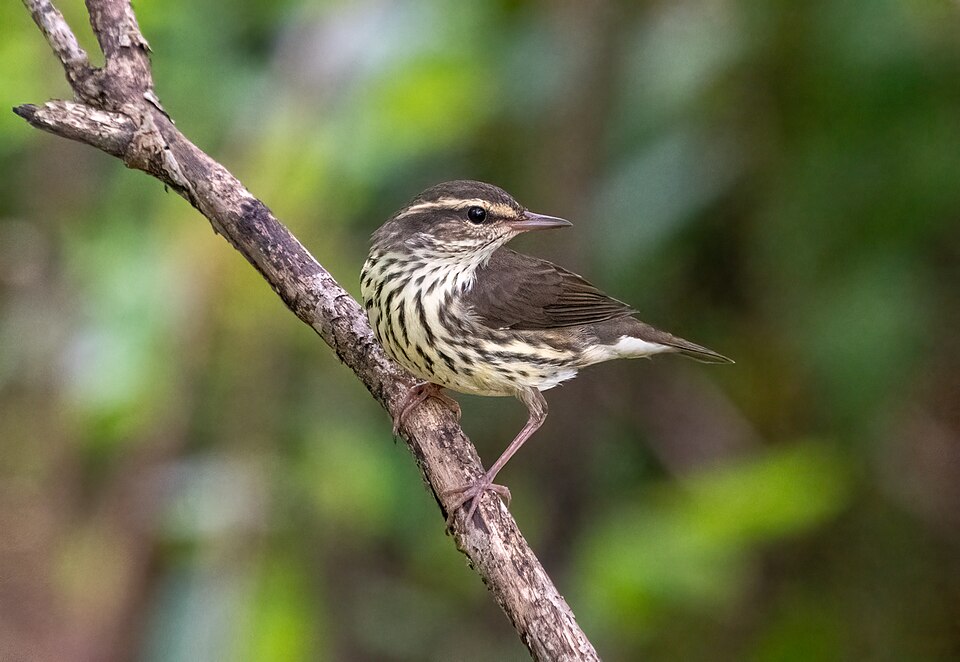
The Northern Waterthrush is a large, ground-walking New World warbler (family Parulidae) that breeds in cool, dark wooded swamps and willow-bordered rivers across northern North America. It is identified by its brown back, white supercilium, heavily streaked breast, and a distinctive teetering walk that distinguishes it from hopping warblers. Its loud, accelerating chirping song is often the first clue to its presence in dense cover.
Learn to identify
Full-grown Northern Waterthrush on its wintering grounds, photographed in Belize in February.
Learning lesson · openly licensed photographs, labelled by BirdBot; labels checked against the cited sources and approved by AI

Pale eyebrow: a bright pale stripe over the eye. Plain brown back: evenly dark brown above. Streaked throat: even the throat is finely streaked. Streaked underparts: heavy dark streaks on breast and flanks. Louisiana Waterthrush has a whiter, less-streaked throat and less yellow wash.
Underparts and eyebrow are usually tinged yellow, but some birds are whiter.
Sources: Audubon Guide to North American Birds: Northern Waterthrush · Wikipedia: Northern waterthrush (revision 1380698504)
Photo: Mike's Birds from Riverside, CA, US, CC BY-SA 2.0, via Wikimedia Commons; labels added by BirdBot.
The Northern Waterthrush is a large warbler, measuring 12–15 cm (4.7–5.9 in) in length with a wingspan of 21–24 cm (8.3–9.4 in) and a weight of 13–25 g (0.46–0.88 oz). Despite its name, it is not a thrush but a member of the wood-warbler family. The sexes are morphologically similar, though young birds have buff underparts rather than the white or yellowish underparts of adults.
The closest relative is the Louisiana Waterthrush (Parkesia motacilla). While both species walk rather than hop, the Louisiana Waterthrush has buff flanks, a buff undertail, and bright pink legs. It also has a whiter throat with fewer streaks, a smaller size and bill, and a narrower, darker eye-line. The call notes and habits also differ; the Northern Waterthrush is seldom aggressive toward other species but reacts strongly to the song of the Kirtland's Warbler.
Northern Waterthrushes are solitary before pair formation and form family groups after the young depart from the nest. They are annual migrants, traveling to the West Indies, Central, and South America. Migrations occur in loosely associated flocks that fly at night. The species is seldom aggressive toward other birds, with a notable exception: it reacts strongly to the song of the Kirtland's Warbler.
This bird is a terrestrial ground feeder that forages alone. It uses a variety of tactics, including twig gleaning, flycatching, hovering, chasing, and pecking. Its microhabitats for foraging include water, ground, foliage, and air. Before leaf emergence in spring, the bird typically spends about 75% of its time feeding in water, alternating between wading and walking along logs, branches, and the water's edge.
The Northern Waterthrush prefers cool, dark, wooded swamps, thickets of bogs, margins of northern lakes, and willow and alder-bordered rivers. During spring and fall migration, it can be found in thick cover along streams, in marshes, and by stagnant pools. On the wintering grounds in Puerto Rico, the species uses four main habitats: white mangrove, red mangrove, black mangrove, and scrub. Males, which are larger and migrate earlier, prefer white mangrove, while females winter in the drier, less food-rich habitats. During the non-breeding period, they are site-faithful and tend to be solitary.
Pair bonding begins immediately after the female arrives on the breeding site. Males perch in trees near water, vibrating their wings, raising their crown feathers, and singing, while females feed along the water's edge. The male selects the general area, but the female chooses the actual nest site.
The song consists of loud, emphatic, clear chirping notes that generally fall in pitch and accelerate. The notes are loosely paired or tripled, with little variation. The call is a loud, hard spwik rising with a strong K sound. The flight call is a buzzy, high, slightly rising zzip.
The Northern Waterthrush is listed as Least Concern (LC) in the AviList v2026 checklist. While habitat degradation and pesticides are cited as threats, populations have remained stable despite these pressures. Drainage of swamps for agriculture and wetland development may reduce breeding habitat, and aerial spraying for spruce budworm can affect the birds directly or reduce their prey biomass.
To find a Northern Waterthrush, listen for accelerating chirps near stream edges in dense cover. Look for a teetering, ground-walking warbler with a brown back and streaked breast. When observing, maintain a respectful distance to avoid disturbing nesting birds, especially during the breeding season. Focus on wetland habitats with willow and alder borders, and be patient, as the bird often remains hidden in thick vegetation.
Next Step: During spring migration, listen for accelerating chirps at dawn in willow-bordered swamps. This time-bound cue often reveals the bird before it disappears into the dense cover.


