
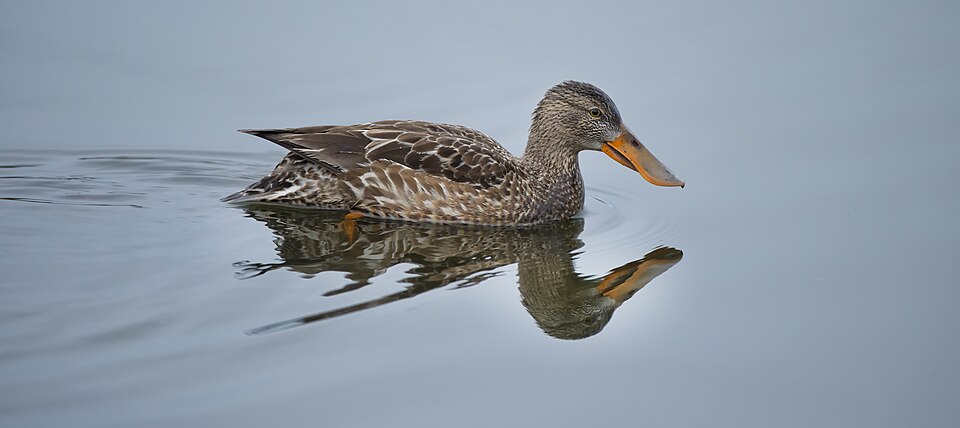
The Northern Shoveler (Spatula clypeata) is a common dabbling duck unmistakable in the Northern Hemisphere due to its large, spatulate bill. Males display iridescent green heads, white breasts, and chestnut flanks, while females are mottled brown. They feed by filtering water through comb-like lamellae on their bills to capture tiny aquatic invertebrates and plant matter.
Learn to identify
Adult male Northern Shoveler in breeding plumage, photographed in Switzerland; North American males look the same.
Learning lesson · openly licensed photographs, labelled by BirdBot; labels checked against the cited sources and approved by AI

Dark green head: can look black at a distance. Huge spoon-shaped bill: long, broad and blackish on the male. White breast: bright white in front of the sides. Chestnut sides: rusty belly and flanks. Mottled brown females are told from Mallards by the huge bill.
In summer eclipse plumage, males look like the brown female.
Sources: Audubon Guide to North American Birds: Northern Shoveler · Wikipedia: Northern shoveler (revision 1387344016)
Photo: JoachimKohler-HB, CC BY-SA 4.0, via Wikimedia Commons; labels added by BirdBot.
The most reliable field mark for the Northern Shoveler is its bill, which is twice as wide at the tip as at the base. This unique shape gives the bird its name and distinguishes it from all other North American ducks. While the plumage varies significantly between sexes and seasons, the bill remains consistent.
During the breeding season, the male is strikingly colorful. The head and neck are iridescent dark green, appearing black at a distance or in poor light. The breast is pure white, contrasting sharply with the bright chestnut belly and flanks. The bill is black or very dark grey. In flight, the pale blue forewing feathers are visible, separated from the green speculum by a white border. In early autumn, a white crescent appears on each side of the face. During the non-breeding eclipse plumage, the male resembles the female but retains the distinctive pale blue forewing.
The female is a dull, mottled brown, similar in pattern to a female Mallard. However, she is easily distinguished by her long, broad bill, which is grey tinged with orange on the cutting edge and lower mandible. Unlike the male, the female's forewing is grey, lacking the pale blue coloration.
Field Check: When in doubt, look for the pale blue forewing in flight. If the bird is in eclipse plumage and the forewing is grey, it is likely a female or a juvenile. The bill shape is the constant identifier across all plumages.
Northern Shovelers are birds of open wetlands, preferring shallow pools, marshes, and wet grasslands with some emergent vegetation. During the breeding season, they require dry areas nearby for nesting. In winter, they move to freshwater marshes, swamps, and flooded areas.
According to AviList v2026, the species breeds across the Holarctic region (excluding the Arctic) and winters through eastern Africa, southern, southeastern, and eastern Asia, the Philippines, the Caribbean, and Central America. In North America, they breed from the southern edge of Hudson Bay westward and as far south as the Great Lakes, Colorado, Nevada, and Oregon. They are strongly migratory, wintering further south than their breeding range.
Northern Shovelers are quiet birds that tolerate human presence and can be relatively tame. They typically stay in small groups of up to twenty, though they may form larger flocks during migration. Their feeding behavior is highly specialized. They draw water into their bills and pump it out through the sides, using long comb-like lamellae to filter out minute food particles. This diet consists mainly of tiny crustaceans, molluscs, insects, seeds, and plant matter. They also eat water beetles, small minnows, and snails.
Social feeding is common, with birds drawn to areas where other ducks are churning up food. Single birds may swim in tight circles to create whirlpools that bring food to the surface. They also dabble for longer periods than other surface feeders and can dive using their wings in shallow marshes.
Breeding usually occurs from April to June. The female builds a nest on dry land close to fresh water, forming a neat cup of grasses lined with down feathers. She lays between 9 and 11 olive-colored eggs, measuring approximately 52 x 37 mm. Incubation is handled solely by the female and lasts 23 to 25 days. The male loses interest soon after incubation begins. Ducklings are precocial, following the female immediately after hatching and becoming independent after 40 to 45 days.
The Northern Shoveler is listed as Least Concern (LC) in the IUCN Red List, as recorded in AviList v2026. In North America, the species is protected under the Migratory Bird Treaty Act. Among North American duck species, the Northern Shoveler is second only to the Mallard and Blue-winged Teal in overall abundance. Populations have been stable to increasing in recent decades, supported by favorable breeding, migratory, and wintering habitat conditions.
Look for Northern Shovelers in shallow, mud-bottomed marshes rich in invertebrates. Watch for the distinctive side-to-side bill swinging as they filter feed. Because they are quiet and tolerant of humans, you can observe them from a distance without disturbing their feeding. Avoid approaching nests during the breeding season to prevent abandonment. If using a camera, maintain a respectful distance to ensure the birds remain undisturbed.


