
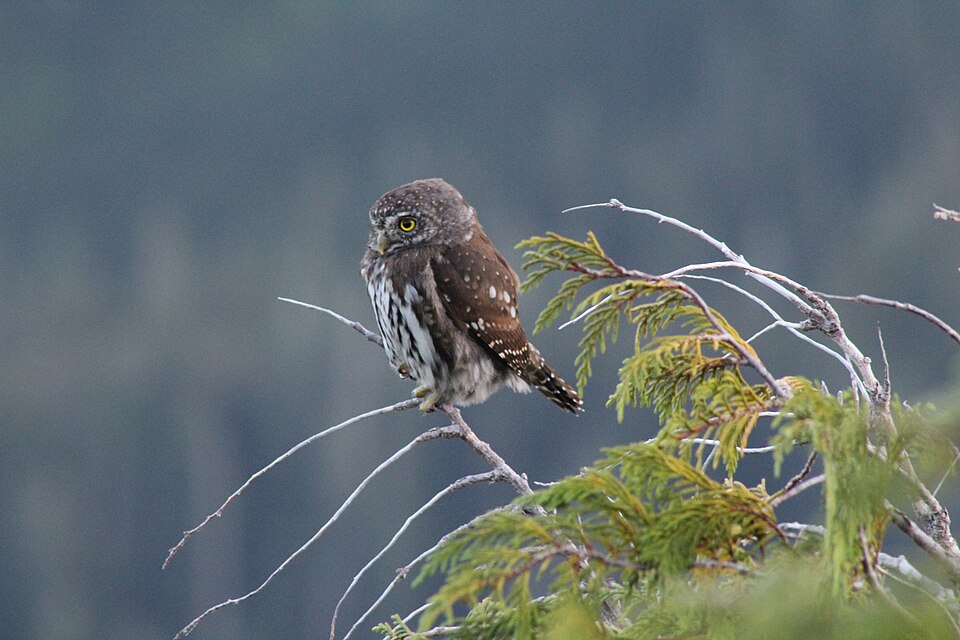
The Northern Pygmy Owl (Glaucidium gnoma) is a small, diurnal owl in the family Strigidae, recognized by its large yellow eyes, yellow hornbill, and distinctive black teardrop markings on the nape that resemble a second pair of eyes. It inhabits open coniferous, mixed, and deciduous forests across North America, hunting by day from high perches.
Learn to identify
Adult Northern Pygmy Owl perched on a cedar, photographed in southeast Alaska.
Learning lesson · openly licensed photographs, labelled by BirdBot; labels checked against the cited sources and approved by AI

White-spotted round head: round head with a weak facial disc. Yellow eyes: the bill is yellowish-green. Streaked white belly: sharp dark streaks below a dark upper breast. Long, pale-barred tail: long for an owl. Small owl, long tail, streaked belly.
From behind, two black nape spots look like eyes.
Sources: Audubon Guide to North American Birds: Northern Pygmy-Owl · Wikipedia: Northern pygmy owl (revision 1374586560)
Photo: Forest Service Alaska Region, USDA, Public domain, via Wikimedia Commons; labels added by BirdBot.
The most striking field mark of the Northern Pygmy Owl is the pair of black, teardrop-shaped markings on the back of its head, bordered by white. These markings resemble a second pair of eyes, a distinctive feature of the species. When the owl turns its head, these markings become visible, creating the illusion that the bird is looking in the opposite direction.
Other key identification features include:
Juveniles resemble adults but have fluffier, unspotted plumage and grayer heads. There is no seasonal variation in plumage.
Northern Pygmy Owls prefer open coniferous and mixed forests, avoiding dense, continuous stands. This preference likely relates to their hunting strategy, which involves diving from perches in open spaces. They also utilize open fields, wetlands, logged areas, and meadow edges for foraging.
Their range extends from northwestern Canada (southern Yukon) southward to southwestern United States (southern California), eastward to western Saskatchewan, and southward through the Rocky Mountains to Wyoming, Colorado, New Mexico, and adjacent Texas. In Mexico, they occur in the Sierra Madre Occidental and Oriental, extending to southeastern Mexico, Guatemala, and northern Nicaragua, as well as southern Baja California.
Historically, Leander S. Keyser's Birds of the Rockies (1902) noted the species as a rare resident in the mountains, breeding as high as 10,000 feet. While this provides dated background on its presence in the Rockies, current range data from AviList v2026 confirms its broad distribution across mature and old-growth forests.
Unlike most owls, the Northern Pygmy Owl is primarily diurnal, relying on vision rather than sound to capture prey. It is a "sit and wait" predator, perching in the highest branches of trees to scan for movement.
When attacking, the owl either dives directly at prey on the ground or zigzags from branch to branch before dropping onto its target with sharp claws. Despite its small size, it is bold and has been observed attacking prey or driving off predators several times its own size.
These owls are solitary and highly territorial. Females are particularly aggressive, sometimes engaging in aerial fights where they lock feet and fall to the ground. In contrast, courtship involves gentler behaviors, such as food-giving and snuggling. The owl's flight is notably noisy, with wings that whistle as it soars, a stark contrast to the silent flight of many other owl species.
When resting, the owl uses its nictitating membrane (clear-white eyelid) to cover its eyes, maintaining an alert appearance that may deter predators. When awake, it erects its tuft feathers to resemble twigs, elongating its body and pressing feathers close to enhance camouflage.
Note: Behavioral details in this section are based on historical natural history accounts and may lack recent primary validation.
The Northern Pygmy Owl is an opportunistic predator with a diet that includes both birds and mammals. Common prey items include:
After capturing a bird, the owl plucks it and may eat it entirely or extract only the brains.
Pairing and breeding occur from April to early June. The species relies heavily on old woodpecker cavities in coniferous trees for nesting sites, often in boreal or deciduous forests. The choice of habitat may be influenced by the presence of woodpeckers that create these cavities.
The call of the Northern Pygmy Owl is a key identification tool, especially since the bird is often hidden in the canopy.
The Northern Pygmy Owl is listed as Least Concern (LC) in the IUCN Red List, as recorded in AviList v2026. This status reflects its wide range across North America. The species is not currently targeted by shooting or trapping.
Note: This status is as recorded in the AviList v2026 checklist and is not a new conservation assessment or a local abundance estimate.
Observing Northern Pygmy Owls requires patience and an understanding of their behavior. Here is a practical field exercise:
By focusing on the call and the distinctive perch behavior, you can increase your chances of spotting this elusive and fascinating owl while minimizing stress to the bird.


