
The Northern Hawk-Owl (Surnia ulula) is a medium-sized, primarily diurnal owl in the family Strigidae. It is identified by its compact dark chocolate plumage with white spots, creamy white underparts crossed by cinnamon-brown bars, and a flight pattern characterized by rapid, strong, low dives between perches. It inhabits dense coniferous or mixed forests adjoining open areas, preferring mountainous ranges with available perches. Note: Natural history details in this guide are drawn from a single attributed account (Animal Diversity Web) and may be dated. Range data is supplemented by AviList v2026 to provide broader geographic context.
Learn to identify
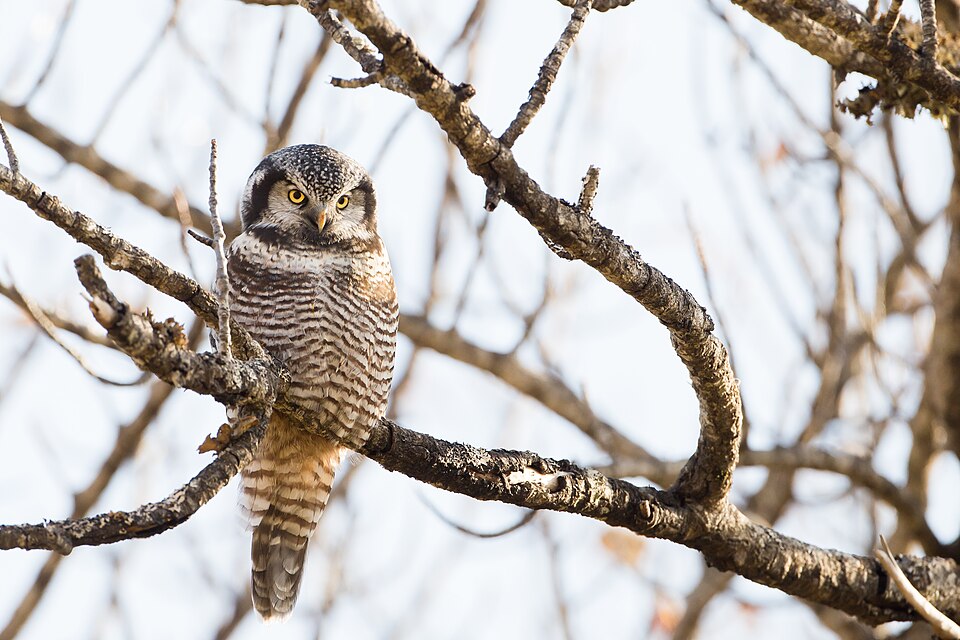
Adult Northern Hawk-Owl perched on a spruce top at Lista, Norway.
Learning lesson · openly licensed photographs, labelled by BirdBot; labels checked against the cited sources and approved by AI

Black-rimmed white face: a bold black border around a pale face. Heavily barred underparts: brown bars across white below. White-spotted upperparts: off-white spots on dark brown. Long, banded tail: brown bands on a long tail. Less upright than most owls, it looks and acts like a hawk.
Subspecies differ in tone and in how heavily they are barred.
Sources: Audubon Guide to North American Birds: Northern Hawk Owl · Wikipedia: Northern hawk-owl (revision 1380698456)
Photo: Marton Berntsen, CC BY-SA 4.0, via Wikimedia Commons; labels added by BirdBot.
The Northern Hawk-Owl possesses a compact plumage structure, distinct from the downy feathers of boreal owls. Its upperparts are dark chocolate in color, marked with white spots. The breast and belly are creamy white, crossed by horizontal cinnamon-brown bars. The facial disks are poorly developed but framed by distinct black lines. The species lacks true ear tufts, earning it the nickname "earless" owl, and features elliptical external ear openings. Both legs are fully feathered, a key field mark that helps distinguish it from other similar-sized owls.
This species primarily occupies dense coniferous or coniferous-deciduous forests that adjoin open areas. It shows a preference for mountainous ranges where open areas and perches are readily available. The abundance of prey dictates the specific location of its habitat, and the owl will not inhabit dark, impenetrable spruce-fir forests. According to AviList v2026, its range extends across forested tundra, taiga, and dense coniferous forests from Scandinavia eastward across Russia, northern Kazakhstan, and Mongolia to southeastern Russia and northernmost China. In North America, it ranges from Alaska and northwestern Canada eastward to southeastern Canada and far northeastern US, with seasonal irruptions in northern US and northern Europe.
Unlike many owls, the Northern Hawk-Owl is primarily diurnal, though it may also be active at night. It rarely walks on the ground; when it does, its motion is waddle-like. Its flight is rapid and strong. When moving from one perch to another, the owl quickly dives down, stays low, and then abruptly flies up to the new perch. This low-diving flight pattern is a critical field cue for identification. Males establish territories a few weeks before nesting and attract females to the nest site through Advertising Calls.
The Northern Hawk-Owl preys on small mammals, including voles, lemmings, mice, shrews, snowshoe hares, cottontails, moles, squirrels, and rats. During the summer, its diet consists primarily of rodents. In winter, it shifts to birds, such as ptarmigan and grouse. The extent to which it preys on birds remains unknown. It shares similar hunting habits with boreal owls and hunts both during the day and at night.
Northern Hawk-Owls are generally monogamous. Males attract females by clapping their wings while in flight and making Advertising Calls while perched. Females respond with their own Advertising Calls. Males court by bringing food to the nest and the females. The female lays the first egg, which immediately starts the incubation period, with an interval of approximately 1.6 days between eggs. The female incubates the eggs for 25-29 days. After hatching, the female broods the young for approximately 10 days, while the male provides food and protection against predators. Three to five weeks after hatching, the young leave the nest.
The Northern Hawk-Owl is listed as Least Concern (LC) in AviList v2026. This is a taxonomic and status record, not a new assessment or a local abundance estimate. Historical records note that the species has been shot down by some native groups for consumption, but this is a historical observation and not a current threat. Current legal protections vary by region and jurisdiction.
To observe a Northern Hawk-Owl ethically, maintain a significant distance to avoid disturbing its hunting or nesting activities. Use binoculars or a spotting scope to observe plumage details, such as the cinnamon-brown bars on the underparts and the black-framed facial disks. Avoid approaching nests or feeding sites, and respect local regulations regarding wildlife observation.
Observation Checklist:


