
The Northern Harrier (Circus hudsonius) is a medium-sized raptor in the family Accipitridae, easily recognized by a distinctive white rump patch visible in flight and an owl-like facial structure that aids in detecting prey by ear. It is found in wide-open grasslands, marshes, and fields, particularly during fall through spring, and is currently listed as Least Concern in the AviList v2026 taxonomy.
Learn to identify
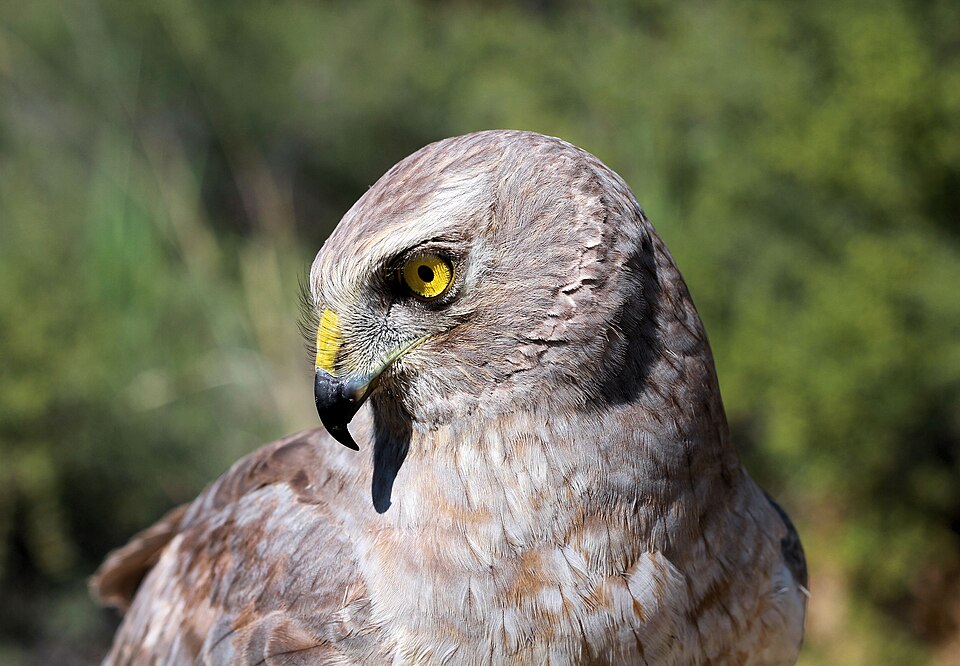
Adult male Northern Harrier perched on a fence post in Berkeley, California.
Learning lesson · openly licensed photographs, labelled by BirdBot; labels checked against the cited sources and approved by AI

Grey head: adult males are grey; females are brown. Grey upperparts: grey back and wings on adult males. Black wingtips: dark tips on the long, folded wings. Long tail: very long wings and tail for its size. In flight: white rump, low and slow, wings in a shallow V.
Females and juveniles are brown; juveniles are rusty-orange below.
Sources: Audubon Guide to North American Birds: Northern Harrier · Wikipedia: Northern harrier (revision 1383345339)
Photo: Becky Matsubara from El Sobrante, California, CC BY 2.0, via Wikimedia Commons; labels added by BirdBot.
Identifying a Northern Harrier in the field relies on a combination of structural features and plumage patterns. The most reliable field cue is the white rump patch, which is present in both males and females and becomes highly visible when the bird is in flight or stretching its wings. This patch contrasts sharply with the darker upperparts, making it a critical diagnostic feature for distinguishing harriers from other raptors like kites or hawks.
Another distinctive feature is the owl-like face. Unlike most raptors, Northern Harriers possess a facial disk that helps them detect prey by ear. This adaptation allows them to locate small mammals moving through vegetation or under snow, even when visual cues are limited. While the specific anatomical mechanisms of this hearing are complex, the functional result is a raptor that hunts with a keen reliance on auditory input, a trait that sets it apart from visually dominant hawks.
Plumage varies by sex and age. Historically described in Reed's 1916 field guide, adult males are blue-gray above with whitish underparts streaked and barred with rusty tones. Females and juveniles are generally brownish-black above with rusty underparts and dusky streaking on the breast and sides. The upper tail coverts and the base of the tail are white, further aiding identification in flight.
As the name suggests, the Northern Harrier is strongly associated with open, wet, or grassy environments. It is most commonly found in wide-open grasslands, marshes, or fields. These habitats provide the low-lying cover necessary for its hunting strategy, which involves flying at low elevations to spot and dash down upon prey.
According to AviList v2026, the species breeds in North America and winters in northern South America. Historically, early 20th-century accounts noted its presence in boggy marshes frequented by bitterns and its range extending from the southern United States to Hudson Bay. While these historical records provide context for its broad distribution, current range statements should be verified against up-to-date geographic data, as habitat changes can influence local presence.
Northern Harriers exhibit unique behavioral traits, particularly during the breeding season. Both males and females participate in courtship displays that involve a fast series of kek notes lasting one to two seconds. These vocalizations are a key component of their social interactions and pair bonding.
Their flight is often described as quiet and owl-like, especially when they are feeding at low elevations. This silent, gliding flight allows them to approach prey without detection.
During the breeding season, Northern Harriers consume a diet of small mammals, reptiles, amphibians, and birds. This varied diet reflects their adaptability to different prey types available in their open habitats. Historically, meadow mice and moles were noted as primary food sources, but the current understanding includes a broader range of small vertebrates.
Nesting occurs on the ground. Reed (1916) noted that the nest is composed of grasses and contains four plain bluish-white eggs, with nesting typically occurring in May and June. The ground-nesting behavior makes the species vulnerable to disturbances, emphasizing the importance of ethical observation practices.
The Northern Harrier is currently categorized as Least Concern (LC) in the AviList v2026 checklist. It is important to note that this category is a global assessment and does not necessarily indicate local abundance or security in every region.
Observing Northern Harriers requires patience and respect for their habitat. The best time to look for them is during fall through spring, when they are most active in open grasslands, marshes, and fields. To observe them ethically:
By following these guidelines, you can enjoy observing this fascinating raptor while minimizing your impact on its environment.


