

The Northern Bobwhite (Colinus virginianus) is a small, ground-dwelling quail in the family Odontophoridae, recognized by its mottled reddish-brown plumage, rounded wings, and square tail. Males display white facial stripes and a white throat, while females have buff faces and yellow beak bases. They inhabit early successional vegetation in forests and rangelands, relying on diverse invertebrates, seeds, and protective cover.
Learn to identify
Male Northern Bobwhite, photographed at Falcon Lake State Park, Texas.
Learning lesson · openly licensed photographs, labelled by BirdBot; labels checked against the cited sources and approved by AI
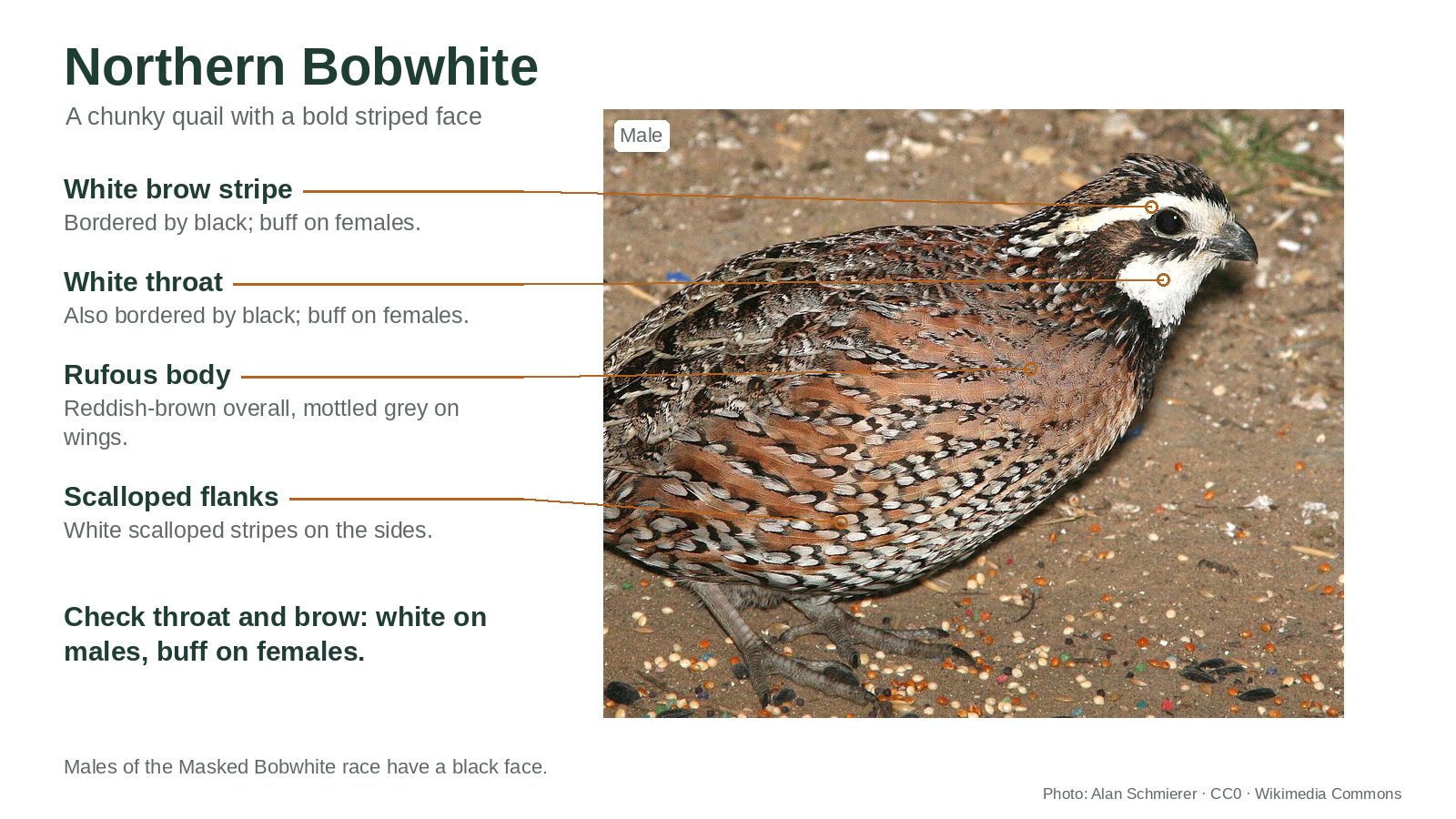
White brow stripe: bordered by black; buff on females. White throat: also bordered by black; buff on females. Rufous body: reddish-brown overall, mottled grey on wings. Scalloped flanks: white scalloped stripes on the sides. Check throat and brow: white on males, buff on females.
Males of the Masked Bobwhite race have a black face.
Sources: Audubon Guide to North American Birds: Northern Bobwhite · Wikipedia: Northern bobwhite (revision 1375249002)
Photo: Alan Schmierer, CC0, via Wikimedia Commons; labels added by BirdBot.
Northern Bobwhites are small galliform birds, weighing between 140 and 170 grams and measuring 20.3 to 24.7 cm in length. Their compact bodies feature rounded wings and a distinct square tail, adaptations that support their ground-dwelling lifestyle. The plumage is sexually dimorphic, offering clear field cues for distinguishing adults:
Both sexes exhibit a mottled appearance on the back and breast, created by white edges, dark bars, and vermiculations on a reddish-brown background. This cryptic coloration helps them blend into the grassy and brushy habitats they occupy. Note that the current sources do not provide detailed descriptions of seasonal plumage changes or specific juvenile field marks beyond the general buff coloration shared with females.
According to AviList v2026, the Northern Bobwhite is native to the eastern USA to western Guatemala and has been introduced to much of western North America, the Bahamas, Hispaniola, Italy, Croatia, Slovenia, and southern Japan. In their native range, they show a clear preference for early successional vegetation in forest habitats, often created by disturbances such as fire, agriculture, or timber harvesting. In rangeland habitats, they utilize both early and later successional vegetation.
Essential habitat components include a diversity of invertebrates, seeds, and herbaceous plants. Protective cover is critical for nesting and weather protection. Notably, water sources are not typically a limiting factor in habitat selection, as bobwhites can obtain ample moisture from dew.
Northern Bobwhites are diurnal and spend most of their time on the ground, though they are capable of short flights averaging 5.1 seconds. Feeding activity peaks in the early morning and late afternoon. Their social structure is dynamic:
The Northern Bobwhite is an omnivore with a diet that shifts seasonally. Approximately 85% of their diet consists of vegetation, while 15% is animal matter, though these proportions vary by season.
Northern Bobwhites exhibit ambisexual polygamy, meaning both males and females may incubate and raise broods with more than one mate during the breeding season. Courtship can begin as early as February in southern Texas, with intensive nesting from May to August.
The famous "bob-white" call is actually a minor part of the species' vocal repertoire. Their entire vocal array is classified into specific categories:
Nonvocal interactions are also diverse, with dominant birds often engaging in head-shaking, head-scratching, and preening.
The Northern Bobwhite is listed as Near Threatened (NT) in the IUCN Red List, as recorded in AviList v2026. Populations are declining, primarily due to habitat loss associated with large-scale farming and the reduction of fence rows and suitable habitat plots. One subspecies, the masked bobwhite (Colinus virginianus ridgwayi), is considered endangered. While habitat management is critical for the species' survival, specific current conservation strategies and management efforts are not detailed in the provided sources.
To observe Northern Bobwhites ethically, approach their habitat with patience and minimal disturbance. Look for ground-dwelling birds in open, early successional habitats during early morning or late afternoon when feeding is most active. Listen for the diverse calls that indicate group movement or food-finding. Maintain a safe distance to avoid stressing the birds, especially during the breeding season when nests are on the ground and vulnerable to disturbance. If you spot a covey, note the social dynamics and the mottled plumage that helps them blend into the grasses and brush.
Next Action: On a cool morning, visit a field edge with early successional brush and listen for the distinctive "bob-white" call or the low, clear whistles of a covey moving through the grass. Focus on the ground layer where they forage for insects and seeds.


