
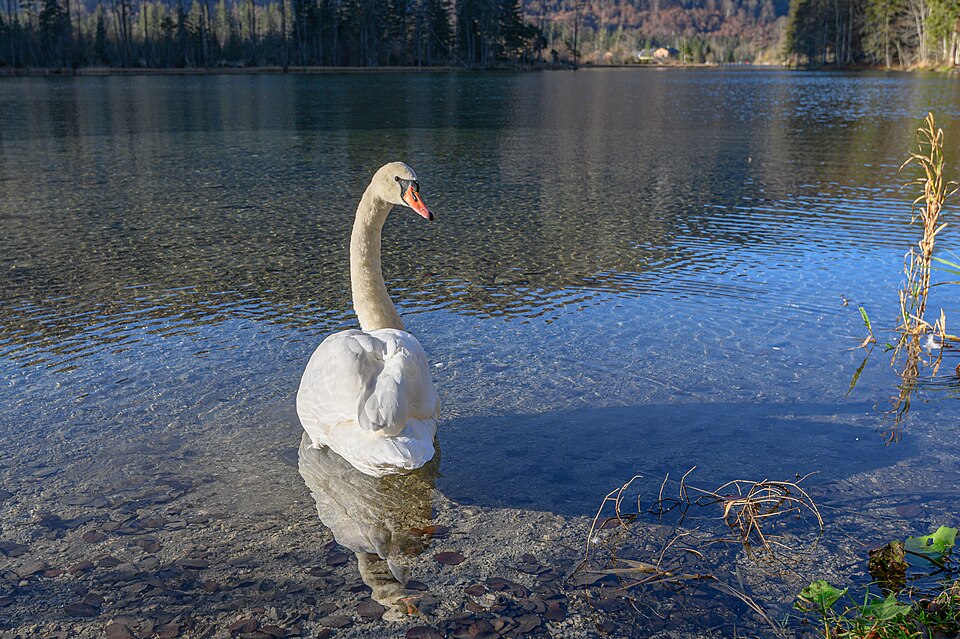
The Mute Swan (Cygnus olor) is a large, white waterfowl. Its primary field marks are the orange bill with a black knob at the base and a black tip, and its swimming posture, which features a curved neck and a downward-pointing bill. It is classified as Least Concern globally but can be aggressive near nests.
Learn to identify
Pair of adult Mute Swans swimming at Priwall, northern Germany.
Learning lesson · openly licensed photographs, labelled by BirdBot; labels checked against the cited sources and approved by AI

Black knob: raised knob at the bill base; larger in males. Orange bill: bright orange, edged in black, with a black nail. S-curved neck: often held in a graceful curve when swimming. All-white plumage: a very large, wholly white swan. An orange bill with a black knob means Mute Swan.
Young birds are duller, may be brownish-gray, and have a gray bill.
Sources: Audubon Guide to North American Birds: Mute Swan · Wikipedia: Mute swan (revision 1383130791)
Photo: Frei Photo, CC BY-SA 4.0, via Wikimedia Commons; labels added by BirdBot.
While the orange bill with a black knob is the primary field mark, a subtle but useful cue is the plumage. The head and neck may appear stained brown if the bird has been in water or mud containing iron. This discoloration is distinct from the uniformly white plumage of other swans and can help confirm identification in the field.
Native to the Palearctic region from central Europe to southeastern China, the Mute Swan is partially migratory, moving southward in winter. It has been introduced widely to western and southwestern Europe, Japan, southwestern Australia, and eastern North America. In its native range, it occupies well-sheltered bays, open marshes, lakes, and ponds. During winter, it shifts to marine waters, where gatherings of more than 100 individuals can occur in open salt water.
Mute Swans are territorial, establishing large home ranges of 4 to 10 acres that can encompass an entire small lake or pond. They do not undergo mass migration but may gather in large numbers in coastal areas during the colder months. In flight, they reach top speeds of 50 to 55 mph. Their visual displays are a significant part of communication; for example, males may arch their secondary wing feathers over their back in an aggressive posture.
Note: Behavioral metrics such as flight speed and territory size are historical estimates drawn from the Animal Diversity Web account, which cites sources from the 1960s–1990s. These figures may not reflect current ecological studies.
The Mute Swan is primarily herbivorous, feeding on aquatic vegetation. It also consumes small proportions of aquatic insects, fish, and frogs. Unlike diving ducks, Mute Swans do not dive; instead, they plunge their heads and long necks below the water's surface to feed. They typically feed in deeper waters than ducks and other waterfowl, reducing direct competition. However, their feeding activity can make food more available to other birds by bringing parts of aquatic plants to the surface.
Pair bonds are not necessarily lifelong, though established pairs are more successful breeders. Nesting begins in March or early April. The nest is a large mound of aquatic vegetation lined with feathers and down, built well above the normal water level in swampy areas near ponds or lakes. Clutches typically contain 5 to 7 eggs, though up to 12 have been recorded. Incubation lasts 36 to 38 days, with the female doing most of the sitting while the male stands guard. Chicks are precocial, leaving the nest after one day, and can fly in about 60 days. They remain with their parents until the following breeding season, when they are driven away to join non-breeding flocks.
Despite the name "Mute" Swan, the species is not silent. Adults produce snorts, hisses, puppy-like barks, and whistles. These sounds are not far-reaching due to the bird's straight trachea. However, the sound of their wings during flight is very audible, described as a musical throbbing or humming. Visual displays, such as posturing, are also a primary form of communication.
According to AviList v2026, the Mute Swan is classified as Least Concern (LC) globally. In North America, where it is an introduced species, its expansion has raised concerns for native wildlife. The Animal Diversity Web account notes that Common Loons and recently re-introduced Trumpeter Swans are species of primary concern in areas where Mute Swans are established, as the latter are aggressive and have been known to drive off similarly sized species at nest sites.
Observing Mute Swans requires caution, especially during the breeding season. Nests are strongly defended, and swans have been known to attack other waterfowl and even people. Blows from their powerful wings can be painful and potentially dangerous to children. Always maintain a safe distance, use binoculars or a telephoto lens, and never approach a nesting pair. If you observe a swan displaying aggressive posturing, such as arching its wings, back away slowly and quietly.


