
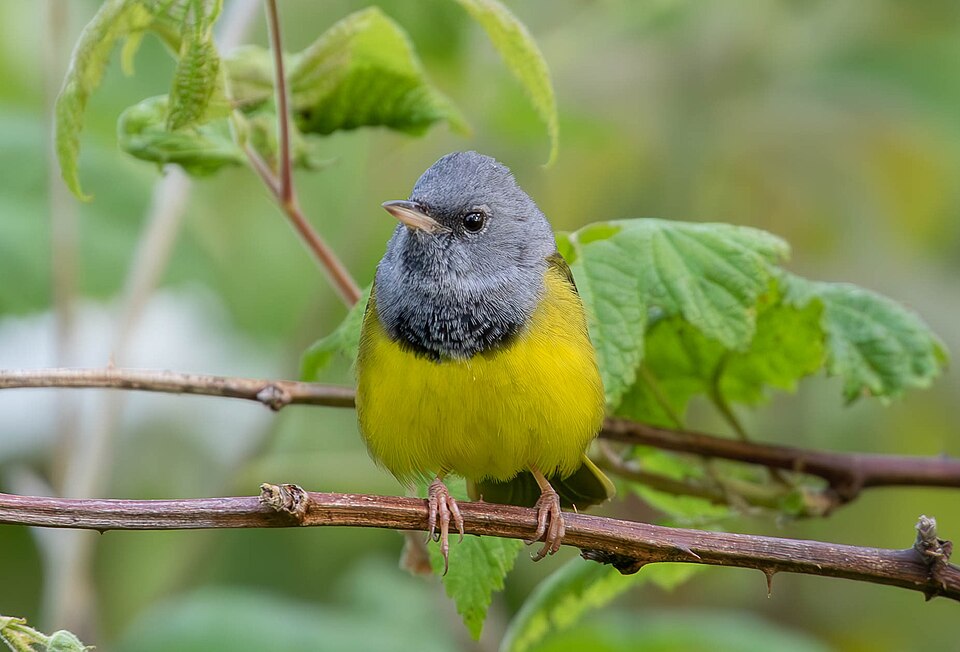
The Mourning Warbler (Geothlypis philadelphia) is a small New World warbler identified by its gray head, black breast, and bright yellow underparts in adult males. It breeds in brushy woodland edges and dense second growth, where it builds a bulky nest low to the ground. The species is best detected by its loud, ringing territorial song, which is often heard before the bird is seen.
Learn to identify
Adult male Mourning Warbler perched on a twig, front view.
Learning lesson · openly licensed photographs, labelled by BirdBot; labels checked against the cited sources and approved by AI

Grey hood: grey head and neck; no broken eye-ring. Black "veil" on throat: a black patch on the throat and upper breast. Yellow underparts: evenly yellow below; olive above. Pink legs: pale pinkish legs and feet. Grey hood and black bib, without a broken eye-ring.
Females are paler and may show a narrow eye-ring.
Sources: Wikipedia: Mourning warbler (revision 1380697403) · Audubon Guide to North American Birds: Mourning Warbler
Photo: kirk gardner, CC BY 4.0, via Wikimedia Commons; labels added by BirdBot.
Adult males in spring and summer display a distinct pattern: a gray head and neck that darken to grayish-black on the crown, hindneck, chin, and throat, paired with a solid black chest. Their underparts are bright yellow, transitioning to olive-green on the sides and flanks. The upperparts are olive-green with white edging. Females resemble males but lack the black on the chin, throat, and chest; instead, they have a light gray or brownish-white throat and duller yellow underparts. In fall and winter, male plumage changes slightly, with gray-tipped feathers on the throat and chest and a broken black patch on the breast, along with a white-broken eye ring.
A key field cue for separating this species from the similar Connecticut Warbler is the absence of a white eye ring and the presence of a black breast patch in males. As noted in historical field guides, the Mourning Warbler is "similar to the last [Connecticut Warbler], but with no eye ring and with a black patch on the breast" (Reed, 1919). Blanchan (1923) further describes the male's breast feathers as having black edges that make them look "crinkled, like crape," with markings converging into a spot on the upper breast.
Only males sing, producing two distinct vocalizations. The territorial song is loud, ringing, and throaty, often paraphrased as whee-o whee-o whee-o, whoo-e whoo-e. The flight song is rapid, starting with chipping notes, followed by a quick version of the territorial song, and ending with more chipping notes. Adults of both sexes emit call notes: a loud, harsh tshrip when disturbed or migrating, and a higher-pitched, less harsh tsip when approaching nests or during territorial encounters between females.
Historical accounts offer complementary descriptions of this vocalization. Blanchan (1923) notes that the bird brings back in October "the loud, clear, rapid whistle with which it has entertained its nesting mate in the Canada woods through the summer," describing the song as resembling the syllables "true, true, true, tru, too." Reed (1919) characterizes the song as "similar to the liquid song of the Water-Thrush" and the call as a sharp "peenk."
Mourning Warblers breed in southeastern Canada and northeastern USA, specifically in brushy woodland clearings, forest edges, and dense second growth. They favor edge conditions such as roads, logging trails, and clearings, often in vegetation types like pine, maple-basswood, or aspen. During winter, they inhabit lowland edge areas in Nicaragua to northwestern South America, typically in dense brush or tall grass at elevations from sea level to about 152 meters, though they can be found as high as 1,219 meters.
These diurnal, migratory birds are territorial during the breeding season. Males defend territories of 1.6 to 2.4 acres using aggressive displays, including rapid wing-flipping, tail-opening, and chasing. Both sexes participate in parental care; the female incubates the eggs (usually 4, with a range of 2 to 5) for about 12 days, while the male feeds her. After hatching, the female broods the nestlings for 8 to 9 days, and the male brings food. Adults use distraction displays, such as mimicking a mouse or feigning a broken wing, to protect their offspring from predators.
Mourning Warblers are insectivores, feeding on spiders, beetles, and insects found on the ground or in low vegetation. Nestlings are primarily fed Lepidoptera larvae and other small insects.
The Mourning Warbler is classified as Least Concern (LC) in the AviList v2026 checklist. Population trends and specific causes of any decline remain uncertain according to available natural history accounts.
Listen for the male's loud, ringing territorial song in brushy woodland edges during the breeding season (late April to early July). Look for rapid wing-flipping displays or the bird foraging on or near the ground in dense undergrowth. To observe ethically, maintain a respectful distance, avoid disturbing the nest site, and use binoculars or a spotting scope to minimize impact on the bird's behavior.
Both have gray heads and yellow underparts, but the Mourning Warbler has a black breast (in males) and lacks the white eye ring found in Connecticut Warblers. The Mourning Warbler's song is also more ringing and throaty.
The best time is during the breeding season, from late April to early July, when males are singing and displaying in their territories. They are also present during spring and fall migrations.
They build bulky nests on or near the ground, usually 15 to 50 cm off the ground, in dense herbaceous or shrubby vegetation near edge areas.
They winter in lowland edge areas in Nicaragua to northwestern South America, typically in dense brush or tall grass.


