
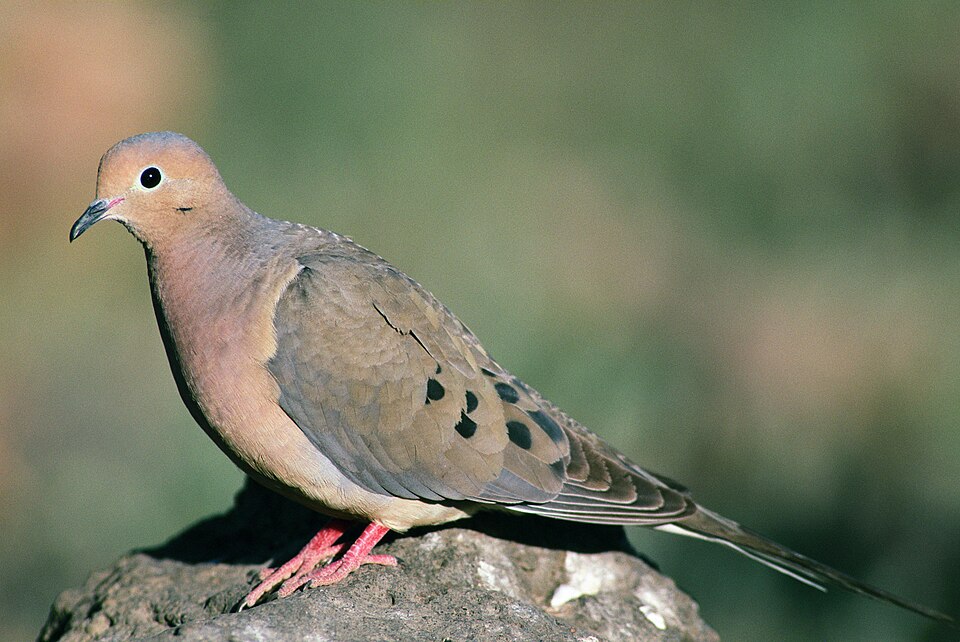
The Mourning Dove (Zenaida macroura) is a medium-sized, streamlined dove native to North America, ranging from southern Canada to western Panama. It is identified by its grayish-brown plumage, black spots on the wings, a long pointed tail with white tips, and a distinctive mournful cooing call. Highly adaptable, it thrives in open woodlands, agricultural fields, and suburban areas, where it feeds primarily on seeds and grains.
Learn to identify
Adult Mourning Dove perched on a rock (U.S. Fish and Wildlife Service photo).
Learning lesson · openly licensed photographs, labelled by BirdBot; labels checked against the cited sources and approved by AI
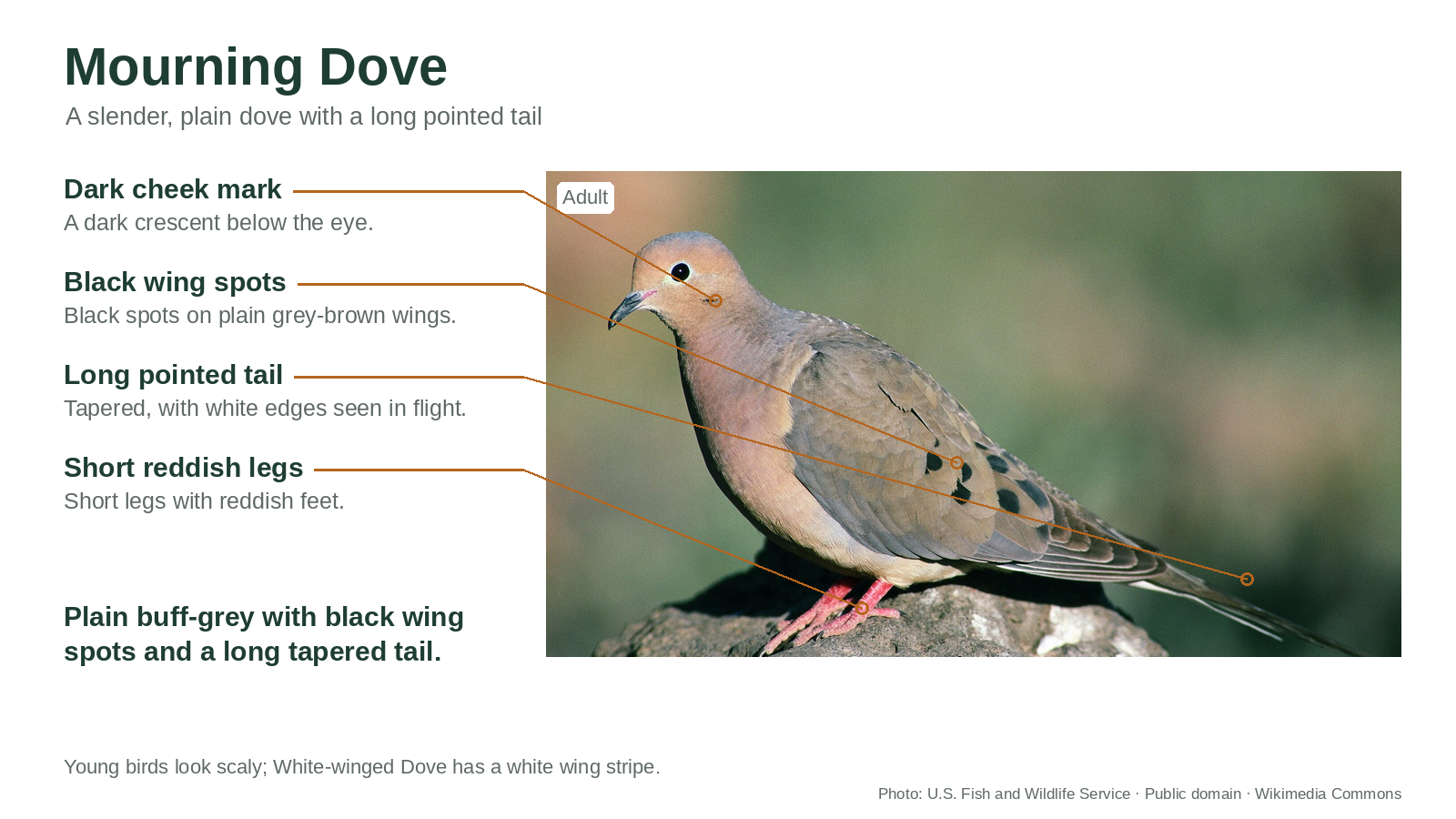
Dark cheek mark: a dark crescent below the eye. Black wing spots: black spots on plain grey-brown wings. Long pointed tail: tapered, with white edges seen in flight. Short reddish legs: short legs with reddish feet. Plain buff-grey with black wing spots and a long tapered tail.
Young birds look scaly; White-winged Dove has a white wing stripe.
Sources: Audubon Guide to North American Birds: Mourning Dove · Wikipedia: Mourning dove (revision 1383980500)
Photo: U.S. Fish and Wildlife Service, Public domain, via Wikimedia Commons; labels added by BirdBot.
The Mourning Dove’s most reliable field mark is its long, pointed tail, a shape unique among North American doves. This streamlined silhouette, combined with a relatively small head, distinguishes it from bulkier pigeons. The plumage is grayish-blue to grayish-brown on the back, accented by distinct black spots on the wings and behind the eyes. White tips on the tail feathers create a sharp contrast when the bird spreads its wings in flight. The bill is small and black, and the legs and feet are red.
Males are generally larger than females and exhibit slightly brighter coloration, featuring a bluish crown and a rosy breast. Females are more uniformly grayish-brown. Both sexes share the characteristic black wing spots and white tail tips.
The most common confusion is with the Rock Pigeon. The Mourning Dove is smaller and more slender than the Rock Pigeon, with a noticeably longer, pointed tail. This difference in build and tail shape provides a reliable field cue for quick identification in urban and suburban settings.
Mourning Doves are native to the Nearctic region, living from southern Canada throughout the United States and south to Panama. They are found year-round throughout most of their range, though northern populations migrate south during the winter. These birds are highly adaptable and occupy a wide variety of habitats, including open woodlands, forest edges near grasslands, agricultural areas, and suburban neighborhoods. They are most abundant in areas where humans have created large expanses of suitable open habitat with scattered trees for perching and nesting.
Mourning Doves are primarily granivores, with a diet consisting of approximately 95% seeds and plant parts. They prefer seeds that rest on the ground, walking along the surface to peck at food items. Their diet includes agricultural crops such as corn, millet, rye, barley, and oats, as well as wild seeds and waste grain. Occasionally, they consume fruit and insects, such as grasshoppers, ants, beetles, and snails, particularly when ground foods are scarce. They may also feed in trees and bushes during periods of low ground-level food availability.
Mourning Doves are monogamous, with some pairs maintaining their bond through the winter. They are swift and direct in flight, capable of evasive maneuvers to escape predators. The male’s courtship song is a simple, mournful call often described as “coo oo, OO, OO, OO,” which can be heard throughout the warm months. In flight, they produce whistling noises and sharp wing-flapping sounds, the purpose of which is not fully understood. Mourning doves also use a variety of body displays to scare away intruders, threaten invading males, and attract potential mates.
Mourning Doves are monogamous, with some pairs remaining together through the winter. Males perform courtship displays on a perch, driving away other males. After mating, the pair builds a simple, open nest, a process that takes over ten hours and spans three to four days. Females typically lay two small, white eggs. Both parents share in incubation, which lasts 14 to 15 days. The young are altricial and are fed regurgitated crop milk for the first 3 to 4 days, followed by regurgitated seeds. Female mourning doves feed the young most during the first 15 days after hatching but after that males take over the responsibility for feeding the young. Young leave the nest about 15 days after hatching but remain nearby until they are more accomplished at flying, usually around 30 days old. They can breed by 85 days of age. Mourning Doves have the longest breeding season of any North American bird, with breeding occurring from February through October.
Mourning Doves are widespread and abundant across their range. According to the IUCN Red List, they are classified as Least Concern (LC). They are not currently threatened. The species is highly adaptable and maintains a large presence in both wild and human-modified landscapes.
The most effective way to find Mourning Doves is to look for them on telephone wires and similar perches throughout your neighborhood. These birds are highly adaptable to suburban and urban environments, often perching in the open where they can survey their surroundings. From these vantage points, they frequently drop to the ground to feed on seeds and grains. In spring, focus on the edges of agricultural fields and open woodlands where males are actively cooing and pairs are building nests. When observing, maintain a respectful distance to avoid disturbing nesting pairs or foraging flocks. Focus on their natural behaviors, such as ground foraging and their swift, direct flight patterns, to gain a deeper understanding of the species.


