
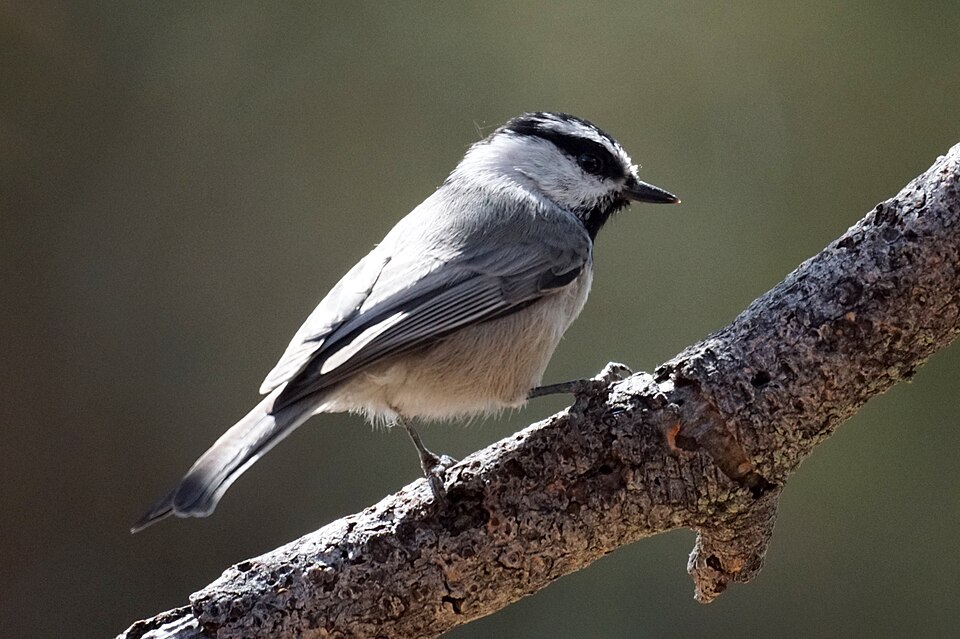
The Mountain Chickadee (Poecile gambeli) is a small, acrobatic passerine found in montane coniferous and mixed forests across western North America. It is distinguished from other chickadees by its prominent white eyebrow and pale gray sides, and it breeds at elevations of three kilometers or higher, moving to lower elevations in winter.
Learn to identify
Adult Mountain Chickadee perched on a garden hose fitting.
Learning lesson · openly licensed photographs, labelled by BirdBot; labels checked against the cited sources and approved by AI

Black cap: joins a black stripe behind the eye. White eyebrow: breaks the black cap; can be narrow when worn. Black bib: below a white cheek. Other North American chickadees have a solid black cap.
Summer birds in worn plumage may show only a faint eyebrow.
Sources: Audubon Guide to North American Birds: Mountain Chickadee · Wikipedia: Mountain chickadee (revision 1354822739)
Photo: Mike's Birds from Riverside, CA, US, CC BY-SA 2.0, via Wikimedia Commons; labels added by BirdBot.
At approximately 13 centimeters in length, the Mountain Chickadee has a short, round body with a large head and a short, stout bill. Males and females are visually identical. The key field marks are the black crown and throat, white cheeks, and a distinctive white eyebrow. This white eyebrow, along with its pale gray sides, distinguishes the species from other chickadees. Rocky Mountain forms have buff on the back, sides, and flanks, and possess broader white eyebrows.
These birds are well-adapted to cold environments. In the field, look for the contrast between the dark head and the pale, grayish-white underparts.
According to AviList v2026, the Mountain Chickadee inhabits montane coniferous and mixed forests from southern Yukon and southwestern Alberta south to far northern Baja California and east to western Montana and eastern New Mexico, with an isolated population in western Texas. During the nesting season, they reside at elevations of three kilometers or more. In fall and winter, they migrate to lower elevations, sometimes wandering into adjacent lowland states.
Keyser (1902) noted the species as an "abundant resident" in the Rocky Mountains, nesting from 8,000 feet to the timber-line. In a 1902 account of a journey from Georgetown to the timber-line, Keyser recorded the bird as a "steady" companion found in the gorge above Graymont and thereafter up to the timber-line.
Mountain Chickadees are highly agile and acrobatic, often foraging upside down or at awkward angles on tree branches. They spend nearly all daylight hours feeding, using their sharp beaks to extract insects and open seeds. They are social birds, frequently seen flitting through flocks while chattering with mates. Their flight is quick and darting, allowing them to change direction in mid-air to avoid predators.
Wikipedia notes that juvenile birds often leave adult groups for summer foraging but return to flock with older birds in the winter. In mixed flocks, black-capped chickadees have been indicated to become dominant over mountain chickadees. Individuals in urban areas appear to habituate quickly to novel stimuli, potentially allowing the species to successfully nest in human-dominated environments.
Their diet is omnivorous, consisting of roughly 70% insects and 30% plant material. Insect prey includes caterpillars, beetles, ants, and spiders. Plant foods include seeds and wild berries, with a particular preference for bayberries and poison ivy berries. They are regular visitors to feeding stations, especially when raising young, and favor sunflower seeds and suet.
These specific dietary proportions are drawn from Harrison (1983) as cited in the Animal Diversity Web account; more recent ecological studies may provide updated estimates of seasonal diet composition.
Mountain Chickadees are cavity nesters, using natural holes, abandoned woodpecker cavities, or birdhouses. Pairs may dig their own cavities in rotted stumps, a process that takes about a week to ten days. The female lines the nest with fur, feathers, or moss. Breeding occurs from April to July, with the female laying 6 to 12 eggs (averaging 8-9) and incubating them for 14 days. Both parents feed the young, which fledge after about 20 days.
The contact call is a descending whistle, often described as "fee-bee-bay" or "fee-bee-fee-bee." The song is a minor whistle, typically composed of four distinct notes.
In a historical account from 1902, Leander S. Keyser described the song as an "affecting little minor whistle," usually composed of four distinct notes, with the chief emphasis on the second syllable, which is considerably prolonged. He noted it was quite different from that of the black-capped chickadee both in intonation and technical arrangement.
The Mountain Chickadee is listed as Least Concern (LC) in the AviList v2026 checklist. While the species is generally stable, the destruction of standing deadwood can limit the availability of nesting cavities. Maintaining mature forests with snags is important for supporting this and other cavity-nesting species.
To observe Mountain Chickadees ethically in their alpine and subalpine habitats, stay on established trails to avoid disturbing nesting sites in snags and rotted stumps. Look for their acrobatic foraging on the underside of branches. A useful field exercise is to listen for the descending "fee-bee" call and watch for the white eyebrow against the dark head. If you have a birdhouse, Harrison (1983) suggests a height of typically 2 to 5 meters to match their preferred nesting range, though local conditions may vary.
Winter is an excellent time to observe them at lower elevations, as they migrate down from their high-elevation nesting grounds during the colder months.


