
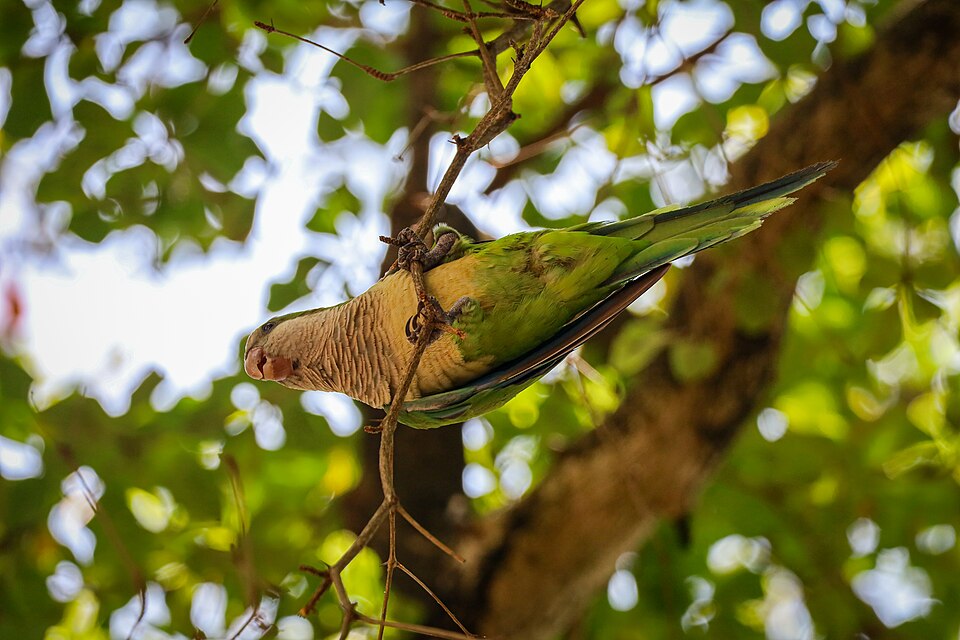
The Monk Parakeet (Myiopsitta monachus), also known as the Quaker Parrot, is a medium-sized, bright-green parrot with a pale grey, scalloped breast and a long, tapered tail. It is distinguished from other parrots by its habit of building large, communal stick nests in trees or man-made structures, rather than using tree cavities. Native to South America, it is also established in feral populations in North America and Europe.
Learn to identify
Wild Monk Parakeet in its native range, photographed at Costanera Sur Nature Reserve, Buenos Aires, Argentina; introduced colonies in North America look the same.
Learning lesson · openly licensed photographs, labelled by BirdBot; labels checked against the cited sources and approved by AI

Gray face and breast: pale gray forehead, throat and chest, scalloped darker. Green upperparts: bright green back and wings. Blue flight feathers: blue in the outer wing, most obvious in flight. Long, pointed tail: long and tapering. Unlike most parrots, it builds bulky stick nests in trees and on structures.
Escaped pets may be blue, yellow or white instead of green.
Sources: Audubon Guide to North American Birds: Monk Parakeet · Wikipedia: Monk parakeet (revision 1387402998)
Photo: dfaulder, CC BY 2.0, via Wikimedia Commons; labels added by BirdBot.
Monk Parakeets are visually distinct among parrots due to their specific plumage patterns and body shape. They are medium-sized birds, with the nominate subspecies averaging 29 cm (11 in) in length and a wingspan of 48 cm (19 in). Weight typically ranges from 95 to 120 g (3.4 to 4.2 oz).
Sexual dimorphism is extremely subtle. Females tend to be 5–10% smaller than males, but this difference is not reliably visible in the field. Reliable sexing requires DNA or feather testing. Males and females share the same plumage, making visual identification of sex impossible without laboratory analysis.
The most distinctive behavior of the Monk Parakeet is its nesting strategy. Unlike most parrots, which rely on existing tree cavities, Monk Parakeets construct large, external nests from sticks, twigs, and other materials. This makes them one of the few parrot species (along with the cliff parakeet and some African lovebirds) that build their own nests.
These nests are often communal, with multiple pairs occupying a single large structure. Each pair has its own separate chamber or "apartment," which may include distinct areas for incubation, feeding young, and watching for danger. As the flock grows, new pairs add their chambers to the existing nest. In the wild, these composite nests can become quite large, sometimes reaching the size of a small automobile.
These structures are not exclusive to parrots. Other birds, such as pigeons, sparrows, and American kestrels, as well as mammals like red squirrels, may cohabit in the same nest structure. In some cases, breeding groups may include helper individuals, often grown offspring, who assist in feeding the young.
Native to the temperate and subtropical regions of South America, the Monk Parakeet prefers open savannas, scrub forests, and palm groves. Its range includes semiarid savanna with scattered trees and grassland habitats in the Cerrado of Brazil, extending southward through Uruguay to central-eastern Argentina, and west to Paraguay and eastern Bolivia.
The species is highly adaptable. In its native range, it has expanded into eucalyptus forests, which provide protected nesting sites with limited ecological competition. In introduced regions, self-sustaining feral populations occur in many places, mainly in areas of similar climate in North America and Europe. Established colonies have been documented in urban centers such as New York City, London, and Barcelona, where they often occupy parks, farms, and areas near reliable food sources.
Monk Parakeets are primarily herbivorous but technically omnivorous. Their diet consists mainly of seeds, fruits, vegetables, and grains. They consume a variety of seeds, including sunflower, safflower, and pumpkin seeds, as well as blossoms, leaf buds, thistles, and grasses.
Near populated areas, they have been observed eating crops such as maize, sorghum, and citrus, as well as sweet potatoes and legumes. They also consume insects and worms. In both native and introduced ranges, they are considered significant agricultural pests due to their impact on crops.
Monk Parakeets are highly social and gregarious, often living in large, noisy flocks. They are tolerant of humans and can be found in and near towns, farms, and orchards. Their vocalizations are loud and throaty, often described as "chape-yee" or "quak quaki," along with screeches. Individuals are thought to have unique voice prints that allow them to recognize each other within the flock.
In South America, populations that do not live near urban areas with year-round food sources may migrate in winter to find better resources. In introduced regions, they tend to remain near reliable food sources and nest sites.
The Monk Parakeet is listed as Least Concern (LC) in the AviList v2026 checklist. In its native range, it is very common and not currently under threat of endangerment. However, in introduced regions, feral populations can have significant ecological impacts.
A 2025 study by Izquierdo-Palma et al. investigated how invasive parrots, including the Monk Parakeet, affect plant-bird interaction networks. The research found that these birds act as both seed predators and dispersers, becoming central connectors in local ecosystems. By introducing novel interactions and exploiting plants not previously used by local birds, they alter network modularity and nestedness. This dual role increases antagonisms and generates new interspecific interactions, which can enable native birds to access previously unavailable resources but also heightens the risk of secondary invasions and the spread of exotic plants.
In the United States and the United Kingdom, measures are in place to control the spread of feral populations, including nest removal, due to concerns about crop damage and threats to infrastructure.
Observing Monk Parakeets can be done ethically by focusing on their distinctive nests rather than approaching the birds directly. Look for large, communal stick nests in trees or on man-made structures such as utility poles or buildings. These nests are often visible from a distance and can be identified without disturbing the birds. If you hear loud, throaty calls in an urban or suburban area, look for the characteristic green plumage and scalloped grey breast. Avoid feeding the birds, as this can encourage them to remain in areas where they may cause agricultural or ecological issues.


