
The Masked Booby (Sula dactylatra) is the largest species in the booby family, distinguished by its bright white body, black wings and tail, and a black mask around the eyes and bill. It breeds on small, flat, treeless islands in tropical oceans, foraging far offshore by diving from heights of up to 30 meters to catch fish and squid. Classified as Least Concern in AviList v2026, this colonial seabird is known for its non-aggressive demeanor toward humans and its unique foot-incubation of eggs.
Learn to identify
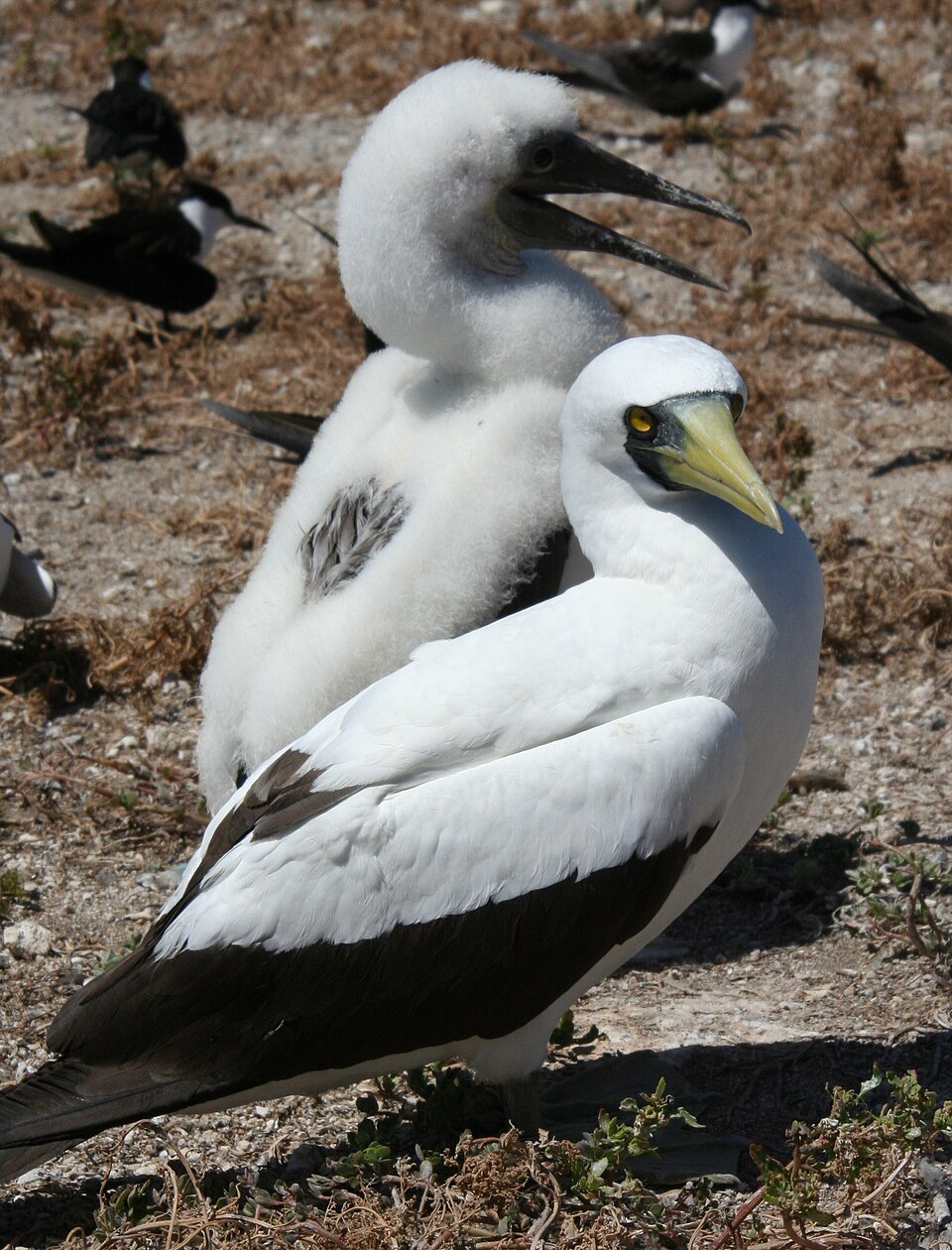
Adult Masked Booby with its downy chick, Tern Island, French Frigate Shoals, Hawaii.
Learning lesson · openly licensed photographs, labelled by BirdBot; labels checked against the cited sources and approved by AI

Yellow eye: adults have a yellow iris. Black mask: bare dark face skin around a yellow bill. Bright white body: white head, neck and body. Dark wings and tail: brown-black flight feathers. White booby, black mask, yellow bill.
Juveniles are gray-brown above with a pale collar.
Sources: Audubon Guide to North American Birds: Masked Booby · Wikipedia: Masked booby (revision 1374632985)
Photo: Duncan Wright, USFWS, Public domain, via Wikimedia Commons; labels added by BirdBot.
Adult Masked Boobies present a high-contrast silhouette with a bright white body, black wings and tail, and a distinctive black mask around the eyes and bill. This mask is the primary field mark for distinguishing adults from other white-bodied seabirds. While both sexes share similar bright white plumage, females are slightly larger (75–86 cm) than males (74–82 cm), with a combined weight range of 1,220–2,353 g and an average wingspan of 152 cm.
Age identification is critical for field observers. Juveniles are grey with white underparts and do not resemble adults until their fourth year, often leading to confusion with Northern Gannets (Sula bassanus). Chicks are born naked but are completely covered with feathers after 35 to 40 days.
Masked Boobies are pelagic birds that spend the majority of their lives at sea, returning to land primarily for breeding. They prefer small, flat islands without trees, often nesting on cliff edges or in flat areas that allow for easy take-off. Their foraging range extends far from land, typically around 65 km offshore, though they stay closer to shore when feeding offspring.
Their breeding range is extensive, covering islands in the Red Sea, northwestern Arabian Sea, the Malagasy region, the Indian Ocean, and parts of the Pacific and Atlantic Oceans. Key breeding sites include the Hawaiian Islands, Easter Islands, and islands off western Mexico in the Pacific, as well as Fernando de Noronha, Abrolhos, and Trindade in the Atlantic.
Masked Boobies are colonial, diurnal foragers. They spend most of their time out at sea in search of food, diving from heights of up to 30 meters to catch prey. Their diet consists mostly of fish and squid. When collecting food for their offspring, they tend to stay closer to land, but otherwise hunt around 65 km from shore.
Despite their size, Masked Boobies are not aggressive. They are quick to sound an alarm if surprised or threatened but are sometimes friendly to humans. In the Galapagos, thousands of tourists pass close by their nests seemingly without negative effects. They are generally silent at night but vocal during the day, particularly in breeding colonies.
Masked Boobies nest colonially in small hollows in the ground. The female usually lays two eggs, and both parents incubate them. Because they lack brood patches, they incubate the eggs with their feet. Incubation lasts an average of 43 days.
A distinctive aspect of their reproductive strategy is siblicide. The first chick to hatch kicks the second chick out of the nest, so the parents raise only one offspring. Chicks are fed once or twice a day, with females often bringing more food than males. The chick fledges in 109 to 151 days and becomes independent one to two months later. Juveniles reach sexual maturity in 3 to 5 years.
Breeding seasons vary widely throughout their range, occurring from February to August, January to July, or August to March, depending on the location.
Masked Boobies have distinct vocalizations that vary by sex. Males produce high-pitched whistles during courtship displays or when alarmed. Females make more "honky" sounding calls, typically used for help or warning. Both sexes are usually silent at night.
The Masked Booby is listed as Least Concern (LC) in AviList v2026. Interactions with humans seem to have had little effect on the species, although there have been a few cases of boobies caught in fishing traps. Their wide distribution across tropical and subtropical oceans is recorded in the current checklist.
Masked Boobies are generally non-aggressive and sometimes friendly to humans, as seen in the Galapagos where thousands of tourists pass close by their nests without negative effects. However, because they are quick to sound alarm calls when surprised, it is essential to maintain a respectful distance from nesting colonies to avoid stressing the birds or disrupting their foraging and breeding cycles.
When observing, look for the distinctive black mask in flight, which is a key field mark for adults. During the breeding season, listen for the male's high-pitched whistle during courtship displays, which can help locate active nests. Focus on their natural behaviors, such as their diurnal foraging patterns and the unique foot-incubation of eggs, while strictly adhering to local wildlife observation guidelines to ensure minimal disturbance.


