
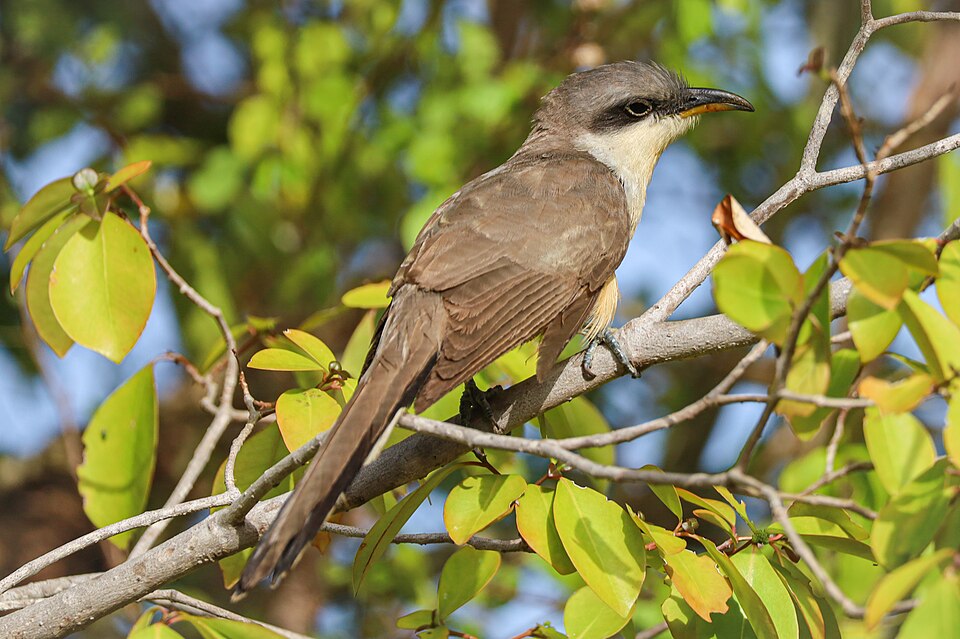
The Mangrove Cuckoo (Coccyzus minor) is a resident cuckoo of mangrove swamps and hammocks in southern Florida, the Caribbean, and the Americas. It is the largest of North America's three Coccyzus cuckoos, identified by its brown upperparts, black facial mask, buffy underparts, yellow eye ring, and a distinctive guttural "gawk gawk gawk" call.
Learn to identify
Adult Mangrove Cuckoo, photographed in Costa Rica; the species also lives in southern Florida and the Caribbean.
Learning lesson · openly licensed photographs, labelled by BirdBot; labels checked against the cited sources and approved by AI

Yellow on the bill: curved black bill, yellow on the lower half. Black mask: dark patch through and behind the eye. Buffy underparts: washed with warm buff below. Big white tail spots: bold black-and-white pattern under the long tail. Yellow-billed Cuckoo is similar but lacks the buffy underparts and bold mask.
Sexes look alike; juvenile plumage is not covered here.
Sources: Audubon Guide to North American Birds: Mangrove Cuckoo · Wikipedia: Mangrove cuckoo (revision 1314890200)
Photo: http://www.birdphotos.com, CC BY 3.0, via Wikimedia Commons; labels added by BirdBot.
Despite its scientific name minor (meaning "small"), the Mangrove Cuckoo is on average the largest of the three Coccyzus cuckoos found in North America. Adults measure 28–34 cm (11–13 in) in length, weigh 64–102 g (2.3–3.6 oz), and span 38–43 cm (15–17 in) across the wings.
Visually, the bird is a long-tailed, slender cuckoo with brown upperparts and a black curved bill that has yellow on the lower mandible. The most reliable field marks are the black facial mask and the buffy underparts, which contrast with the black-and-white pattern below. A yellow ring around the eye is also a key diagnostic feature.
In the field, the Mangrove Cuckoo is best separated from the similar Yellow-billed Cuckoo by its habitat and specific plumage details. The Mangrove Cuckoo is restricted to mangrove swamps and hammocks, whereas the Yellow-billed Cuckoo is found in a broader range of habitats. Look for the distinct black facial mask and the buffy wash on the underparts, which are absent in the Yellow-billed Cuckoo. The guttural "gawk" call is also a primary auditory cue for locating the bird in dense vegetation.
Research indicates that Mangrove Cuckoos exhibit substantial phenotypic variation across their geographic range, particularly in bill size and ventral color. A 2016 study of 274 museum specimens found that this variation is clinal, with populations in Florida, the Bahamas, and the Greater Antilles tending to have smaller bills, while those in the Lesser Antilles have larger bills. Individuals intermediate in bill size and color also characterized populations from throughout the remainder of the range in northern South America and Middle America. No named subspecies was found to be reciprocally diagnosable, suggesting that previously recognized subspecific distinctions are invalid.
The Mangrove Cuckoo is often heard before it is seen. Its most common call is a guttural "gawk gawk gawk gawk gauk gauk." The bird also produces a single "whit" sound. These vocalizations are essential for locating the bird in dense mangrove vegetation, where visual observation can be difficult.
The Mangrove Cuckoo is a species of cuckoo native to the Neotropics. It is a resident of southern Florida in the United States, the Caribbean, both coasts of Mexico and Central America, and the Atlantic coast of South America as far south as the mouth of the Amazon River. It is found primarily in mangrove swamps and hammocks. The species is generally fairly common within its specialized range.
Unlike many cuckoos, the Mangrove Cuckoo is not a brood parasite; it raises its own offspring. It nests 2–3 m (6 ft 7 in – 9 ft 10 in) above water in a mangrove tree or in a fork of a tree. The clutch usually consists of two white eggs, measuring 31 mm × 23 mm (1.22 in × 0.91 in). Both parents participate in feeding the chicks.
The Mangrove Cuckoo is an opportunistic feeder. It prefers caterpillars and grasshoppers but will also take other insects, insect larvae, spiders, snails, small lizards, bird eggs, nestlings of small birds, and fruit. This varied diet allows it to exploit the diverse food sources available in mangrove ecosystems.
The Mangrove Cuckoo is listed as Least Concern (LC) in the AviList v2026 checklist. While the species is generally common in its range, it could be threatened by human development of mangrove habitat. Conservation efforts should focus on preserving the integrity of mangrove swamps and hammocks, which are critical for nesting and foraging.
To observe Mangrove Cuckoos, visit mangrove swamps or hammocks in southern Florida, the Caribbean, or Central America. Listen for the distinctive guttural "gawk" call, which is often the first sign of the bird's presence. Observe from a distance to avoid disturbing nesting sites, as the birds are sensitive to human activity in their dense habitat. Use binoculars or a spotting scope to view the bird without approaching too closely.


