
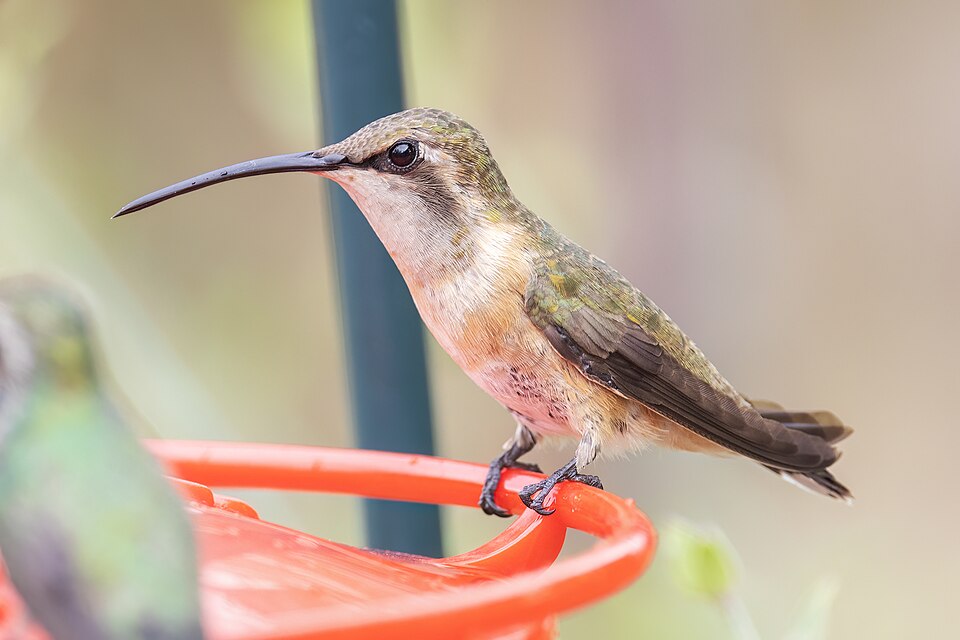
The Lucifer Sheartail (Calothorax lucifer) is a medium-sized, green hummingbird with a long curved bill and a deeply forked tail. Males display iridescent purple necks, while females are duller with pale throats. It inhabits arid mountains, plains, and rocky foothills in the southwestern United States and northern Mexico, favoring canyons and slopes with desert shrubs.
Learn to identify
Adult male Lucifer Sheartail, photographed in southeastern Arizona.
Learning lesson · openly licensed photographs, labelled by BirdBot; labels checked against the cited sources and approved by AI

Curved bill: long and noticeably down-curved. Purple gorget: male has a long magenta-purple throat. Long dark tail: blackish; can look forked. Check the curved bill; other southwestern hummingbirds can show a slight curve too.
Females lack the gorget; they are buff below with a dusky ear patch.
Sources: Audubon Guide to North American Birds: Lucifer Hummingbird · Wikipedia: Lucifer sheartail (revision 1350335280)
Photo: Polinova, CC BY-SA 4.0, via Wikimedia Commons; labels added by BirdBot.
The Lucifer Sheartail is approximately 10 cm (3.9 in) long. Its most distinctive feature is the deeply forked tail, which gives the species its common name. The bill is long and slightly curved, adapted for probing tubular flowers.
A white streak behind the eye is a useful field cue for both sexes. In the field, the male’s iridescent neck and the female’s pale, non-iridescent throat are the primary distinguishing features.
Note on Visual References: Historical illustrations, such as those from the 19th century, may not accurately represent modern field plumage details, including the specific "crimson trim" on females or the exact shape of the male's gorget flare. For precise plumage verification, consult modern field guides or recent photographs.
The Lucifer Sheartail occupies arid environments in the southwestern United States and northern Mexico. Its range includes southwest Texas, extreme southwestern New Mexico, and southeastern Arizona, extending into central and northern Mexico, including the Madrean sky islands of the Sierra Madre Occidental.
Preferred habitats include canyons, mountain slopes, and dry washes with desert shrubs and cacti. The species is typically found at altitudes between 3,500 and 5,500 feet (1,100–1,700 m). During winter, the birds migrate to central Mexico.
Lucifer Sheartails hover and make quick, straight flights between perches, nests, and foraging areas. They also perform specific flycatching flights to capture insects.
During courtship, males hover high above females and then dive, producing a snap sound with their wings or tail. They fly away with tail feathers forked, creating a different series of snapping sounds. This display lasts 30 to 45 seconds and may repeat several times an hour. Males do not form pair bonds and are probably polygamous.
The diet consists mainly of nectar from agave and colorful desert flowers, as well as spiders and small insects, primarily flies. Females forage specifically for spiders to feed their young.
Foraging activity is often concentrated in the early morning hours (8 am to 11 am), when insects are more visible and abundant. In one study, hummingbirds made as many as 200 flycatching flights in the first hour (8–9 am) and as few as 13 in the third hour (11–12 am). While defending nectar plants, males may capture small insects for food.
Females build small cup nests on desert shrubs or cacti on steep, dry, rocky slopes, typically 2–10 feet (0.61–3.05 m) above ground. Nests are often built in close proximity to one another, and females may steal nest material from rivals.
The female lays two white eggs. Incubation lasts about 15 days, and the chicks remain in the nest for about 23 days. There is one or two broods per season. The breeding season is known to last from April to August.
The Lucifer Sheartail is listed as Least Concern (LC) in the AviList v2026 checklist. This status reflects the species’ current global assessment but does not indicate local abundance. The arid, rugged habitats it frequents may limit human impact, but information on past abundance and present population trends is limited.
To observe Lucifer Sheartails, visit arid canyons or rocky slopes in the southwestern US or northern Mexico during the spring and summer months. Look for hovering behavior near agave plants or defensive displays at nectar sources. Observe from a distance to avoid disturbing nesting females, who are aggressive toward rivals and predators. Early morning is the best time to see active foraging and flycatching behavior.
Behavioral Nuance: While males defend specific nectar plants, most Lucifer Sheartails are non-territorial and forage at undefended agave or agave surrounded by dense vegetation. This behavior helps distinguish them from more aggressive hummingbird species that strictly defend feeding territories.


