
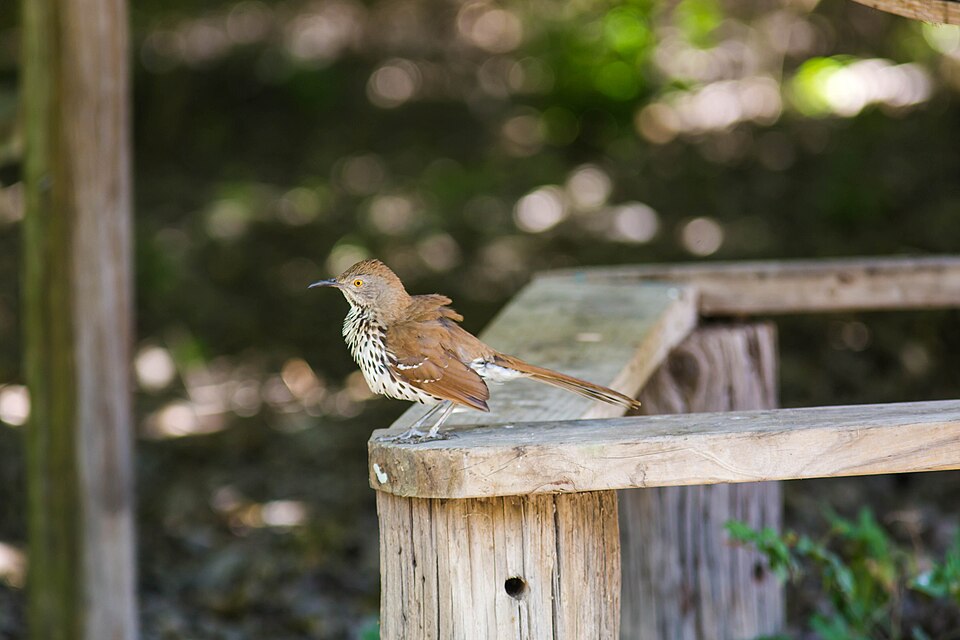
The Long-billed Thrasher (Toxostoma longirostre) is a slender, long-tailed thrasher with a grayish face, white underparts marked with black spots, orange eyes, and a long black bill. It is a permanent resident of brushy lowlands and hills from southern Texas to central Veracruz, where it forages on the ground by thrashing leaf litter and sings rich, musical warbles from exposed perches.
Learn to identify
Adult Long-billed Thrasher in South Texas.
Learning lesson · openly licensed photographs, labelled by BirdBot; labels checked against the cited sources and approved by AI

Long bill: long and slightly curved. Orange eye: a bright orange iris. Gray face: more gray on the face than Brown Thrasher. Long tail: a slender bird with a long tail. Brown Thrasher is very similar; check for the grayer face and orange eye.
Birds of eastern Mexico are smaller, darker and buffier below.
Sources: Audubon Guide to North American Birds: Long-billed Thrasher · Wikipedia: Long-billed thrasher (revision 1380693992)
Photo: Andy Morffew from Itchen Abbas, Hampshire, UK, CC BY 2.0, via Wikimedia Commons; labels added by BirdBot.
Focus on the high-contrast field marks: the closed wings appear rufous due to dullish-brown coverts with rufous-brown edges and broad white tips on the primary coverts. The underparts are white or pale-buffy white, but the chest and belly contain keenly blackish oval shapes. The iris is typically orange or orange-yellow, giving the bird a beady, intense look. The bill is long, black, and stands apart from the face, with the base of the lower mandible appearing pinkish-grey.
The upperparts are grayish-brown on the crown, with rufous coloration on the back, rump, and shoulders. Juveniles differ from adults by having dusty streak marks on the rump and buffy-white undertail coverts.
The Long-billed Thrasher shares a striking resemblance to its close relative, the Brown Thrasher, but several field cues separate the two. The Long-billed has a more gray face compared to the Brown Thrasher's reddish appearance. Its underparts are whiter and less buffy, with more robust black spotting. The eye appears more orange and beady, and the bill is longer, blacker, and more distinct from the face. Overall, the Long-billed Thrasher presents a higher-contrast pattern than the Brown Thrasher.
The Sage Thrasher, which shares some distribution with the Long-billed, is smaller and grayer, with rectrices (tail feathers) of a more distinguished white color.
This species is a resident in brushy habitats of lowlands to hills from southern Texas and eastern Coahuila to central Veracruz in eastern Mexico. In Texas, its range extends north to San Antonio and Aransas County. It favors dense spiny vegetation, including mesquite, cacti, huisache, and yucca, which provide shelter and nesting sites. The breeding density is highest in the Rio Grande Valley. While it is a permanent resident of its range, with the exception of vagrants found in New Mexico and Colorado, its population in the lower Rio Grande Valley decreased from the 1930s to the 1970s due to habitat destruction for agricultural purposes.
Long-billed Thrashers usually stay hidden on or near the ground, though they may sing from conspicuous perches. When searching for food, they energetically turn over or "thrash" leaves and other litter, rapidly sweeping their bill from side to side to toss leaf-litter upwards and behind themselves. They also scratch the ground for food. Their flights are generally close to the ground, short, and erratic with exaggerated fluctuations. These birds are staunch defenders of their territories and will defend their nests ferociously, including against humans.
Their diet consists of invertebrates such as grasshoppers, beetles, and other insects, crustaceans, and gastropods, supplemented by an adequate amount of vegetable matter, especially berries. This mixed diet is found by sweeping ground litter and scratching in dense vegetation.
The song is warbling and resembles other thrashers' songs but is especially rich and musical, though occasionally scratchy. Phrases are often repeated two to four times. A distinctive call is a "loud, rich whistle cleeooeep" or "mellow, whistled tweeooip or ooeh." Other calls include a "loud sharp chak" and a "very rapid, sharp rattle chtttr." During territorial disputes, they emit tsuck and verrs sounds that resemble the calls of the Brown Thrasher. Males are generally spotted singing from March until mid-summer, with occasional song snatches throughout the year.
The nest is a bulky cup placed in thick low or mid-height vegetation, made of materials such as twigs, straws, and grasses. It is typically situated in dense vegetation with spiny shrubs and trees to make the nest inaccessible to potential predators. The female lays 2 to 5 eggs, which are bluish-white with dense reddish-brown and gray speckles; their appearance is indistinguishable from the Brown Thrasher's eggs. Most egg laying in Texas occurs in April and May, and in May and June in Mexico, though dates have been as late as June and July, respectively. The eggs hatch over a period of 24 days, and unlike most thrashers, the hatching process is synchronous. Both parents are responsible for incubation, which lasts 13 or 14 days, as well as feeding the fledglings. They are rarely victims of brood parasitism by the brown-headed cowbird or bronzed cowbird.
The Long-billed Thrasher is listed as Least Concern (LC) in the IUCN Red List as recorded in AviList v2026. This status reflects its wide range and common residency within its habitat, although local populations may face pressures from habitat loss.
In the Rio Grande Valley, listen for the rich, musical warbling song from March through May, when males are most active. Look for the bird in mesquite thickets and dense spiny vegetation, where it is most likely to be seen foraging on the ground. Because the bird is generally not wary but is difficult to approach due to dense cover, patience and quiet observation are key. When observing, maintain a respectful distance to avoid disturbing nesting pairs, especially during the spring breeding season. If you encounter a bird defending its territory, back away slowly to prevent stress or injury.


