
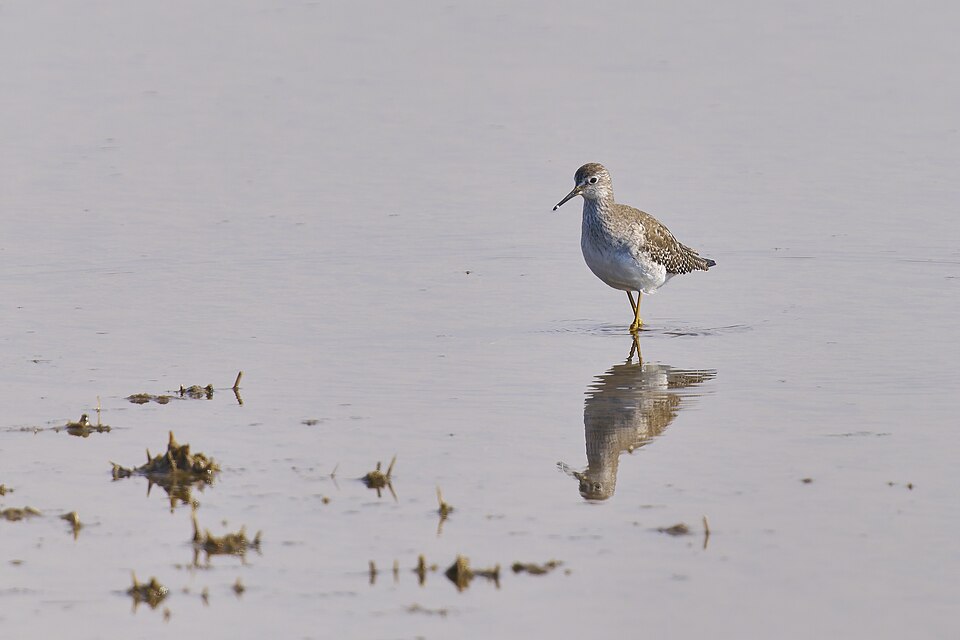
The Lesser Yellowlegs (Tringa flavipes) is a medium-sized shorebird in the family Scolopacidae, distinguished by its long, bright yellow legs, slender straight bill, and a characteristic two-note 'tu-tu' call. It breeds in open boreal forests near wetlands and winters in coastal mudflats and salt marshes, migrating along coastal routes in the fall.
Learn to identify
Lesser Yellowlegs in breeding plumage, photographed in Connecticut in May.
Learning lesson · openly licensed photographs, labelled by BirdBot; labels checked against the cited sources and approved by AI

Mottled upperparts: grey-brown, black and white in breeding plumage. Short, slim, straight bill: about as long as the head; all dark. Streaked neck and breast: brown streaks on white underparts. Bright yellow legs: long and slender. Check bill length: about the head's length on this species.
Greater Yellowlegs looks similar but has a longer bill.
Sources: Audubon Guide to North American Birds: Lesser Yellowlegs · Wikipedia: Lesser yellowlegs (revision 1376636355)
Photo: Paul Danese, CC BY-SA 4.0, via Wikimedia Commons; labels added by BirdBot.
Lesser Yellowlegs are medium-sized sandpipers with long, graceful necks and bright yellow legs. Males and females are similar in plumage and size, though females have slightly longer wingspans on average. There is no reported geographic variation in plumage.
The Lesser Yellowlegs is often confused with the Greater Yellowlegs (Tringa melanoleuca). The most reliable field marks for separation are size, bill shape, and vocalization.
| Feature | Lesser Yellowlegs | Greater Yellowlegs |
|---|---|---|
| Size | Smaller (up to 30% smaller) | Larger |
| Bill Length | Slender; about the same length as the head | Robust; about 1.5 times the length of the head; slightly upturned |
| Bill Color | Black | Black |
| Call | 1 to 3 (usually 2) low notes | 3 to 4 higher, more resonant notes |
According to AviList v2026, the Lesser Yellowlegs breeds in subarctic tundra to forest from Alaska mainland eastward to James Bay and probably central Quebec. It winters in the southern USA, throughout the Caribbean, and southward to Tierra del Fuego.
During the breeding season, these birds occupy open and edge boreal forest habitats, usually near wetlands. They are found in open deciduous or coniferous forest mosaics with wet or sedge meadows, marshes, bogs, or muskegs. Pairs travel daily between nesting areas and foraging areas, which are mainly along the shores of lakes, sloughs, estuaries, and marshes.
During migration and winter, Lesser Yellowlegs are found in inland (spring and fall) and coastal (fall) wetland habitats from 0 to 3,800 meters elevation. The highest concentrations of migrating and wintering individuals are typically seen in mudflats, saltwater marshes, and lagoons near the coast. They may also be observed in flooded agricultural fields.
Lesser Yellowlegs walk with a quick, graceful gait and have a flight described as languid, though they can fly up to 75 km per hour. They typically walk through shallow water but will also swim. They sleep with one leg and their bill tucked into their feathers and may drop their wings to sun themselves.
Northward migration occurs from February to May, while southward migration takes place between June and October. In spring, they migrate through both interior and coastal areas, especially the interior United States. In fall, they migrate only along coasts. They fly in small, mixed flocks of 3 to more than 50 and have been observed migrating during both day and night.
Research using automated radio telemetry indicates that Lesser Yellowlegs are intermediate-distance migrants, traveling approximately 5,000 to 7,500 km from subarctic breeding grounds such as James Bay to their wintering grounds in northern South America. This distance places them between short-distance migrants (like the Least Sandpiper) and long-distance migrants (like the Pectoral Sandpiper) in terms of migratory strategy, often exhibiting characteristics of an energy-minimizing strategy compared to longer-distance species (Anderson et al., 2019).
Lesser Yellowlegs eat mainly invertebrates, especially flies and beetles. They may also eat small fish, snails, spiders, crustaceans, worms, and seeds. They forage by walking through shallow water or mud and plucking prey from at or below the surface with their long bill. They either make short jabs with the bill or move it from side to side, snapping at prey. Most foraging occurs in water only a few centimeters deep, although they may forage in water up to their bellies. Reported insect prey includes high proportions of midges (Chironomidae), water boatmen (Corixidae), mayflies (Baetidae), and water scavenging beetles (Hydrophilidae).
Both males and females give the characteristic "tu-tu" call, which serves as a welcome or contact call. They use a sharp "kip" alarm call, accompanied by bobbing of the tail and head. Parents use a softer "kip" or "cup" call with nestlings. Breeding males and females perform a song described as "pill-e-wee" repeated. Only males perform a flight display to advertise breeding territories, which involves flying to 10 to 75 meters, leveling off, and gliding down while spreading the tail, dangling the legs, and elevating the head.
Lesser Yellowlegs are seasonally monogamous. Pairs form soon after arrival in breeding areas and begin breeding, usually by mid-May. They lay 4 eggs (maximum 6) in June and July in simple nest scrapes placed in elevated, mossy, dry areas with overhanging vegetation, within 200 meters of water. Eggs are incubated for 22 to 23 days. Young are precocial, leaving the nest within hours of hatching and becoming independent from 23 to 31 days after hatching. Both parents incubate and brood the young, though females generally stay with the young for about 11 days after hatching, while males stay for about 26 days.
The Lesser Yellowlegs is listed as Vulnerable (VU) in the IUCN Red List category as recorded in AviList v2026. The species has a broad range, extending from the subarctic to Tierra del Fuego, though population decreases along migration routes have been documented. The BirdLife International factsheet provides additional context on threats and conservation actions, though specific population trend data requires direct consultation of the full assessment.
To observe Lesser Yellowlegs ethically, focus on their foraging behavior in shallow water or mudflats from a distance. Watch for the quick, graceful gait and the side-to-side bill movement as they probe for prey. In fall, prioritize coastal wetlands and mudflats, as this is when they migrate exclusively along coasts. Listen for the low, two-note "tu-tu" call to confirm identification when visual cues are obscured by distance or other shorebirds. Avoid approaching nesting areas in boreal forests during the breeding season to prevent disturbance to cryptic ground nests.


