
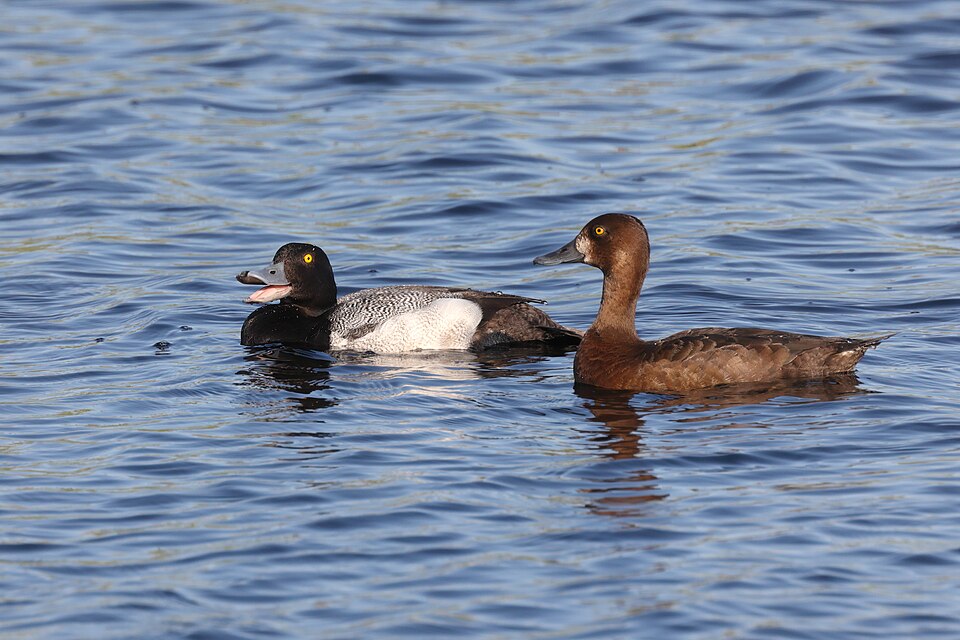
The Lesser Scaup (Aythya affinis) is a medium-sized diving duck in the family Anatidae. Males in breeding plumage are distinguished by their purplish-black heads, blue bills, and deep yellow eyes, while females are chocolate brown with a white patch at the base of the bill. Both sexes display a prominent white wing stripe. They inhabit shallow freshwater and brackish wetlands and are currently listed as Least Concern by the IUCN. Despite this global status, the breeding population has undergone a dramatic reduction over the past 50 years, declining from an estimated 6.9 million in the 1970s to a low of 3.2 million in 2006.
Learn to identify
Adult male Lesser Scaup photographed in January at Oso Flaco, San Luis Obispo County, California.
Learning lesson · openly licensed photographs, labelled by BirdBot; labels checked against the cited sources and approved by AI

Peak at back of crown: the best mark versus Greater Scaup. Yellow eye: bright yellow in adult males. Blue-grey bill: slightly smaller than Greater Scaup's. Pale middle: black at both ends, whitish in the middle. Look for the peak at the back of the head.
Head gloss is often purple but varies with light.
Sources: Audubon Guide to North American Birds: Lesser Scaup · Wikipedia: Lesser scaup (revision 1356839610)
Photo: ALAN SCHMIERER, CC0, via Wikimedia Commons; labels added by BirdBot.
Identifying Lesser Scaup in the field requires attention to subtle plumage differences, particularly when distinguishing them from the closely related Greater Scaup (Aythya marila). According to the Animal Diversity Web, these two species are difficult to distinguish at a distance, but several key features help separate them in closer view.
Lesser Scaup exhibit distinct sexual dimorphism throughout most of the year. Males in breeding plumage (August to the following June) have a purplish-black head, breast, neck, tail, and vent, with white sides and belly and a white back with grey flecking. Their bills are blue, and their irises are a deep yellow. Females are chocolate brown with lighter sides and a rufous head. A critical field mark for females is the white patch at the base of their dark grey bill. In all birds, the secondary feathers are white at the end, creating a white wing stripe on the trailing edge of the upper wing surface.
Lesser Scaup are medium-sized diving ducks. Males measure from 40.4 to 45.1 cm in length and weigh between 700 and 1200 g. Females are slightly smaller, measuring 39.1 to 43.4 cm and weighing 600 to 1100 g. Iris color also varies with age and sex: hatchlings have grayish irises, juvenile males have yellow-green irises, and adult males have deep yellow irises. Females retain brownish irises throughout their lives.
Distinguishing female Lesser Scaup from female Greater Scaup is a common challenge. The Animal Diversity Web notes that the species are difficult to distinguish, especially at a distance. In closer view, the female Lesser Scaup's rufous head and the specific placement of the white patch at the base of the dark grey bill are key features to observe.
Lesser Scaup are reliant on wetland habitats for both foraging and breeding. They are found throughout the year on semi-permanent or seasonal wetlands with emergent vegetation (such as cattails, Typhus, or bulrushes, Scirpus) or submergent vegetation (pondweed, Potamogeton, water milfoil, Myriophyllum spicatum, hornwort, Ceratophyllum demersum, or muskgrass, Chara). They are most abundant in ponds with high amphipod abundance and intact wetland margins.
Their range extends across North America. According to AviList v2026, they breed from northern Alaska and western Canada southward through northern California, southern Colorado, and Minnesota. In winter, they migrate to the Hawaiian Islands, the Caribbean, and northern South America. They prefer fairly shallow wetland areas, including ponds, lakes, river impoundments, and coastal bays.
Lesser Scaup are social and non-aggressive birds, generally tolerant of conspecifics except during the early breeding season when males defend their mates. In winter, they form large flocks for molting and migration, with reports of flocks as large as 500,000 individuals. They are active during the day, foraging in short bouts of about 20 minutes at a time.
Unlike many other ducks, breeding pairs do not defend territories. Instead, they have small, overlapping home ranges that change in size throughout the breeding season, typically ranging from 26 to 166 hectares. In winter, they may be somewhat nomadic. Females exhibit philopatry, returning to their natal range in subsequent years, while males do not.
Lesser Scaup forage in shallow, open water by diving at an angle and surfacing a few meters from where they dived. Their diet consists primarily of insects, crustaceans, and mollusks. In breeding lakes, amphipods are especially important. Midges (Chironomidae) and leeches (Hirudinea) are also significant in northern lakes. Mollusks and plant seeds become more important at other times of the year, and fish and their eggs are taken opportunistically. Seeds become particularly important in the diet during the fall.
Lesser Scaup are among the latest nesting ducks in North America. Most individuals arrive on breeding grounds by May, with nesting and egg-laying activity peaking in June. Nesting is highly synchronous across large geographic areas. The nest is a scrape in a grassy area, gradually lined with grasses and feathers to form a bowl. Females lay 6 to 14 pale, greenish eggs, laying one per day until the clutch is complete. Incubation lasts 21 to 27 days and is performed solely by the female, who begins incubating a day or two before the final egg is laid.
Males abandon their mates in mid to late June, about mid-way through incubation. Young are precocial at hatching and can feed themselves. Females lead their brood away from the nest within a day of hatching. Young feed from the water surface initially but begin diving by two weeks of age. Females attend their brood for 2 to 5 weeks after hatching, often abandoning them before they begin to fly. Young can fly 47 to 61 days after hatching.
Lesser Scaup are fairly quiet animals. Males give a soft call during courtship and a whistle during mating displays that accompanies their visual display. The most common display is called the "cough" because they give a short "whew" sound while they flick their wings and tail. Females make a soft "arrr" sound during courtship, which signals her interest in a particular male. They also make a "purrrr" call directed towards predators, which is also used to attract the help of their male mates when flying from the nest to a pond.
The Lesser Scaup is currently listed as Least Concern (LC) by the IUCN, as recorded in AviList v2026. This status reflects their large population sizes and geographic range. However, the species has experienced a dramatic population decline during the 1970s–2000s, a trend documented in research published in the Canadian Journal of Zoology. Studies indicate that reduced reproductive output is linked to reduced body condition during spring migration, with hypotheses including the degradation of spring stopover sites and increased exposure to contaminants.
Regional threats remain significant. High levels of selenium have been detected in the livers of lesser scaup in the Great Lakes region. Furthermore, research on female body condition just prior to egg laying in North America suggests that nutrient stress is resulting in lower reproductive success in some areas. While globally secure, these localized pressures highlight the importance of maintaining high-quality wetland habitats and monitoring population trends.
When observing Lesser Scaup in the field, it is important to maintain a respectful distance to minimize disturbance, especially during the breeding season. Look for diving behavior in shallow wetlands and use the white wing stripe as a key identification feature. To distinguish them from Greater Scaup, focus on the male's head gloss: Lesser Scaup males have a purplish-black head, while Greater Scaup males have a greenish-black head. Listening for the soft "cough" display call can also help confirm identification.


