
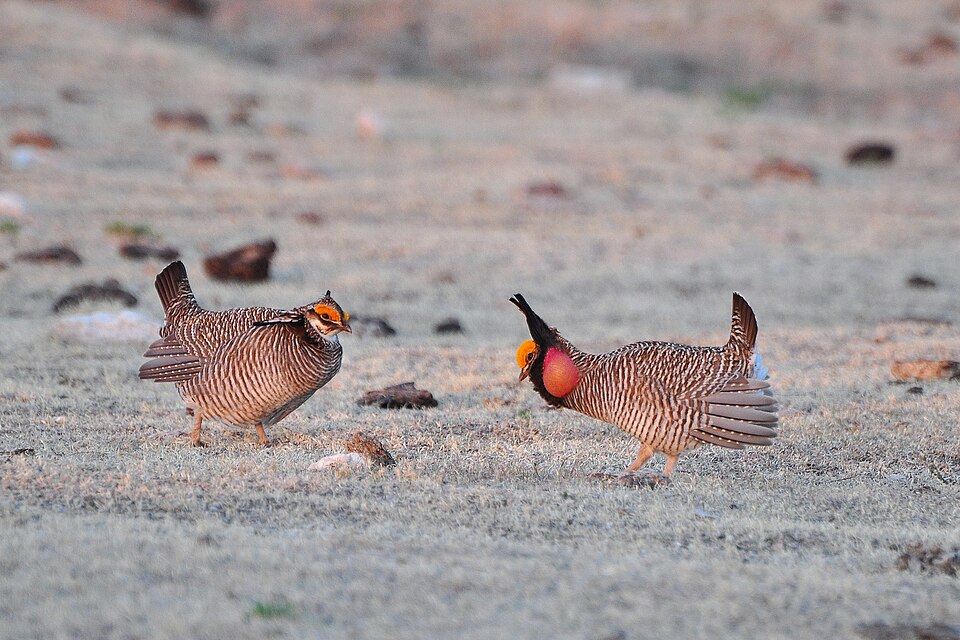
The Lesser Prairie-Chicken (Tympanuchus pallidicinctus) is a rotund, grey-brown ground bird found in the arid high plains of the south-central United States. Males are distinguished by yellow eye combs, erect pinnae, and red neck sacs used during lekking displays. The species is classified as Vulnerable in AviList v2026.
Learn to identify
Adult male Lesser Prairie Chicken displaying on a lek in New Mexico.
Learning lesson · openly licensed photographs, labelled by BirdBot; labels checked against the cited sources and approved by AI

Long raised head feathers: lifted in display to show the neck sac. Yellow comb over the eye: comb-like feathers on mature males. Reddish neck sac: inflated in display; one on each side. Brown and white barring: paler and smaller than Greater. Range is the best clue: it does not overlap with Greater.
Sources describe the sac as pinkish-red to purplish.
Sources: Audubon Guide to North American Birds: Lesser Prairie-Chicken · Wikipedia: Lesser prairie-chicken (revision 1355923286)
Photo: https://www.flickr.com/photos/larry1732/, CC BY 2.0, via Wikimedia Commons; labels added by BirdBot.
The Lesser Prairie-Chicken is a rotund, ground-dwelling bird, typically 38–41 cm long and weighing 700–800 g. Its plumage is a cryptic mix of grey and brown with heavy barring, blending seamlessly into the high plains terrain. The breast is paler than the back, and the tail is short.
Field Cue: Distinguishing from the Greater Prairie-Chicken
While similar, the Lesser Prairie-Chicken is generally paler above. The brown bars on its back are narrower and lighter in color, with blackish edges, giving the back a distinct appearance compared to the darker, more heavily barred Greater Prairie-Chicken. This observation was first noted in Chester A. Reed's 1916 field guide, which described the species as "nearest like the prairie hen but paler above."
Male Display Features
The definitive field cue for a male is its courtship attire: bright yellow eye combs, long pinnae (neck feathers) that stand erect, and red esophageal air sacs that inflate during the lekking dance. Females lack these ornamental features, making the displaying male the primary identification target for observers.
This species inhabits the arid high plains of Colorado, Kansas, Oklahoma, Texas, and New Mexico. Their preferred habitat consists of a mix of shrubs, such as shinnery oaks or sand sagebrush, alongside tall grasses, usually bluegrasses, and sandy soil. This specific combination of vegetation provides essential concealment from aerial and terrestrial predators, as well as shade during the summer months. The foliage also supports the insect populations that form a significant part of their diet.
AviList v2026 describes the broad range as the arid grassland of the south-central USA. Home ranges can be extensive, with males occupying up to 5 square kilometers and females up to 2.3 square kilometers. Habitat fragmentation from farming and man-made structures has placed considerable stress on these ranges.
The most notable behavior of the Lesser Prairie-Chicken is its classic lekking system. In the spring and fall, males congregate in areas with increased visibility, often where shrubs and tall grasses are less dense, to maximize the visibility of their mating displays. These displays involve a semi-prone position, wings spread slightly, erect pinnae and tail, and inflated air sacs.
Males use both visual and auditory signals to attract females. They call out, dance, and perform aggressive gestures toward rival males to establish territory within the lek. Dominant males typically occupy the center of the lek and secure a disproportionately high percentage of successful copulations. Females select mates based on the male's activity level and vocal ability. Males demonstrate territorial fidelity, often returning to the same lek sites over multiple mating seasons.
Lesser Prairie-Chickens are omnivorous, feeding on a variety of insects, grasses, and shrubs. Insects such as grasshoppers and beetles are important food sources, particularly when available. They also consume the greenery and seeds of native grasses and shrubs. The reliance on different food types varies throughout the year based on availability. During the fall and winter, these birds often gather in flocks to forage on row grains and acorn masts.
After mating, females leave the lek to find a suitable nesting site. Nesting areas are selected primarily for horizontal and vertical coverage, litter availability, and proximity to other lekking sites. Clutch sizes range from 6 to 14 eggs, which are buff to cream-colored with fine speckling in olive, pale brown, or lavender. Incubation lasts approximately three weeks. Juveniles become independent at 12 to 15 weeks. Males contribute little to raising the next generation beyond providing genetic material. Females that are unsuccessful with their first nest may attempt a second one in the same breeding season.
The Lesser Prairie-Chicken is listed as Vulnerable (VU) in the IUCN Red List as recorded in AviList v2026. The species is the subject of range-wide monitoring programs that evaluate responses to habitat conditions and conservation practices. A study adapting the design of the range-wide monitoring program applied a multiscale occupancy model, finding that occupancy was positively affected by increased mean patch size of native land cover and land enrolled in prescribed grazing or the Conservation Reserve Program (Condor, 2016).
Conservation efforts often focus on maintaining the specific shrub-grass mosaic the species requires. Because the birds rely on this vegetation for concealment from predators and shade, habitat fragmentation from farming and man-made structures remains a significant stressor on their extensive home ranges.
The best time to observe Lesser Prairie-Chickens is during the spring or fall lekking seasons. Look for open areas within the high plains habitat where visibility is high. Observe lekking displays from a distance to avoid disturbing the birds. Watch for males with erect pinnae and inflated neck sacs. In winter, look for flocks foraging on the ground, often burrowing in snow for shelter during extreme cold.
For specific locations, check with state wildlife agencies in Kansas, Texas, Oklahoma, Colorado, or New Mexico. These agencies often maintain lists of known lek sites and provide guidelines for ethical observation, including recommended distances and times of day to minimize disturbance.


