
The Lesser Nighthawk (Chordeiles acutipennis) is a small, nocturnal nightjar in the family Caprimulgidae. This guide focuses on how to recognize this elusive bird in the field, where to find it, and how to observe it without disturbing its sensitive ground-nesting habits.
Learn to identify
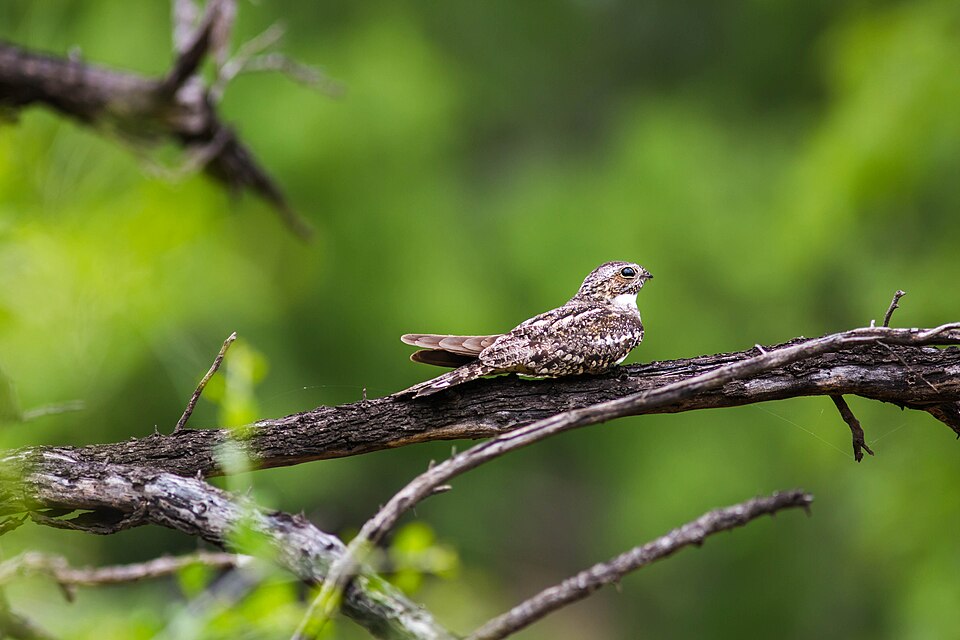
Adult Lesser Nighthawk roosting on a branch, La Ensenada, Costa Rica, February.
Learning lesson · openly licensed photographs, labelled by BirdBot; labels checked against the cited sources and approved by AI

Tiny bill, huge gape: a short, curved bill on a very large mouth. Pale throat mark: both sexes show a pale V on the throat. Cryptic brown and gray: mottled plumage blends into bark. Long wings and tail: a slim, long-winged, long-tailed shape. In flight, the pale wing bar sits close to the tip.
Very similar to Common Nighthawk; not always separable.
Sources: Audubon Guide to North American Birds: Lesser Nighthawk · Wikipedia: Lesser nighthawk (revision 1363842334)
Photo: Jerry Oldenettel, CC BY-SA 2.0, via Wikimedia Commons; labels added by BirdBot.
The Lesser Nighthawk is a cryptic, nocturnal bird averaging about 20 cm in length. Identification relies on specific plumage details, particularly the throat color and wing markings, which are most visible when the bird is flushed or in flight.
Sexes are distinguished primarily by throat coloration. Adult males have a distinct white throat, while females have a buff-colored throat and buff spots on the inner parts of the wings. These marks are critical for identification, especially when the bird is in flight or perched in a way that exposes the throat.
The Lesser Nighthawk breeds from the southwestern United States to western Peru and far northern Chile. Northern populations winter as far south as northern Colombia. The species favors large, naturally open areas with relatively level topography. It prefers naturally open land over disturbed lands with weeds, often utilizing vernal pool soils for nesting. These habitats provide the open space necessary for its aerial hunting and the low disturbance required for its ground-nesting strategy.
As a nocturnal species, the Lesser Nighthawk is most active during the night, ranging far on nightly forays for food and social interaction. Its behavior is characterized by agility in flight and a strong reliance on seclusion from human disturbance, especially during the nesting period.
The bird catches small insects, including winged ants, mosquitoes, beetles, moths, and grasshoppers, while flying high in the air. It often hunts near trees, brush, springs, and streams where insect activity is concentrated. This aerial foraging strategy allows it to exploit a wide range of prey items without needing to perch frequently.
Nesting Lesser Nighthawks are highly sensitive to disturbance. If an intruder approaches within a few meters of the nest, the bird will flush from the ground and perform a low circling flight with accentuated wing beats. This display serves as a distraction, drawing the predator away from the eggs or chicks. The species typically nests in May or June, which is later than many other lowland species.
Lesser Nighthawks are ground nesters, laying two speckled eggs directly on the ground or on gravel rooftops. The female incubates the eggs for 18 to 20 days. Once hatched, the mother brings food to the young. The chicks are precocial and leave the nest and their mother once they are able to fly. The lack of a constructed nest makes the eggs and chicks highly dependent on camouflage and the parents' defensive behaviors for protection.
The Lesser Nighthawk is listed as Least Concern (LC) in the AviList v2026 checklist. While the global status is stable, local conditions can vary. A 1998 account by Lovio noted that the species' status was uncertain near the Pacific coast, citing scarcity in specific regions. Because this regional assessment is dated, current local abundance should be verified through recent regional surveys or eBird data for the specific area of interest.
Observing Lesser Nighthawks requires patience and an understanding of their nocturnal habits. Males attract females using a series of calls, which can be a useful auditory cue in open areas at night.
Next Step: On a clear night in May or June, visit a known vernal pool or open grassland area. Sit quietly for 15–20 minutes and listen for the male's calls or watch for the distinctive low circling flight pattern near the ground.


