
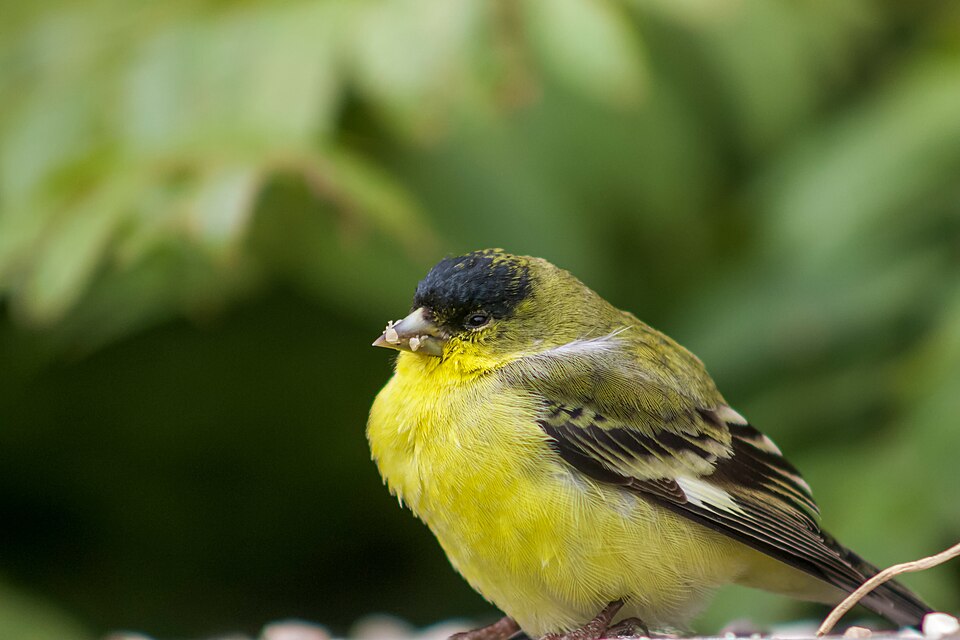
The Lesser Goldfinch (Spinus psaltria) is a small, stocky finch with black upperparts and yellow underparts. It is highly social, foraging in flocks and exhibiting distinct geographic plumage variation: western males have greenish backs, while eastern and southern males have black backs. The species breeds from April to September in open woodlands, scrub, and agricultural fields.
Learn to identify
Adult male Lesser Goldfinch of the black-backed form, Chalk Bluff Park, Texas.
Learning lesson · openly licensed photographs, labelled by BirdBot; labels checked against the cited sources and approved by AI

Black head: black from crown to ear-coverts on dark males. Black back: black-backed males dominate Colorado to Texas. White wing patch: at the base of the primaries. Bright yellow underparts: yellow from throat to belly. Black or green back, yellow below, white wing patch.
Western males are often green-backed; females are plainer.
Sources: Audubon Guide to North American Birds: Lesser Goldfinch · Wikipedia: Lesser goldfinch (revision 1347137143)
Photo: Don Faulkner, CC BY-SA 2.0, via Wikimedia Commons; labels added by BirdBot.
Lesser Goldfinches are compact birds, typically measuring 9 to 11 cm in height and weighing between 6.0 and 11.5 g. They possess short, round beaks and rounded, notched wings. The most reliable field cue for identification is the geographic variation in male plumage. In western North America, adult males display a greenish color on their backs, whereas males in the eastern and southern parts of their range exhibit the traditional black backs. Females are slightly smaller than males but do not differ significantly in color.
Historical field notes from Leander S. Keyser's Birds of the Rockies (1902) describe white markings on the wings that create a "gauze-like" appearance when the bird is in rapid flight, a subtle cue that can help distinguish it from similar species in the field. Keyser also noted that on the plains of Colorado, the Lesser Goldfinch dwells in harmony with the American Goldfinch, a useful context for field identification in the West.
Some taxonomists recognize subspecies based on these phenotypic differences: Spinus psaltria psaltria (green-backed, western US), S. p. mexicanus (black-backed, mainly Mexico), and S. p. arizonae (intermixed black and green backs, slightly larger wingspan). However, the recognition of these subspecies remains disputed.
According to AviList v2026, the Lesser Goldfinch occupies varied woodland, scrub, and forest-edge habitats and agricultural fields. Its range extends from the western USA (central Washington to southern Wyoming and southward to southern Texas and Baja California) through the mountains of Mexico to northern Nicaragua. It is also present in the Yucatan Peninsula, southwestern Costa Rica and Panama, the Sierra de Perijá, the Sierra Nevada de Santa Marta, central Venezuela, and the Andes from western Venezuela southward to north-central Peru.
These birds are adaptable, living at elevations ranging from about 30 to 2,100 m. They are most commonly found in open land with scattered trees, agricultural lands, woodland areas, open parks, farmlands, weedy fields, and residential areas. They often share habitat with other similar species, such as the American Goldfinch (Spinus tristis).
Lesser Goldfinches are highly social, often seen in flocks of 4 to 6 members that fly and forage together. During migration to breeding grounds, they form larger flocks of 20 to 30 birds, which may include multiple species of goldfinch, such as Lawrence's Goldfinch (Spinus lawrencei). In these mixed groups, Lesser Goldfinches appear dominant, often chasing other species out of trees or away from food sources.
Despite their social nature, they are aggressive when protecting nesting sites. Males usually fight off predators or intruders, while females perch and watch, occasionally joining in aggression focused on female intruders. They do not maintain specific territories beyond the tree or bush where they raise their young.
Lesser Goldfinches have tapered beaks, more so than other goldfinch species, which allows them to access seeds trapped in chaff or alder cones. Their diet includes seeds, nuts, buds, fruits, flowers, and insects such as plant lice. A distinctive foraging behavior is their tendency to fly around while searching for food rather than staying in one place, which helps them avoid competition with other goldfinches that feed more stationary.
Their diet is rich in carotenoids, plant chemicals that reflect yellow, orange, and red light. The absorption of these carotenoids into the blood is directly linked to the vibrancy of their plumage, making carotenoid-rich plants a staple in their diet for mate attraction.
The breeding season occurs from April to September. Pairs typically form within 10 to 14 days of arriving in breeding areas. Courtship involves males perching at the top of trees, singing, and engaging in high-speed chases with females, maneuvering in and out of foliage.
Females build nests of leaves, tall grasses, bark, cocoons, and webs in trees. They lay 3 to 5 eggs, typically one per day, and begin incubation immediately after the first egg is laid. Females remain on the nest for 12 to 13 days until hatching. Males feed females regurgitated food every hour during incubation and continue this pattern after hatching, with females then feeding the nestlings.
Lesser Goldfinches use a variety of chirps and tweets. Their alarm calls consist of three sections of increasing intensity: "dee-ree," "bay-bee," and "bee-ee." Males sing year-round from perches, using complex songs to attract mates or mark territory. One analyzed song consisted of 54 notes in 16.2 seconds. Courtship calls include a male "tee-yer" and a female pre-copulatory response.
Listed as Least Concern (LC) in the IUCN Red List as recorded in AviList v2026, the Lesser Goldfinch is not currently considered threatened or endangered. This status reflects the species' broad range and adaptability to various habitats, from agricultural fields to woodland edges.
To observe Lesser Goldfinches ethically, look for flocks foraging in open areas with scattered trees, such as weedy fields, streamside trees, and agricultural lands. Note their tendency to fly while searching for food rather than staying stationary. Listen for the three-part alarm call or the complex, year-round songs of males perched in trees. In the western US, look for the greenish back on males to distinguish them from other goldfinches.


