
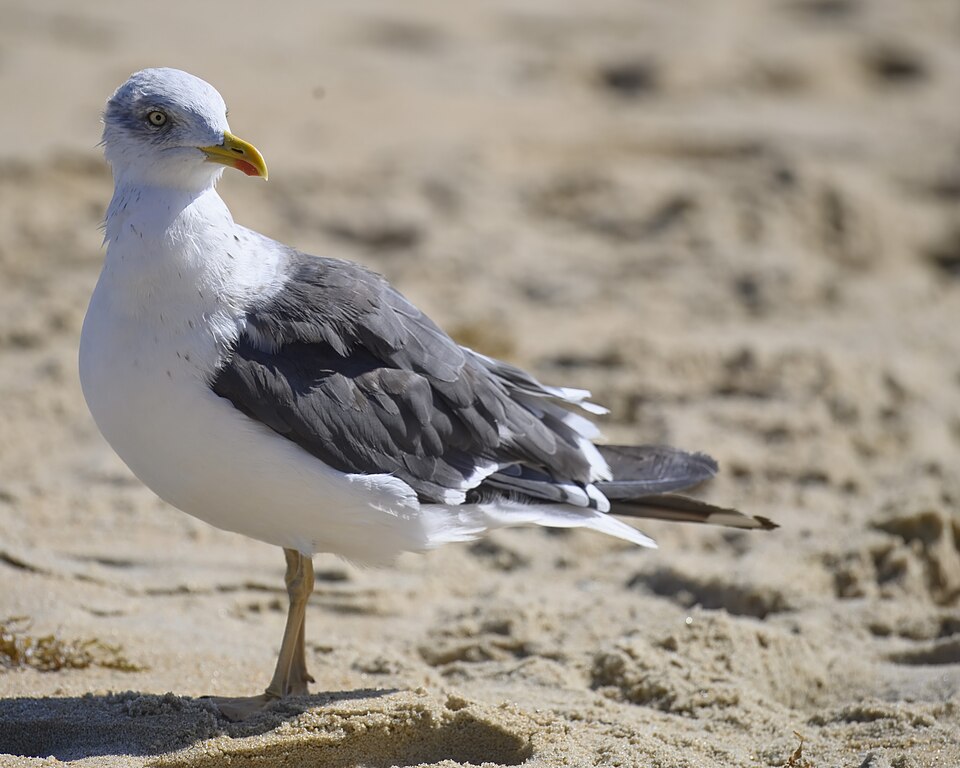
The Lesser Black-backed Gull (Larus fuscus) is a large gull in the family Laridae, distinguished from the similar Herring Gull by its slimmer build, yellow legs, and smaller white wing-tip mirrors. Adults display black or dark grey wings and back, while the head appears greyer in winter. The species is currently classified as Least Concern (LC) by the IUCN Red List, as recorded in AviList v2026.
Identifying the Lesser Black-backed Gull often requires comparing it to the Herring Gull (Larus argentatus), as the two are frequently found together. The Lesser Black-backed Gull is smaller, with a length of 51–64 cm and a wingspan of 124–150 cm. Males average 824 g, slightly larger than females at 708 g. The most reliable field marks are the yellow legs (contrasted with the pinkish legs of the Herring Gull) and the smaller white "mirrors" at the wing tips. Adults have black or dark grey wings and back, depending on the subspecies, while the head becomes greyer in winter, a feature that helps distinguish it from the Great Black-backed Gull.
A critical field cue is the bill: it is yellow with a distinct red spot at the base of the upper mandible. This spot serves as a visual stimulus for chicks, which peck at it to induce feeding. In the field, this red spot, combined with the yellow legs, provides a quick diagnostic check against the Herring Gull.
Immature birds present a different challenge. Young gulls have scaly black-brown upperparts and a neat wing pattern. They take four years to reach full adult plumage. When distinguishing juvenile Lesser Black-backed Gulls from juvenile Herring Gulls, look for the more solidly dark, unbarred tertial feathers on the Lesser Black-backed Gull.
The call of the Lesser Black-backed Gull is a "laughing" cry similar to that of the Herring Gull, but with a markedly deeper pitch. This tonal difference is often the quickest way to separate the two species in a mixed flock when visual details are obscured by distance or lighting.
According to AviList v2026, the species breeds from Greenland, Iceland, and western Europe to central Asia and north-central Siberia. During the non-breeding season, it winters mostly coastally in southwestern Europe, Africa (excluding southwestern and southern regions), India, Sri Lanka, and eastern North America. The species has expanded its range westward, first colonizing Greenland in the 1980s. While it has not yet bred in an intraspecific pair in the United States, hybrid pairs with American Herring Gulls have been recorded, with one instance producing offspring.
The Lesser Black-backed Gull is part of the herring gull complex, a classic example of a ring species where adjacent forms differ slightly but the end members are distinct. Genetic studies indicate that members of this complex differentiated largely in allopatry following multiple vicariance and long-distance-colonization events, rather than primarily through isolation by distance. Researchers note that closure of the ring in the opposite direction may be imminent, with lesser black-backed gulls about to colonize North America.
Like most Larus gulls, the Lesser Black-backed Gull is an omnivore. Its diet includes fish, insects, crustaceans, worms, starfish, molluscs, seeds, berries, small mammals, eggs, small birds, chicks, scraps, offal, and carrion. This dietary flexibility allows the species to thrive in both marine and urban environments. In some cities, the species nests within the urban environment, often in association with Herring Gulls.
The Lesser Black-backed Gull breeds colonially on coasts and lakes. It constructs a lined nest on the ground or on cliffs. The typical clutch size is three eggs. The annual moult for adults begins between May and August and may not be complete on some birds until November. A partial pre-breeding moult occurs between January and April.
The Lesser Black-backed Gull is listed as Least Concern (LC) in the IUCN Red List, as recorded in AviList v2026. While the global status is stable, there are concerns about declines in specific parts of its range. For example, the species is on the UK Amber List because the UK is home to 40% of the European population, with more than half of these birds found at fewer than ten breeding sites. This concentration highlights the vulnerability of local populations despite the global LC status.
To observe Lesser Black-backed Gulls ethically, look for them at coastal cliffs, lakes, or urban sites where they are known to forage or nest. Because the species breeds colonially and often in association with Herring Gulls, scanning mixed flocks is an effective strategy. Use binoculars or a telephoto lens to identify individuals from a distance, focusing on the yellow legs and the red spot on the bill to distinguish them from Herring Gulls. Always check local regulations and avoid known sensitive nesting areas to prevent disturbance. A practical next step is to listen for the distinctive, deeper "laughing" call in a mixed gull flock and log your sightings on a community science platform to help track population trends.


