
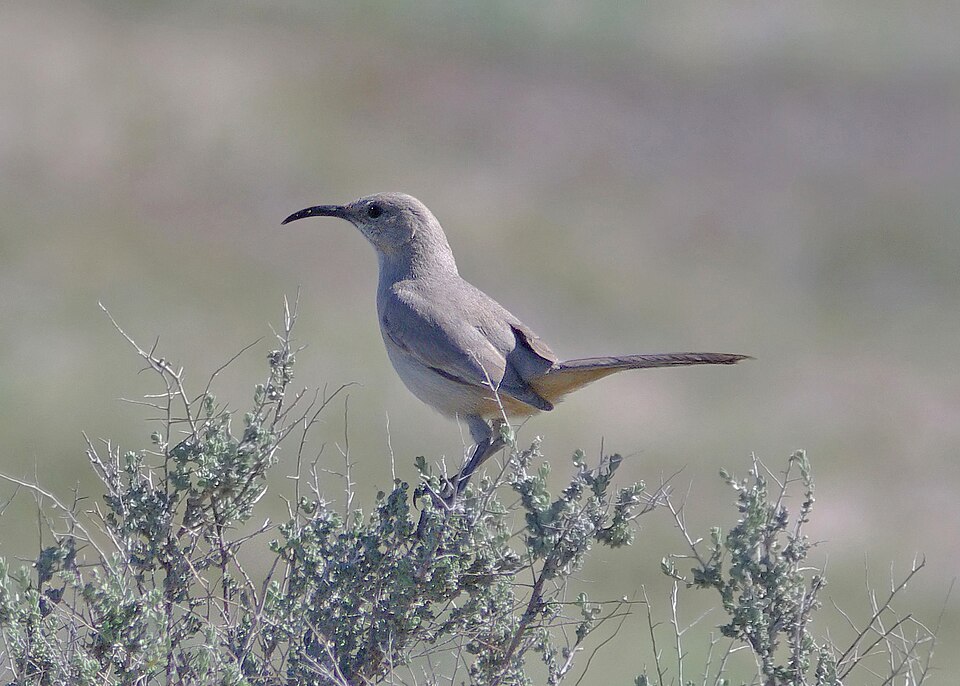
LeConte's Thrasher (Toxostoma lecontei) is a pale, sandy-gray thrasher found in sparsely vegetated deserts of the southwestern United States and northwestern Mexico. It is highly terrestrial, running fast with its tail held up, and is best identified by its black sickle-shaped bill, puffy gray belly, and prolonged, warbled song delivered from exposed perches.
Learn to identify
Adult LeConte's Thrasher, photographed on the Carrizo Plain, California.
Learning lesson · openly licensed photographs, labelled by BirdBot; labels checked against the cited sources and approved by AI

Dark eye: the eye is dark brown. Curved black bill: deeply curved and sickle-shaped. Pale sandy plumage: overall pale sandy gray, like desert sand. Dark tail, buff undertail: a darker tail above pale buff undertail feathers. Less heavy-billed than Crissal or California thrashers; lives on more open desert flats.
Juveniles are darker brown, with looser, fluffier feathers.
Sources: Audubon Guide to North American Birds: LeConte's Thrasher · Wikipedia: LeConte's thrasher (revision 1380690567)
Photo: Alan Schmierer, CC0, via Wikimedia Commons; labels added by BirdBot.
LeConte's Thrashers are medium-sized birds, measuring 24.5–29 cm (9.6–11.4 in) in length and weighing 55–75 g (1.9–2.6 oz). There is no sexual dimorphism; males and females look alike. The plumage is cryptic, blending seamlessly with sandy desert soils. The crown, back, shoulders, and rump are a sandy pale-gray. The wings (primaries and secondaries) are grayish brown, while the tail feathers (rectrices) are a darker gray brown that contrasts with the rest of the plumage. The throat is off-whitish, and the chest and belly are a puffy gray. The vent and uppertail coverts have a warmer tint. The bird has a brown-chestnut iris, a black sickle-shaped bill, and nearly black legs.
Subspecies variation exists. The nominate subspecies T. l. lecontei has the sandy pale-gray upperparts described above. The subspecies T. l. arenicola has a darker chest and underparts and a shorter tail. Juveniles are darker brown with looser, fluffier feathers, especially on the vent.
Note: Detailed plumage and morphological measurements in this section are based on general field guide summaries and tertiary sources. For precise taxonomic distinctions or acoustic analysis, consult primary ornithological references.
LeConte's Thrashers are residents of sparsely vegetated deserts, ranging from south-central and southeastern California and southern Nevada to western Arizona, and disjunctly to south-central Baja California and northern Sonora. They inhabit some of the harshest climates in the region, including the Sonoran Desert and the San Joaquin Valley, where annual rainfall averages only 4 to 20 cm. Typical habitats include dunes, alluvial fans, and flat to gently rolling hills with shallow washes. The vegetation consists of low shrubs such as saltbush, creosote, cholla cacti, and Mojave yucca. Altitudes range from 80 m below sea level in Death Valley to 1,600 m, with an average of 500 m. While they generally do not coexist with other thrashers due to habitat specificity, they overlap with the California Thrasher in higher desert regions.
This is a highly terrestrial bird that flies rarely, usually only for nest building or feeding young. It runs at a surprisingly fast pace, often with its tail held upward, exposing the buffy crissum. As a ground forager, it digs small pits in leaf litter or soil to find prey. LeConte's Thrashers are monogamous and are generally seen in pairs. Juveniles may form small parties of two to eight birds. They compete with species such as the Northern Mockingbird, Loggerhead Shrike, and Greater Roadrunner, and can be preyed upon by the latter.
The diet is omnivorous, including arthropods (beetles, scorpions, spiders, grasshoppers, butterflies, moth larvae), small lizards, snakes, and eggs (including their own species). They also consume seeds and berries. A key adaptation to their arid habitat is water conservation; they obtain most of their moisture from food and generally do not need to drink, though one instance of drinking has been recorded.
The song is a large, prolonged outpouring of warbled phrases, typical of the genus Toxostoma. It starts softly and increases in volume, with a more measured delivery than the Crissal Thrasher. The song is heard from considerable distances, usually from an exposed perch in the morning or evening, though it has been heard at night. Females also sing occasionally. Calls include short whistle notes (e.g., "suuuweeee," "hew-eep") and a double-noted whistling distress call.
The singing season begins in mid-autumn and peaks in late December and early January, when nest building starts. Nests are bulky, with an outer layer of twigs, a middle layer of twigs, grasses, and rootlets, and an inner layer of insulating materials like fuzzy plant seeds, leaves, or flowers. Dense, thorny shrubs such as saltbush are preferred sites, though abandoned vehicles and smoke trees have been used. Both sexes participate in nest building. Clutch size is 2–5 bluish-green eggs, often with brown spotting. Incubation lasts 14–20 days, with the female incubating more at night. The male provides food for the female and young. Fledglings disperse at around 30 days old. Pairs may have up to three broods per season.
LeConte's Thrasher is listed as Least Concern (LC) in AviList v2026. However, populations have declined in certain regions, notably the Coachella, Imperial, and San Joaquin Valley areas in California. Major reasons for decline include urbanization, land conversion for grazing, oil and gas development, and fire with the increase of invasive grasses. Off-road vehicle use is a minor factor. The species is listed as a species of concern in California, but its large overall range justifies its global Least Concern status.
Listen for warbled songs from perches in open desert, or watch for fast-running birds with tails held upward while foraging on the ground. Focus on areas with sparse vegetation like saltbush and creosote. Observe from a distance to avoid disturbing nesting pairs, especially during the breeding season. Note that the bird's cryptic coloration makes it difficult to spot, so listening is often more effective than visual scanning.


