
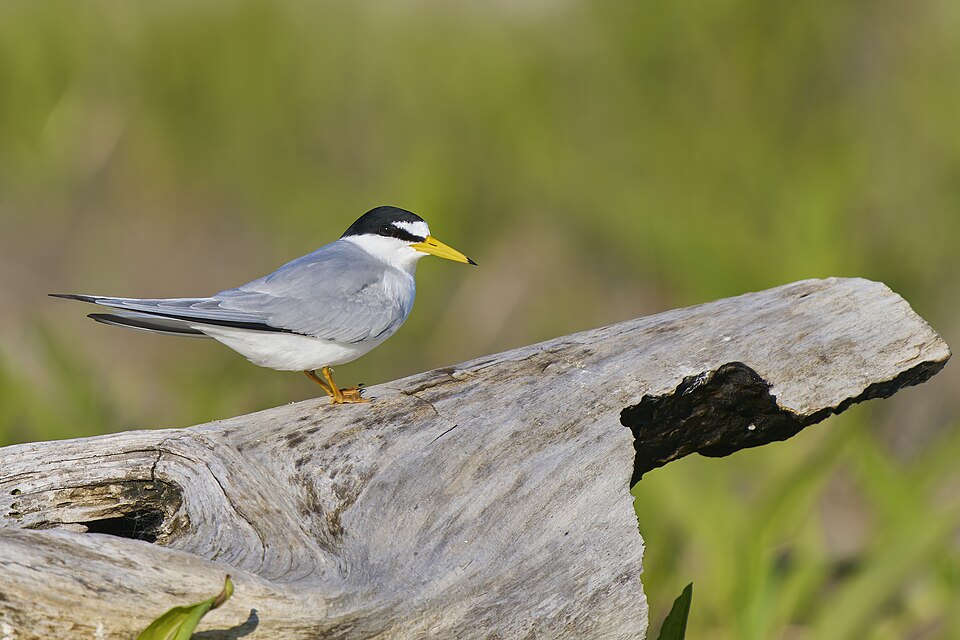
The Least Tern (Sternula antillarum) is the smallest tern in the Americas, identified by its yellow bill with a black tip, black cap, and white forehead during the breeding season. It nests in colonies on sandy beaches, river sandbars, and gravel rooftops, foraging by plunge-diving into shallow water to catch small fish and invertebrates.
Learn to identify
Breeding adult Least Tern on a beach, photographed at Sandy Point Bird Sanctuary, West Haven, Connecticut.
Learning lesson · openly licensed photographs, labelled by BirdBot; labels checked against the cited sources and approved by AI

Black cap: with a black line through the eye to the bill. White forehead patch: small and sharp above the bill. Yellow bill, black tip: all blackish in winter and on young birds. Black outer primaries: on otherwise pale grey wings. Small, with a yellow bill and white forehead.
In winter the forehead is whiter and the cap smaller.
Sources: Audubon Guide to North American Birds: Least Tern · Wikipedia: Least tern (revision 1383753022)
Photo: Paul Danese, CC BY-SA 4.0, via Wikimedia Commons; labels added by BirdBot.
At 21 to 24 cm (8.3 to 9.1 in) in length, the Least Tern is noticeably smaller than other terns in its range, such as the Common Tern or Forster's Tern. Its compact size and slender build are key field marks, but plumage details provide the most reliable identification cues.
During the breeding season (April to August), adult Least Terns display a striking black cap that covers the crown and nape, contrasting sharply with a clean white forehead. The bill is bright yellow with a distinct black tip, and the legs are yellow. The back and upper wings are light gray, while the underparts are white. The outer edges of the narrow, pointed flight feathers have black stripes, which are visible in flight.
In non-breeding plumage, the black cap recedes, leaving a white crown with blackish markings restricted to the nape and around the eyes. The bill turns black, and the eye stripes extend further back. Juvenile Least Terns have barred feathers on their backs, yellow legs, and dark-grayish bills with a black spot behind the eyes. Chicks are fluffy with orange legs and brown beaks, with light brown crowns and off-white undersides.
To gauge its size, note that the Least Tern is larger than an American Robin but smaller than an American Crow. Its wingspan averages 48 to 53 cm (18.9 to 20.9 in), and it weighs between 36 and 54 g (1.3 to 1.9 oz).
Least Terns are coastal and riverine birds, preferring shallow waters where they can easily forage. Their breeding habitats include sandy coasts, river sandbars, gravel beaches, bays, estuaries, salt flats, lagoons, and large river channels. Inland, they are often found alongside riverbeds with sandbars or on lakes near salt flats.
As natural beach habitats become increasingly developed, Least Terns have adapted by nesting on man-made sites such as gravel rooftops, mines, and reservoirs. This shift is particularly evident in areas like California, where gravel rooftops have become important nesting grounds.
Their breeding range extends from the Great Plains to Texas and northern Louisiana, along the central California and Gulf of California coasts to Oaxaca, El Salvador, and Nicaragua, and along the western North Atlantic coast from Maine to Florida. They also breed in the Caribbean, including the Bahamas, Cuba, and Puerto Rico, and in parts of South America, such as Aruba and Venezuela. During winter, they migrate to tropical coasts or offshore areas, with some populations reaching the coasts of northern South America.
Least Terns are highly social and territorial, living and nesting in colonies that can range from a few pairs to several hundred. They are monogamous, maintaining the same partners throughout the breeding year. Courtship involves aerial displays where males fly upward holding a fish in their bills, with females following, before gliding down to the ground for further bonding.
Least Terns are carnivorous shorebirds that feed primarily on small fish, insects, crustaceans, small mollusks, marine worms, and barnacles. They forage by flying or hovering over the water's surface, then plunging into the water when they spot prey. They may also dip down to capture prey on land or at the water's surface. While in flight, they sometimes catch insects on their wings or beaks.
During the breeding season, Least Terns typically forage near the colony, with the Animal Diversity Web account noting a range of about 6 km. Their diet varies by location and season, reflecting the availability of prey in their immediate environment.
Least Terns are fiercely protective of their nesting sites. Parents defend their territories by making alarm calls, flying up into the air to confront intruders, and sometimes diving at them. This aggressive behavior can be observed when humans or other animals approach the colony, making it important to maintain a respectful distance.
Least Terns breed on the ground, scraping shallow holes in sand, dirt, pebbles, or soil to create their nests. These nests are often lined with debris, such as small stones or discarded man-made materials. Both males and females participate in nest construction and incubation.
The reproductive season lasts from April to August, with clutch sizes ranging from 1 to 3 eggs. Incubation takes 19 to 25 days, and chicks hatch with their eyes open, able to walk but staying in the nest for a few days before leaving to find shelter near their parents. Chicks fledge at around 3 weeks of age but may remain close to their parents for up to 3 months.
In hotter climates, males wet their belly feathers with water to cool the eggs during incubation. This behavior highlights the adaptability of Least Terns to their environment.
Least Terns are vocal birds, especially in large nesting colonies. Their calls are high-pitched and sharp, often described as "kee-zink" or "kip-kip-kip-kiddeek." These sounds are used for communication within the colony, alarm calls, and territorial defense. The noise level in a large colony can be quite intense, with all birds calling to each other.
The Least Tern is listed as Least Concern (LC) on the IUCN Red List, as recorded in AviList v2026. However, this does not mean the species is free from threats. In some regions, such as California, populations have declined significantly due to habitat loss, human disturbance, and changes in water levels. For example, a breeding bird survey from 1966 to 2015 showed an 88% decline in California's Least Tern population.
Conservation efforts, including the protection and monitoring of nesting areas, improvement of water flow, and control of predation, have helped some inland populations recover. Nesting on gravel rooftops has also provided a refuge for birds whose natural beach habitats have been lost. Despite these efforts, Least Terns remain sensitive to environmental changes, and their long-term survival depends on continued conservation measures.
Observing Least Terns in the wild requires patience and respect for their habitat. Here are some tips for ethical observation:
By observing Least Terns ethically, you can contribute to their conservation and gain a deeper appreciation for these remarkable birds.


