
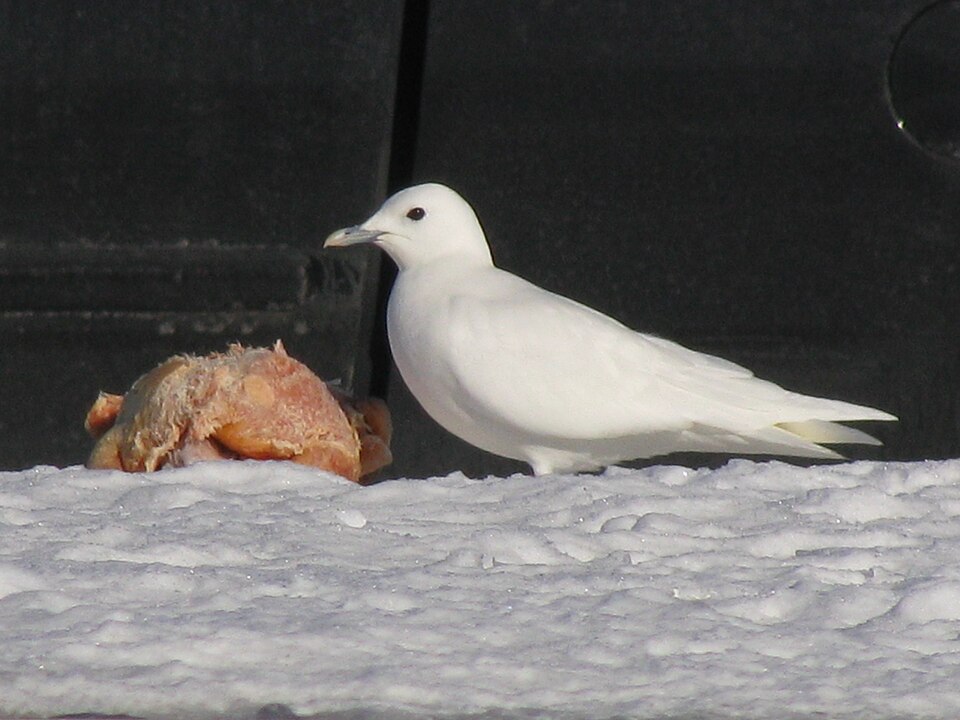
The Ivory Gull (Pagophila eburnea) is a small, pure-white gull with a distinctive pigeon-like shape, a thick blue bill tipped in yellow, and black legs. It is a resident breeding bird in the high Arctic with a circumpolar distribution through Greenland, northernmost North America, and Eurasia. It winters near pack-ice edges and polynyas in the Arctic Ocean, Labrador, and Bering Sea regions.
Learn to identify
Adult Ivory Gull standing on a beach at Pismo Beach, California, in November (a rare vagrant far south of its range).
Learning lesson · openly licensed photographs, labelled by BirdBot; labels checked against the cited sources and approved by AI

Dark eye: stands out on the white head. Yellow-tipped bill: thick, blue-gray with a yellow tip. Pure white plumage: no gray back, unlike other adult gulls. Short black legs: give a pigeon-like look. A pure white, pigeon-shaped gull of the high Arctic.
Young birds have a dusky face and black spots on wings and tail.
Sources: Audubon Guide to North American Birds: Ivory Gull · Wikipedia: Ivory gull (revision 1380687541)
Photo: ALAN SCHMIERER, CC0, via Wikimedia Commons; labels added by BirdBot.
Despite its name, the Ivory Gull does not resemble the typical grey-backed Larus gulls. Instead, it has a compact, rounded body and short legs that give it a pigeon-like silhouette. This shape is one of the most reliable field marks, especially when the bird is perched or walking on ice.
Adults are entirely pure white, lacking the grey back found in most other gulls. Key identification features include:
Juvenile and first-winter birds are not pure white. They have a dusky face and variable amounts of black flecking on the wings and tail. These birds take two years to attain full adult plumage. Second-winter yearlings show an intermediate plumage with smaller dark spots and a less dusky face, though some may closely resemble adults.
The Ivory Gull is a circumpolar Arctic species. Its range is tightly linked to sea ice and coastal cliffs.
In summer, the species breeds on high Arctic islands and cliffs. In North America, breeding is restricted to the Canadian Arctic, with known colonies on Seymour Island (Nunavut), Ellesmere, Devon, Cornwallis, and northern Baffin Islands. In Europe and Asia, it breeds on Svalbard and island archipelagos north of Russia. There are no records of the Ivory Gull breeding in Alaska.
During winter, Ivory Gulls live near polynyas (areas of open water surrounded by sea ice) and the edges of pack ice. North American birds winter along the ice edge stretching from the Labrador Sea to Davis Strait, often appearing on the eastern coasts of Newfoundland and Labrador. Others winter in the Bering Sea and Chukchi Sea from October through June. Juveniles tend to wander further from the Arctic than adults, occasionally appearing as vagrants in coastal Canada, the northeastern United States, and even as far south as California and Georgia.
Historical records from the early 20th century, such as Chester A. Reed’s 1916 field guide, noted that the species winters south to New Brunswick and British Columbia, with casual records from Long Island and the Great Lakes, underscoring its rarity outside the Arctic core range.
Ivory Gulls are opportunistic feeders with a diet that reflects their harsh environment.
They consume fish, crustaceans, eggs, and small chicks. However, they are also significant scavengers, often found on seal or porpoise carcasses. A distinctive behavior is following polar bears and other predators to feed on the remains of their kills. They have also been observed eating polar bear and seal faeces and seal placentae.
In the Arctic winter, Ivory Gulls are often reluctant to land on open water. This behavior is likely an adaptation to avoid water droplets freezing onto their plumage, which could impair flight or insulation. They prefer to rest on ice floes or the ice edge.
The Ivory Gull has a variety of calls that can help with identification in the field:
Ivory Gulls breed in small colonies, typically ranging from 5 to 60 pairs, rarely exceeding 100 pairs. They lay one to three olive eggs in a ground nest lined with moss, lichens, or seaweed. Nesting sites are usually on Arctic coasts or cliffs, but some colonies have been found on gravel-covered floating ice floes off Greenland. Eggs are laid in late June or early July, and chicks fledge in August.
The Ivory Gull is listed as Near Threatened (NT) in the AviList v2026 checklist. This status reflects concerns about its remote habitat and the potential impacts of climate change on sea ice. A 2022 genetic study found no significant signatures of population decline worldwide, though it noted a bottleneck signal at one location in Canada and a surprisingly low effective global population size (~1000 individuals), suggesting limited evolutionary potential. The study also highlighted that the species is currently suffering from rapid alteration of its primary habitat (sea ice) and dramatic climatic events affecting reproduction and recruitment. Further research is needed to fully understand population trends.
Because the Ivory Gull is rarely seen outside the Arctic, timing and location are critical. In North America, the best opportunities occur during the winter months (late November through early March) when birds are most widespread.
Maintain a significant distance to avoid disturbing the bird, particularly if it is resting on ice or near a polynya. Avoid flushing the bird from its resting spot, as the energy cost of takeoff is high in cold conditions. If you spot one, record the date, location, and any associated behavior (such as following a polar bear) to contribute to community science records.


