
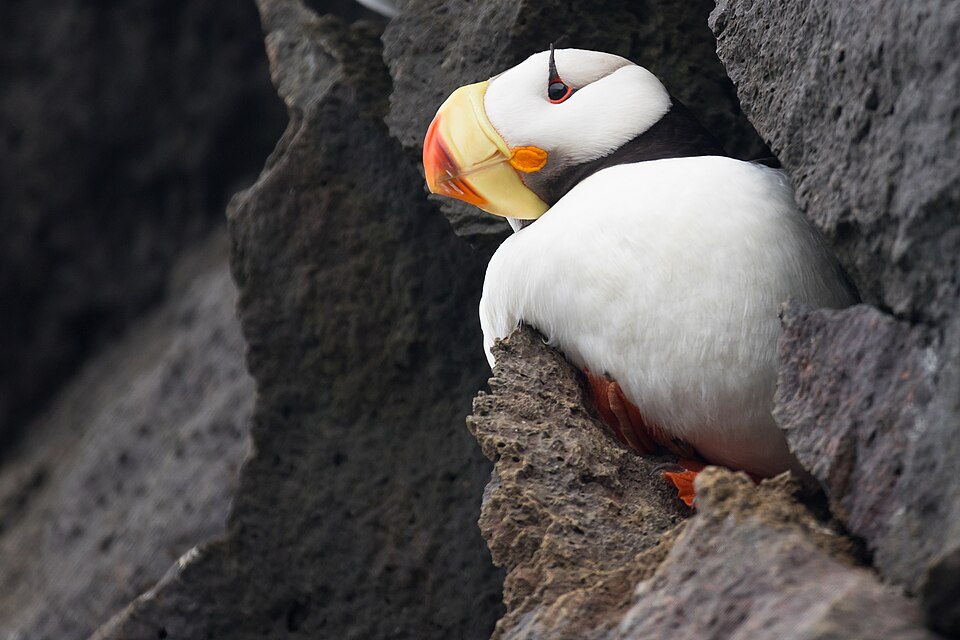
The Horned Puffin (Fratercula corniculata) is a North Pacific seabird in the family Alcidae. It breeds in coastal bluffs and rock crevices from Alaska to northeastern Russia, laying a single egg incubated by both parents for 41 days.
Learn to identify
Adult Horned Puffin in breeding plumage perched on a rock (NOAA Alaska photograph).
Learning lesson · openly licensed photographs, labelled by BirdBot; labels checked against the cited sources and approved by AI

Fleshy black horn: points up from the eye; dark stripe behind it. White cheeks: a clean white face in breeding plumage. Yellow bill, red tip: large and bright in summer; smaller in winter. Orange legs and feet: fade to pale flesh outside the breeding season. Simple yellow-and-red bill plus the horn: Horned Puffin.
In winter the face turns grey and the bill becomes smaller and plainer.
Sources: Audubon Guide to North American Birds: Horned Puffin · Wikipedia: Horned puffin (revision 1369866076)
Photo: Josh Keaton NOAA/NMFS/AKRO/SFD., Public domain, via Wikimedia Commons; labels added by BirdBot.
The Horned Puffin's flight behavior offers a reliable field cue when plumage details are obscured by distance or lighting. The species is characterized by a quick take-off followed by rapid yet shallow wingbeats. Unlike some other auks that may fly lower, Horned Puffins typically maintain a flight altitude of at least thirty meters above the sea surface.
Visually, the species is distinguished by a yellow horny projection above the eye, which is shed in winter. Audubon notes that while the Horned Puffin is very similar to the Atlantic Puffin, it has different bill colors and a longer fleshy 'horn' above each eye. A 1916 field guide by Chester A. Reed described the Atlantic Puffin's blackish throat band as not touching the chin, a feature he used to distinguish it from the Horned Puffin of the Pacific coast.
Horned Puffins breed along the North Pacific coasts and islands, ranging from Wrangel Island eastward through the Bering Sea Islands and Aleutians, patchily in western and southern Alaska, and southward to British Columbia. They also breed in the Kuril and Commander Islands of northeastern Russia. During the non-breeding season, they winter offshore and coastally in the North Pacific Ocean, mostly within their breeding range but extending southward to northern Japan.
On land, they prefer bluffs of fractured rock or crevices in cliff faces near the shoreline. They may also create burrows in upland areas. In locations like the Semidi Islands, they share habitat with parakeet auklets. Colony density is largely determined by the availability of nest sites, with higher breeding sites above the water generally considered less favorable.
Birds arrive at breeding colonies between April and May. Colonies are usually small, and nesting sites are located on steep slopes or cliffs. Nests are typically separated by about 1.5 meters, though individuals may require almost two meters of space between nests. The nest itself is often in a rock crevice, a burrow, or under a boulder, lined with feathers, grass, or debris collected by both sexes.
A mating pair produces a single oval egg, which is gray with purple dots. Both parents incubate the egg for approximately 41 days. If the egg is lost, it is replaced in 10 to 21 days. After hatching, the chick is altricial but becomes able to thermoregulate between 5 and 6 days of age. Following this initial period of close parental care, the chick is left alone in the nest for the next 35 to 46 days while parents provide food. There is no evidence of post-fledging care; chicks depart at night by themselves. Horned Puffins reach reproductive maturity between 3 and 5 years of age.
Horned Puffins forage offshore close to their breeding colonies, spending most of the year in coastal waters. They show no specific preference regarding water temperature or salinity. Their primary diet consists of fish such as juvenile herrings, capelin, and sand lances, captured via surface diving. They occasionally prey on salmon and cod. During the summer, the diet varies to include squid and other invertebrates. In a study of 41 individuals from the Buldir Islands, the diet in order of abundance was squid, then fish, then marine worms. Chicks are fed mostly raw fish. The winter diet is not well studied, but they prefer open water areas with large populations of pelagic fish.
Horned Puffins are diurnal, with peak activity on land between 8 am and 12 pm. They are generally quiet but become vocal when threatened. They form monogamous pairs and defend their nesting sites aggressively. Males may perform a swim display, raising themselves from the water and extending their necks, often followed by head flicking. In aggressive defense, they produce a low-pitched sound described as "A-gaa-kah-kha-kha," while head flicking is accompanied by a repetitive "op-op-op-op." Visual displays are crucial for pair formation, courtship, and nest defense.
Current Status: The Horned Puffin is listed as Least Concern (LC) in AviList v2026. This classification reflects the current global assessment but does not indicate local abundance or a new conservation evaluation.
Population and Trends: The estimated breeding population is 1.2 million birds, with most breeding on islands off the coast of Alaska. Historical data suggests breeding numbers dropped from 1977 to the mid-1990s, with some estimates indicating a 50 percent decline in sea-bird populations, including horned puffins, from 1972 to 1993. Bycatch in fishing gillnets was a significant source of mortality from the 1950s through the 1990s, but improved monitoring since then has not led to further significant population decline. Individuals have been found to carry toxic trace metals like mercury and cadmium, as well as PCBs and organochlorine pesticides, likely from their fish diet.
To observe Horned Puffins ethically, visit breeding colonies during mid-morning when birds are most active on land. Maintain a significant distance to avoid triggering aggressive defensive displays, as pairs defend their nesting sites and males may fight if provoked. Look for their rapid wingbeats as they take off from the cliff face. If you are using compatible camera software, you can contribute detections to community science datasets to help track these populations. Always follow local regulations regarding access to nesting sites.


