
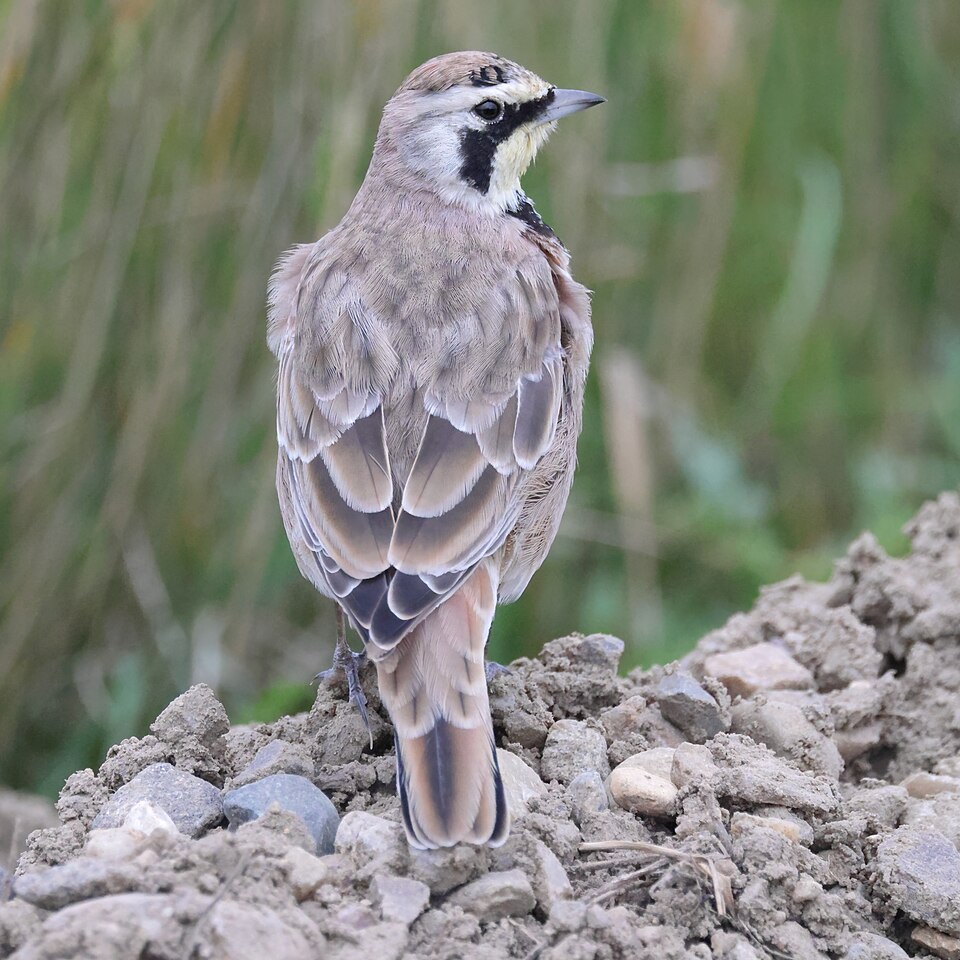
The Horned Lark (Eremophila alpestris) is a small, ground-dwelling songbird in the family Alaudidae, recognized by its black feather tufts, white face with a black eye stripe, and brown body. It inhabits open, treeless landscapes such as prairies, fields, and tundra across the Holarctic region. The species exhibits significant geographic variation in plumage and habitat preferences, with distinct genetic clades identified in North America and Europe. Males perform a distinctive aerial song flight to attract mates, and the species is currently listed as Least Concern by the IUCN Red List.
Learn to identify
Adult male Horned Lark standing on a rock.
Learning lesson · openly licensed photographs, labelled by BirdBot; labels checked against the cited sources and approved by AI

Black "horns": feather tufts on summer males; often hard to see. Yellow face, black mask: face varies from yellow to white by region. Black chest band: less obvious on females. Black tail: contrasts with the pale body in flight. Black-and-yellow face on a brown bird of open ground.
Juveniles are duller, with streaks and spots.
Sources: Audubon Guide to North American Birds: Horned Lark · Wikipedia: Horned lark (revision 1382767616)
Photo: Rubén Zamora, CC BY 3.0, via Wikimedia Commons; labels added by BirdBot.
The most distinguishing feature of the Horned Lark is the pair of black feather tufts on the top of its head, which resemble small horns. The face is typically white or pale yellow, marked by a black stripe that starts at the bill, runs through the eye, and continues down the sides of the head. The breast is white with a black patch, while the body is brown and the tail is black.
Adults measure 18 to 20 cm in length with a wingspan of 31.12 to 35.56 cm. Males average 32 g, while females average 30.6 g. Females generally share the same patterns as males but are smaller, appear duller, and may have gray coloring in areas where males have black. A long, straight claw on the hind toe, known as a 'larkspur,' is a characteristic feature of the lark family.
Geographic Variation: The species shows extensive phenotypic variation across its range. In the Old World, some alpine subspecies in the central Palearctic are distinguished by a much larger black breast patch which connects with black cheek patches. Historical field observations note that Prairie and Desert forms in North America are often paler and less distinctly streaked above than the nominate subspecies, with the Prairie form frequently displaying a white line over the eye. These variations are important for accurate identification in different regions.
Horned Larks are temperate species that prefer large open land devoid of large obstacles such as trees. They are commonly found in fields, prairies, and dry tundra, and also inhabit areas with widespread lawns, such as airports. They are most often found on the ground.
According to AviList v2026, the species has a Holarctic distribution. In the Old World, it ranges from the Arctic Circle southward to northern Africa, Iran, and the Himalayas, and eastward to eastern Russia and Inner Mongolia. In the New World, it ranges from the Arctic southward to central Mexico, with a disjunct population in central Colombia. Phylogeographic studies have identified distinct mitochondrial DNA clades, including a Nearctic South clade and a broader Nearctic North clade in western North America, reflecting complex glacial history and geographic isolation.
Horned Larks are primarily ground-dwelling and forage by walking or running rather than hopping. They are sometimes social, living in flocks, particularly in populations near ocean shores, though some individuals are solitary. Most populations are migratory, flying south for a few months during the winter, while some are sedentary.
The male's song flight is a key behavioral trait. To attract a female and mark his territory, the male flies quickly up to 800 feet above the ground, circles for several minutes while singing, and then dives straight toward the ground with his wings closed. Just before reaching the ground, he opens his wings to catch air and lands softly. The song itself is irregular and high-pitched, described as a tinkling, rapid warble that sounds like "tsip, tsip, tsee, didididi."
Horned Larks are omnivorous. They forage on the ground, covering the area on foot rather than scanning by flight. Their diet includes insects and other arthropods such as spiders, ants, grasshoppers, and wasps, as well as snails. They also consume plant materials, including the fruits, berries, and seeds of various plants. Unless nesting, they usually forage with others from their flock.
Breeding often occurs early in the spring, with most individuals beginning in June. The female builds a shallow depression in the ground, lining it with dry grass, plant down, and stems. Nests are placed near stones or under small plants in open, sandy, or barren areas, sometimes with small pebbles surrounding one side like a doorstep.
The female lays 3 to 4 glossy eggs, which range from gray to greenish white with light brown spots. Incubation lasts 10 to 14 days, and the chicks fledge in 9 to 12 days. Both parents care for the altricial young, feeding them after hatching. In warmer climates, successful parents may raise two or three broods per year.
High-Altitude Adaptations: In alpine grasslands of the northeastern Tibetan plateau (3,400 m), Horned Larks are resident year-round. Compared to low-altitude populations in North America, these high-altitude birds start breeding later, produce fewer but larger eggs, and have a longer nestling period. This suggests they allocate more energy per offspring to compensate for harsh conditions and enhance nest success in high-elevation ecosystems.
The Horned Lark is listed as Least Concern (LC) in the IUCN Red List as recorded in AviList v2026. While the species is not currently threatened globally, the conservation of open land is vital for its survival. Human activities play a dual role: development of clear prairies and grasslands can eliminate habitat, while the creation of large agricultural fields provides suitable foraging and nesting sites.
Legal Protections: In the United States and Canada, the Horned Lark is protected under the Migratory Bird Treaty Act (MBTA), which prohibits the taking, possession, or sale of the bird without a permit. In other parts of its Holarctic range, including Europe and Asia, protections vary by country and are governed by local wildlife regulations.
To observe Horned Larks, visit open fields, prairies, or airports during the day. Look for birds walking or running on the ground rather than hopping. In the breeding season, listen for the high-pitched, tinkling song and watch for the male's dramatic song flight. Maintain a distance to avoid disturbing nesting birds, as their ground nests are vulnerable to predators and human disturbance. Do not approach nests or attempt to handle the birds.
How do I distinguish a Horned Lark from a Meadowlark?
Horned Larks are 18–20 cm long with a white face, black eye stripe, and black feather tufts. They walk or run on the ground rather than hopping. Meadowlarks are longer than a robin and lack the head tufts.
Does the Horned Lark's appearance change by region?
Yes. The species exhibits extensive phenotypic variation across its Holarctic range. Historical field notes describe Prairie and Desert forms as paler with less distinct streaking than the nominate subspecies, a variation still relevant for identification in different parts of the range.
What is the best time to see a Horned Lark's song flight?
The song flight is most prominent during the breeding season. Males perform this aerial display to attract mates and defend territory, as detailed in the Behavior and Vocalizations section.
Are Horned Larks protected by law?
In the US and Canada, they are protected under the Migratory Bird Treaty Act. In other parts of their Holarctic range, protections vary by country and local wildlife regulations.


