
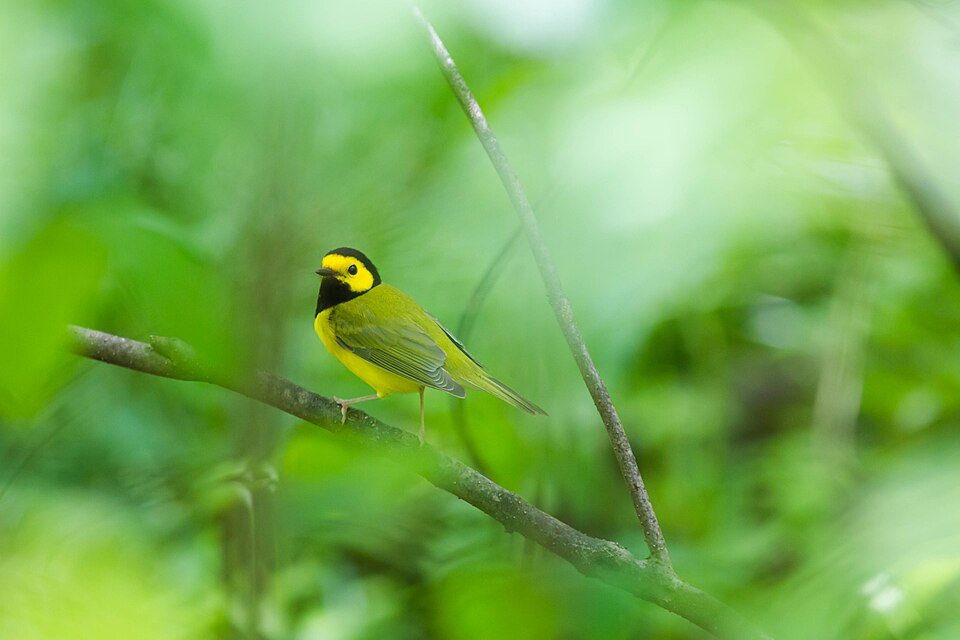
The Hooded Warbler (Setophaga citrina) is a small New World warbler in the family Parulidae, order Passeriformes. It is identified by an olive-brown back, bright yellow underparts, pink legs, and a black face with a yellow eye-ring. Males display more dramatic black hooding than females. The species breeds in forest gaps with developed understory in the eastern United States and winters in Mexico to Panama.
Learn to identify
Adult male Hooded Warbler.
Learning lesson · openly licensed photographs, labelled by BirdBot; labels checked against the cited sources and approved by AI

Yellow face: diagnostic inside the black hood. Black hood: males only; many females show a shadow. Yellow underparts: below a plain olive back. White outer tail feathers: often flashed conspicuously. Black hood around a yellow face: a male Hooded Warbler.
Young males look like females until about 9 to 12 months old.
Sources: Audubon Guide to North American Birds: Hooded Warbler · Wikipedia: Hooded warbler (revision 1380684775)
Photo: panza-rayada, CC BY-SA 3.0, via Wikimedia Commons; labels added by BirdBot.
The Hooded Warbler's plumage is defined by high contrast. The upperparts, including the back and upper tail, are olive-brown, while the underside of the tail features white feathers. Both sexes share a black face with a distinct yellow ring around the eyes, but the male's coloring is significantly more drastic and distinctive. The female presents a more shaded appearance, with the black hooding less pronounced or restricted compared to the mature male. The bird's pink legs are a useful field cue when the bird is perched in the understory.
A key field mark is the bird's habit of spreading its tail like a fan as it flits through the underbrush, displaying the white spots on the outer tail feathers. Neltje Blanchan (1923) described this as a "curious habit" that helps distinguish the species from similar yellow-bellied warblers. This behavior, combined with the black hood and yellow underparts, provides a reliable identification method in the field.
Hooded Warblers are selective about their breeding habitat. They generally nest in gaps within heavily forested areas, specifically avoiding the forest edge. The presence of a well-developed understory is critical for nest site selection. This preference for interior forest gaps rather than edges is linked to the species' vulnerability to predators and habitat loss at forest boundaries.
During the winter months, a notable sexual segregation in habitat occurs. Males tend to remain in forested areas, while females often occupy brushy fields and shrubby areas. This behavioral split is thought to relate to the sexual dominance of the male. The species breeds in the eastern United States and winters in regions ranging from Mexico to Panama.
Hooded Warblers are migratory, moving south nocturnally to their wintering grounds. Their foraging behavior is active and agile; they catch insects in flight or pick them off forest vegetation. Early observers like Chester A. Reed (1919) noted this species was "very active in catching insects on the wing like a true Flycatcher," a habit that distinguishes it from many other understory warblers.
Territorial behavior is complex. While most males attract a single mate, some males hold two females on their territory. The species may avoid small woodlots to increase the number of available territories, which in turn increases the chance of inter-pair fertilization. This dynamic suggests that the social structure is not strictly monogamous, with neighboring males often fertilizing eggs in a female's nest.
The female constructs the nest in the underbrush of a low-lying area. The structure is built from bark and plant material, with an outer layer of dead leaves providing camouflage. Clutch sizes typically range from three to five eggs. Incubation lasts about twelve days, after which the chicks fledge in approximately eight to nine days. Juveniles are capable of reproduction in the following breeding season.
Parental care involves both sexes, with males providing between 25% and 75% of feeding visits to the young. Research has shown that males providing less care do not necessarily use that time to seek additional matings, challenging earlier hypotheses about the trade-off between parental investment and extra-pair fertilization.
The Hooded Warbler's song is a key identification tool. It sings in two distinct modes: one involves repeating the same pattern, while the other is an irregular mix of three to four different patterns. Both males and females sing to attract mates. The repeating mode is often associated with mate attraction, whereas the irregular mode may serve as a method of "negotiating" territory with nearby warblers. The call is described as a sharp "chip."
The Hooded Warbler is currently listed as Least Concern (LC) in the AviList v2026 checklist. While generally abundant in the United States, concerns have been raised in Canada regarding the dwindling number of mating pairs. In Michigan, the species is considered of special concern. Habitat management, such as selective logging that creates interior forest gaps without increasing edge effects, may benefit the species by providing suitable nesting sites while minimizing predation risks.
Because Hooded Warblers nest in low underbrush and avoid forest edges, they can be difficult to spot visually. Listening is often more effective than looking. Focus on forest gaps with dense understory during the breeding season. When observed, maintain a distance to avoid disturbing nesting sites, as the low nest placement makes the birds vulnerable to human presence. Observing from a distance allows you to appreciate the bird's tail-spreading behavior and foraging agility without causing stress.


