
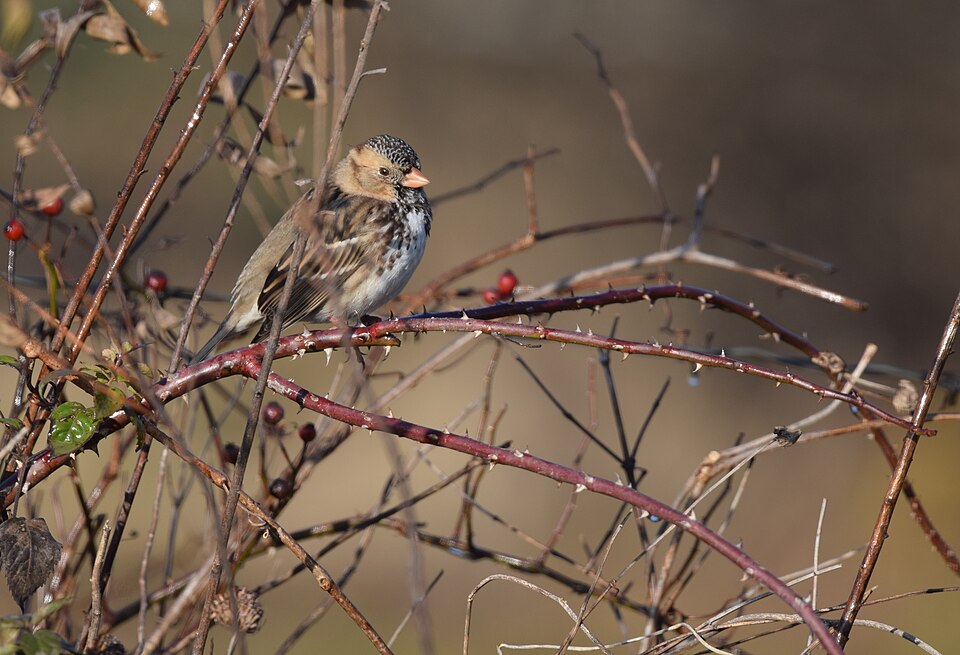
The Harris's Sparrow (Zonotrichia querula) is the largest sparrow in North America, distinguished by its stout pink bill and extensive black head and throat markings in breeding plumage. It breeds in the mixed forest-tundra of northern Canada and winters in agricultural fields and scrubby habitats across the southern central United States.
Learn to identify
Adult Harris's Sparrow in spring (breeding-type) plumage, photographed at Grand Rapids, Michigan, in May.
Learning lesson · openly licensed photographs, labelled by BirdBot; labels checked against the cited sources and approved by AI

Black crown: black on crown and face in breeding plumage. Pink bill: pink in adults and immatures alike. Black throat and bib: contrasts with grey sides of the head. White belly: bright white below, flanks mottled black. Big sparrow, pink bill, black bib: Harris's.
Winter adults are buffier with less black; immatures have white throats.
Sources: Audubon Guide to North American Birds: Harris's Sparrow · Wikipedia: Harris's sparrow (revision 1380683589)
Photo: Caleb Putnam, CC BY-SA 2.0, via Wikimedia Commons; labels added by BirdBot.
At 19 cm in length with an average mass of 36.4 g, the Harris's Sparrow is noticeably larger than most other North American sparrows. Its most reliable field mark is the pink bill, which contrasts with the black and white head patterns. Plumage varies significantly by season and age, making identification context-dependent.
All ages and plumages feature a postocular patch that can be brown or black.
The Harris's Sparrow is a long-distance migrant with distinct seasonal habitats.
During migration, the species forms flocks, often moving through prairie and open grassland habitats. Historical records from the early 20th century noted their abundance on the prairies during migration, though their exact breeding range was less understood at that time. Modern data confirms their breeding grounds are isolated in the northern mixed forest-tundra zones.
Outside of migration, Harris's Sparrows are mostly solitary. However, their social behavior during the breeding season is distinctive.
Male dominance hierarchies are largely determined by the extent of black feathering on the throat and chest. Males with larger black bibs are perceived as higher ranked. When males gather in large groups, such as at breeding sites, they engage in "jump fights" to assert dominance. These fights involve jumping at, pecking, and beating opponents with their wings. These interactions are usually one-sided, with lower-ranked males quickly shying away.
Both sexes arrive at breeding sites simultaneously after migration. Males establish territories shortly upon arrival. Pairs form within seven days of arrival.
Harris's Sparrows are monogamous, though the duration of pair bonds beyond the breeding season is not fully understood. Some research indicates slight site fidelity, with males more likely to return to successful breeding sites than females.
Harris's Sparrows are ground feeders that use a distinctive foraging technique: they kick at nearby vegetation with their feet until seeds or fruit fall to the ground level.
Males sing from exposed perches within their territories. They use one to three song types, which serve to communicate with both females and other males across territory boundaries. The extent of the black "bib" on the male's throat also serves as a visual signal of rank during vocal and physical interactions.
The Harris's Sparrow is listed as Near Threatened (NT) in the AviList v2026 checklist. The specific criteria for this category are not detailed in the provided sources. Its reliance on specific habitat types in both breeding and wintering ranges makes it sensitive to environmental changes.
Observing Harris's Sparrows requires patience and an understanding of their seasonal movements.
Always prioritize the bird's welfare by keeping a respectful distance, avoiding loud noises, and not approaching ground nests. Recording observations and sharing them with community science platforms can help track population trends and habitat use.
Next time you are in a southern US field in winter, look for a large sparrow with a pink bill kicking at the ground.


