
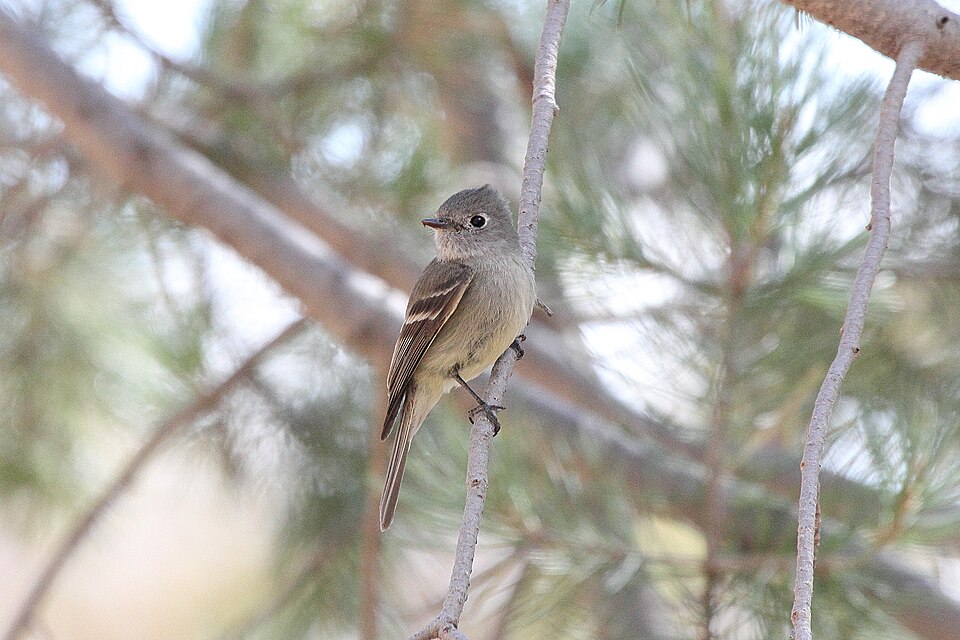
The Hammond's Flycatcher (Empidonax hammondii) is a small tyrant flycatcher best identified by its voice rather than plumage. Males sing a distinctive three-phrase song, while females call "peek." These birds perch high in mature mountain forests, often higher than other flycatchers, making them more likely to be heard than seen.
Learn to identify
Adult Hammond's Flycatcher in western North America.
Learning lesson · openly licensed photographs, labelled by BirdBot; labels checked against the cited sources and approved by AI

White eye-ring: conspicuous around the eye. Small bill: short and narrow for an Empidonax. Two white wing bars: on grayish-olive, darker wings. Yellow-washed belly sides: breast is washed gray. Dusky and Gray look very similar: confirm by call, habitat and range.
Immatures are buffier, with broader wing bars.
Sources: Audubon Guide to North American Birds: Hammond's Flycatcher · Wikipedia: Hammond's flycatcher (revision 1376339443)
Photo: Dominic Sherony, CC BY-SA 2.0, via Wikimedia Commons; labels added by BirdBot.
Note: Natural history details in this guide are based on historical accounts and may not reflect current ecological nuances.
Visually, the Hammond's Flycatcher is a subtle, grayish bird that blends into the forest canopy. Adults have grayish upper parts, a grayish throat, and a dark breast. A key field mark is the presence of whitish or yellowish wing bars. Juveniles differ significantly, appearing brownish with yellowish-brown wing bars, which can make them harder to distinguish from other juvenile flycatchers.
Measurements from historical accounts suggest males range from 14.0 to 14.6 cm in length, while females are slightly smaller at approximately 13.3 cm. The bill is short and pointed, measuring 1.3 to 1.5 cm in males, adapted for catching insects in mid-air.
Because this species is often high in the trees and cryptically colored, vocalization is the most reliable identification tool. The male's call is a sharp "pip," while the female's is a softer "peek." The song itself consists of three rough phrases with similar patterns and vowel sounds: "see-wit...bzurrp...bzeep." This specific structure differentiates the Hammond's Flycatcher from other Empidonax species.
Hammond's Flycatchers breed in western North America and winter as far south as Nicaragua. Their preferred habitat is mature mountain forests with dense canopies and open understories. Key nesting trees include Douglas fir, ponderosa pine, western larch, tanoak, white fir, grand fir, aspen, birch, and maple. The open understory is vital as it facilitates the bird's sallying flight to catch insects. Historical records from the Rocky Mountains note that the species was a common summer resident, breeding at elevations up to 9,000 feet (Keyser, 1902).
These birds are insectivores, feeding primarily on ants, beetles, moths, and flies. They employ a "sit-and-wait" strategy, perching in the center of tall conifers or aspens. When an insect comes into view, the flycatcher quickly sallies out, snaps its beak shut, and returns to the same perch. This behavior, combined with their high perching preference, makes them elusive to visual observers.
The breeding season occurs between early June and late July. Females lay 3 to 4 whitish or yellowish eggs, which they incubate for 12 to 15 days. The nest is a cup constructed from bark, plant fibers, pine needles, and twigs, placed 6 to 60 feet above the ground in a conifer or deciduous tree. Young fledge approximately 17 to 18 days after hatching.
According to AviList v2026, the Hammond's Flycatcher is listed as Least Concern (LC). While the species is still commonly found in the Pacific Northwest, cool, shady forests are essential for nesting, roosting, and foraging. Timber harvest and fires can sometimes benefit the species if they open the understory while leaving the canopy intact, but more research is needed to fully understand the long-term effects of forest management on this population.
To observe a Hammond's Flycatcher, visit mature mountain forests during the breeding season (June to July). Focus on areas with tall conifers and open understories. Listen for the distinctive three-phrase song from high in the canopy, as these birds are often heard before they are seen. Since the bird is often hidden in the foliage, patience and audio identification are key. Avoid disturbing nesting sites by keeping a respectful distance and not using playback excessively, which can stress the birds.


