
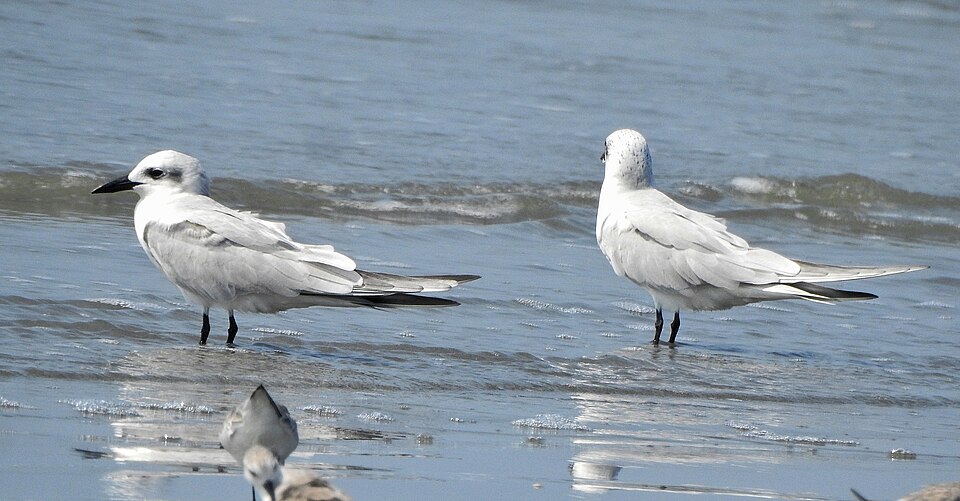
The Gull-billed Tern (Gelochelidon nilotica) is a large, stocky tern distinguished by its short, thick, gull-like bill and robust body. Unlike most terns, it rarely plunge-dives for fish, instead feeding on insects, amphibians, and small mammals over wet fields and brushy areas. Summer adults have grey upperparts, white underparts, a black cap, and black legs.
Learn to identify
Two breeding-plumage Gull-billed Terns (subspecies vanrossemi) standing on sand at San Diego National Wildlife Refuge, California.
Learning lesson · openly licensed photographs, labelled by BirdBot; labels checked against the cited sources and approved by AI
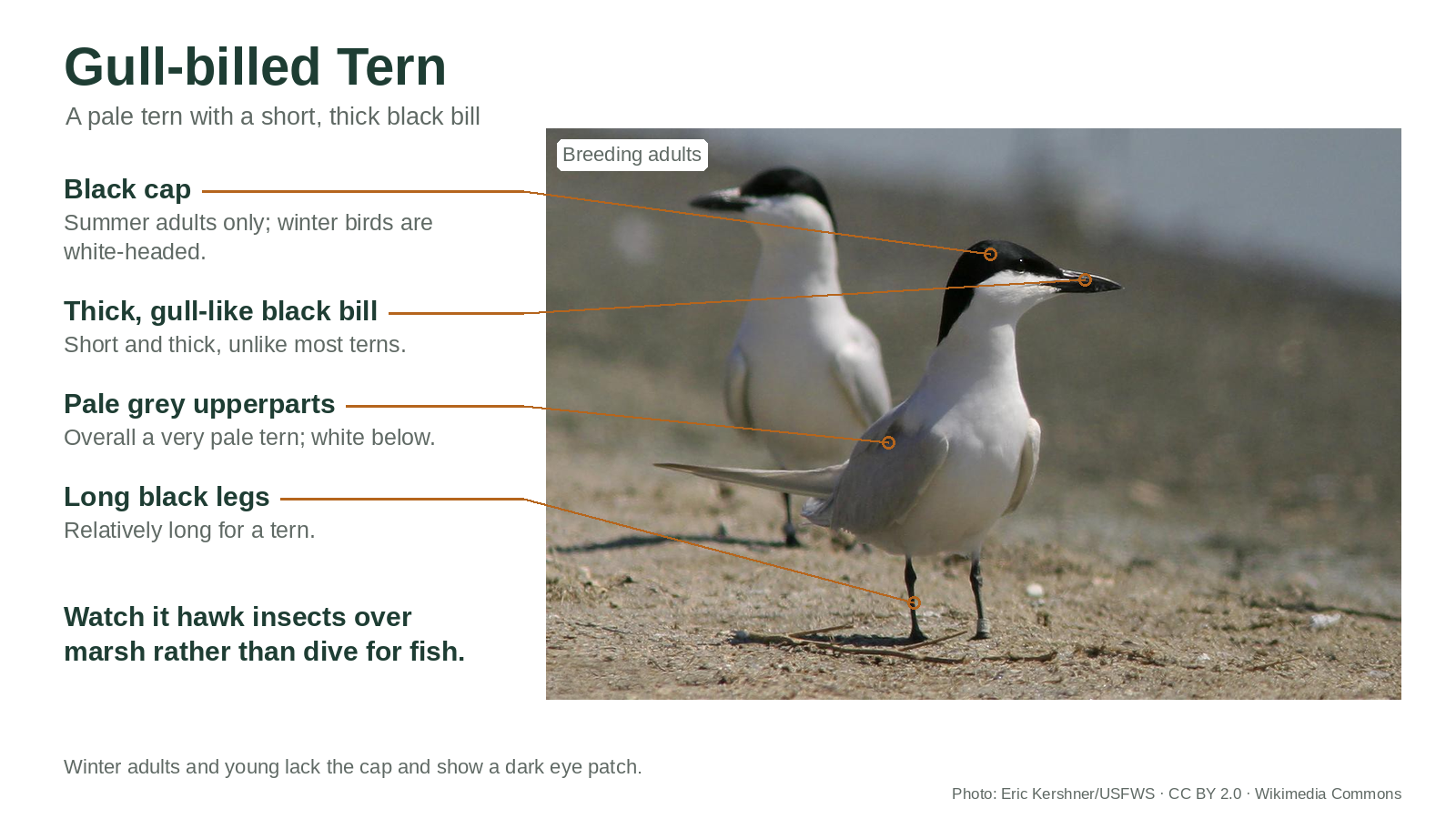
Black cap: summer adults only; winter birds are white-headed. Thick, gull-like black bill: short and thick, unlike most terns. Pale grey upperparts: overall a very pale tern; white below. Long black legs: relatively long for a tern. Watch it hawk insects over marsh rather than dive for fish.
Winter adults and young lack the cap and show a dark eye patch.
Sources: Audubon Guide to North American Birds: Gull-billed Tern · Wikipedia: Gull-billed tern (revision 1373988421)
Photo: Eric Kershner/USFWS, CC BY 2.0, via Wikimedia Commons; labels added by BirdBot.
The Gull-billed Tern is a fairly large and powerful tern, similar in size and general appearance to a Sandwich Tern, but its build is distinct. The short, thick, gull-like bill, broad wings, long legs, and robust body are the primary field marks. It measures 33–42 cm (13–17 in) in length with a wingspan of 76–91 cm (30–36 in) and a body mass of 150–292 g (5.3–10.3 oz).
Plumage varies significantly between seasons and age classes, which is critical for accurate identification:
The Gull-billed Tern is frequently confused with other terns, particularly in regions where it is uncommon. The most common confusion is with the Sandwich Tern.
| Feature | Gull-billed Tern | Sandwich Tern |
|---|---|---|
| Bill | Short, thick, gull-like, black | Typically longer and thinner |
| Body Build | Robust, stocky, broad wings | Typical tern build |
| Foraging | Rarely dives; hunts insects/small mammals | Frequently plunge-dives for fish |
| Confusion Risk | High with juvenile Sandwich Terns | High with Gull-billed Terns in North Sea coasts |
Juvenile Sandwich Terns have a short bill and are frequently mistaken for Gull-billed Terns where the latter species is uncommon, such as on North Sea coasts. Observing behavior is often more reliable than plumage alone, as the Gull-billed Tern's atypical feeding habits set it apart.
The Gull-billed Tern is widely distributed, breeding in scattered localities in Europe, Asia, northwest Africa, and the Americas. Its habitat preferences vary by region:
According to AviList v2026, the species is local yet widespread inland, on rivers and lakes from southwestern Europe to northeastern China, coastal China, the western North Atlantic, the Caribbean, coastal southern California and Mexico, coastal South America, and inland north-central Argentina. It winters to subtropical and tropical coasts, including northern Australia, and is found worldwide except on remote islands.
The Gull-billed Tern is a somewhat atypical tern. While it resembles a Sterna tern in appearance, its feeding habits are more similar to the Chlidonias marsh terns, the Black Tern, and the White-winged Tern. It does not normally plunge-dive for fish like other white terns and has a broader diet than most of its relatives.
Its foraging strategy involves catching insects in flight and hunting over wet fields and brushy areas for amphibians and small mammals. It is also an opportunistic feeder; for example, it has been observed picking up and feeding on dead dragonflies from roads. This terrestrial foraging behavior is a key field cue for identification.
Gull-billed Terns breed in colonies on lakes, marshes, and coasts, including bays and earthen levees. They nest in a ground scrape, laying two to five eggs. In a 2022 study of inland saline lakes in a Mediterranean Biosphere Reserve in Central Spain, researchers found anthropogenic debris, mainly macroplastics, in 2.4% of sampled Gull-billed Tern nests. While no immediate harmful impacts on adults or chicks were detected in that specific study, the presence of plastics in nests highlights the ubiquity of pollutants in protected areas.
The call is described as a characteristic ker-wik. Historical accounts from 1916 described the voice as a high, thin, somewhat reedy tee-tee-tee, sometimes suggesting a weak-voiced katydid. Listening for this distinctive, reedy call can be useful for locating the bird in dense colonies.
The Gull-billed Tern is listed as Least Concern (LC) in the IUCN Red List as recorded in AviList v2026. This status reflects its wide distribution and large population size. However, local populations can be vulnerable to habitat loss, pollution, and human disturbance. The species is covered by the Agreement on the Conservation of African-Eurasian Migratory Waterbirds (AEWA).
When observing Gull-billed Terns, prioritize distance and minimal disturbance, especially during the breeding season. Since they nest in ground scrapes within colonies, approaching too closely can cause adults to abandon nests or stress chicks.
For community scientists, recording detailed observations of foraging behavior and habitat use can contribute to shared datasets. If you have compatible camera or software setups, you may contribute detections to improve understanding of this species' atypical foraging habits.


