
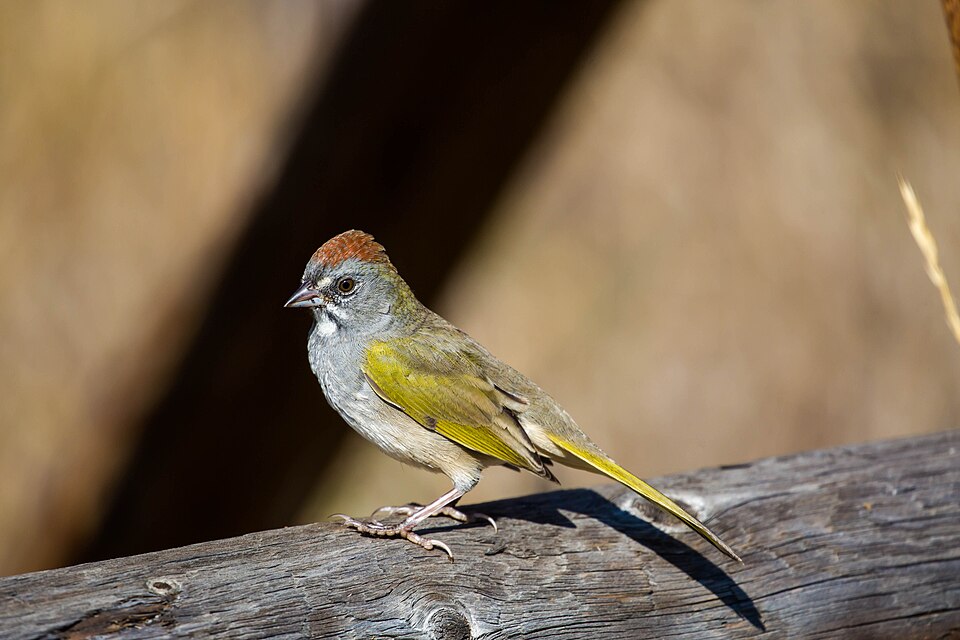
The Green-tailed Towhee (Pipilo chlorurus) is a medium-sized New World sparrow found in the western United States and Mexico. It is best identified by its catlike ascending meow call, which often reveals the bird before it is seen in dense brush. Adults feature a reddish-brown crown, white throat, olive back, and greenish tail, while juveniles are drab and heavily streaked.
Learn to identify
Adult Green-tailed Towhee on sand, Great Sand Dunes National Park and Preserve, Colorado.
Learning lesson · openly licensed photographs, labelled by BirdBot; labels checked against the cited sources and approved by AI

Reddish cap: often raised into a perky crest. Sharp white throat: set off against a gray face and chest. Olive-green upperparts: yellow-green edges on the wings. Green tail: long and yellow-green to olive. Rusty cap over a white throat on a gray-and-green bird.
Juveniles are drab and heavily streaked.
Sources: Audubon Guide to North American Birds: Green-tailed Towhee · Wikipedia: Green-tailed towhee (revision 1381485650)
Photo: Great Sand Dunes National Park and Preserve, Public domain, via Wikimedia Commons; labels added by BirdBot.
The Green-tailed Towhee belongs to the family Passerellidae (New World sparrows) within the order Passeriformes. According to AviList v2026, the species is classified as Least Concern (LC). It breeds in the highlands of the western USA and winters in central Mexico. Isolated breeding areas exist in northwestern Oregon, north-central Montana, and the area where northeastern Wyoming and western South Dakota meet.
Adults are about 18 cm (7.1 in) long and weigh approximately 29 g (1.0 oz). Sexes have similar plumage, though females are slightly duller. Key field marks include:
The song is described as a series of high, varied notes, often ending in a fast rattle or raspy trill. One common description is "tjip drip threeeeh witwitwit-". The most distinctive sound is the catlike ascending meow call, which is usually given from dense cover. Other calls include an emphatic tick, a poitt, and rapid tuck notes.
In its breeding range, habitat varies with elevation. Lower areas include shrub-steppe with sagebrush and scattered trees, as well as brushy areas regrowing after fire. Higher elevations feature open woodlands of pine, oak, and other conifers with a brushy understory. In its non-breeding range, it inhabits semi-open landscapes with Acacia, mesquite, and oak-juniper woodlands. The species is a complete or near-complete migrant, vacating northern breeding areas as early as July and returning by May.
Green-tailed Towhees forage primarily on the ground in dense vegetation. They are known for kicking backward with both feet during a forward hop to flush out insects. They also pick food directly from the ground. Their diet consists of a wide variety of seeds and insects, supplemented by smaller amounts of small fruits. During the breeding season, they forage in pairs; in the non-breeding season, they may join small flocks of sparrows. In human-inhabited areas, they visit feeders, especially in winter.
The female builds a large, deep cup nest with thick walls made of twigs, grass, and bark, lined with finer plant fibers and hair. The nest is placed on the ground under a dense shrub or in a shrub, typically within 1 meter (3 ft) of the ground. Clutches range from two to five eggs, most commonly three or four. Eggs are pale sky blue or turquoise with reddish-brown speckles. The female incubates alone for 11 to 13 days. Fledging occurs 11 to 14 days after hatch. Females brood the nestlings, but both parents provision them.
The Green-tailed Towhee is listed as Least Concern (LC) in the IUCN Red List as recorded in AviList v2026. This status reflects the species' wide range, though it is not a local abundance estimate or a population trend assessment.
Because the nest is on the ground and well-hidden in dense brush, it is difficult to locate and vulnerable to disturbance. The best way to observe this species is to listen for the catlike mewing call in dense cover. Once located, observe from a distance and avoid approaching the nest site, especially during the breeding season (early May to early August). This minimizes stress on the adult and protects the nest from predation or abandonment.


