
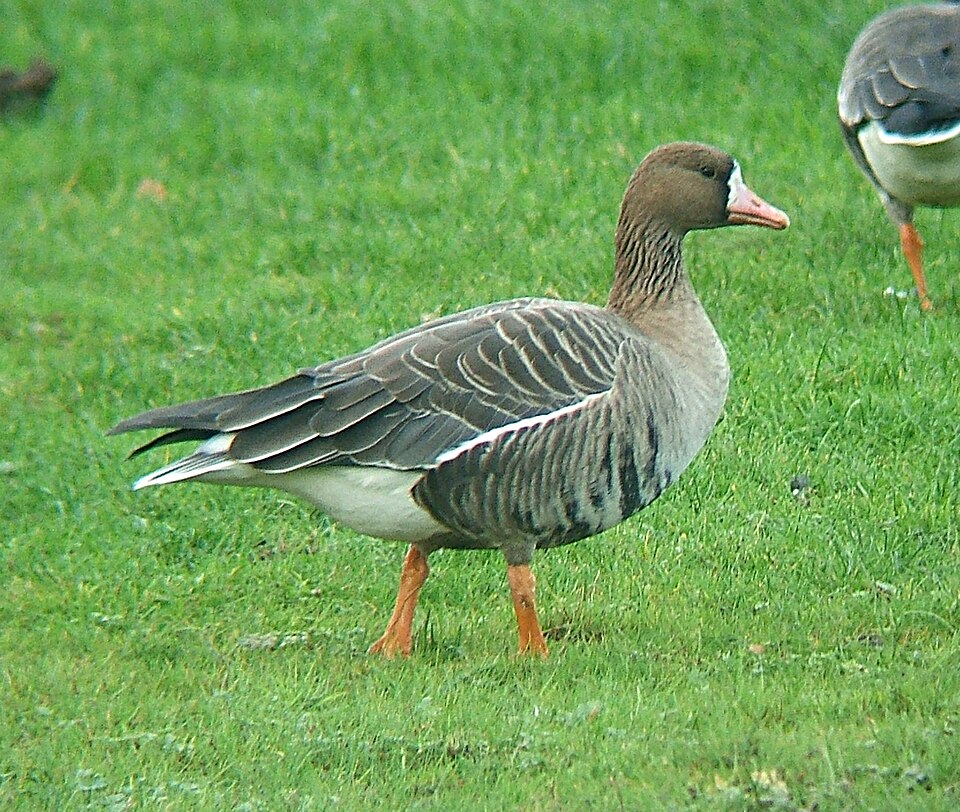
The Greater White-fronted Goose (Anser albifrons) is a medium-sized goose in the family Anatidae, distinguished by a white band at the base of its bill, light brown plumage, white belly, and orange feet. It breeds in riparian areas with brush cover and winters on agricultural lands or freshwater marshes, forming large flocks and lifelong pair bonds.
Learn to identify
Adult Greater White-fronted Goose (subspecies albifrons) on grass in Northumberland, England.
Learning lesson · openly licensed photographs, labelled by BirdBot; labels checked against the cited sources and approved by AI

White blaze at bill base: a white band around the base of a pinkish bill. Black belly bars: variable dark blotches and bars below. Bright orange legs: orange legs and feet. White front plus black belly bars marks an adult.
Young birds in fall are all grey-brown, with a pale bill and legs.
Sources: Audubon Guide to North American Birds: Greater White-fronted Goose · Wikipedia: Greater white-fronted goose (revision 1382144768)
Photo: MPF, CC BY-SA 3.0, via Wikimedia Commons; labels added by BirdBot.
The most reliable field mark for the Greater White-fronted Goose is the white band at the base of the bill, which gives the species its common name. Adults have light brown feathers on the neck, back, and head, with darker brown feathers tipped in white on the rear. The belly is white, the feet are orange, and the bill has a pinkish tint. Males are typically larger than females, but there is no plumage differentiation between the sexes.
Size ranges from 64 to 84 cm in length, with a wingspan of 51 to 65 cm. Mass ranges from 1.93 to 3.31 kg, with a mean of 2.72 kg. These measurements provide a baseline for the species, though the white bill band remains the primary visual cue for identification.
Similar Species: The Lesser White-fronted Goose (Anser erythropus) is a common look-alike. The Greater White-fronted Goose is larger than the Lesser and lacks the yellow eye ring found in the Lesser. Additionally, the white facial blaze on the Greater does not extend upwards as far as it does on the Lesser (Wikipedia, 2026).
During the breeding season, Greater White-fronted Geese prefer riparian areas and the edges of aquatic habitats such as lakes, streams, rivers, and marshes. They are highly dependent on brush cover and woody vegetation, with nests usually located on the ground within 300 feet of water.
In winter, they migrate south to agricultural lands with shallow standing water or freshwater marshes. According to AviList v2026, the species has a Holarctic range, breeding in southwestern Greenland, northern Russia to the Chukotskiy Peninsula, and northern Alaska to west of Hudson Bay. Wintering grounds extend to southern Europe, the Middle East, eastern China, the Korean Peninsula, Japan (Honshu), and the southwestern and southeastern USA and northern Mexico.
For North American observers, the subspecies Anser albifrons gambeli (Gambel’s White-fronted Goose) is the primary form encountered. Historical records from the early 20th century note that these geese were very abundant on the Pacific coast and fairly common in the Mississippi Valley, while remaining rare on the Atlantic coast (Reed, 1916). This distribution pattern highlights the species' strong association with western and central North American wetlands and agricultural areas during the non-breeding season.
Greater White-fronted Geese are social birds that form lifelong monogamous pair bonds. Bonding occurs in the fall and into early spring. They exhibit cooperative breeding, with offspring remaining with their parents for one to two years. Yearlings participate in defending the nest from predators.
Outside the breeding and molting periods, these geese gather in large flocks that can contain up to 30,000 individuals. During migration, they fly at night. Outside of migration, they remain close to nesting and roosting sites, foraging within 20 km of roosts but typically staying within 4 km of their nests.
Historical field notes from North America describe the subspecies Anser albifrons gambeli (Gambel’s White-fronted Goose) as "very noisy birds" known locally as "Laughing Geese" due to their "confused honking, likened to laughter" (Reed, 1916). Reed also noted that these geese were "very wild and difficult to approach," with sentinels stationed to give alarm if danger approached while feeding. These specific behavioral observations apply to the North American subspecies as recorded in 1916 and should not be assumed to characterize the European subspecies identically.
Primarily herbivorous, Greater White-fronted Geese feed on grasses, grains, and berries. During the breeding season, they also consume mollusks and aquatic insects. In winter, their diet becomes exclusively herbivorous, including crops such as rice, soybeans, and grains in early winter, and newly sprouted grasses and forbs in late winter. Primary forage items include white clovers, creeping buttercups, common dandelions, and various grasses.
Note that these dietary specifics are based on general natural history accounts and may vary significantly by region, season, and local agricultural availability.
Greater White-fronted Geese breed once a year in the summer, beginning in late May. Clutches contain 4 to 7 eggs, with an incubation period of 27 days. Both sexes are involved in nest protection and incubation. Maturity is reached at 3 years of age. Juveniles remain with their parents for at least one year, during which adults guide them to winter habitats and teach foraging techniques.
These geese communicate visually and acoustically. Acoustically, they use a series of honks to communicate and warn individuals. They also use postures and hisses to establish boundaries with foes.
Historical field notes from North America describe the calls of the subspecies Anser albifrons gambeli (Gambel’s White-fronted Goose) as a “confused honking, likened to laughter,” earning them the local nickname “Laughing Geese” (Reed, 1916). It is important to note that this specific “laughing” descriptor is associated with the North American subspecies in historical literature, whereas the general honking and warning calls are characteristic of the global species Anser albifrons.
The Greater White-fronted Goose is listed as Least Concern (LC) in AviList v2026. Populations are generally stable. In the United States, the species is protected under the Migratory Bird Act. Historical records note that a population in Greenland was threatened in the 1970s due to habitat loss but recovered within twenty years after legislation was passed.
Observe Greater White-fronted Geese from a distance in agricultural fields or near water, noting their social bonding and foraging habits. Look for large flocks or family groups, particularly during migration or winter. Use binoculars or a telephoto lens to observe the white bill band and orange feet without disturbing the birds. Avoid approaching nests or roosting sites to minimize stress on the animals.
Field Tip: In North America, check agricultural fields in the Pacific Northwest during late September to October for migrating flocks. Historical records indicate these geese reached the U.S. on their return from the Arctic regions around the first of October (Reed, 1916). However, this 1916 date is a historical reference, not a reliable modern predictor; migration timing is highly variable by year and location, so observers should treat this as a general window rather than a fixed date.


