
The Double-crested Cormorant (Nannopterum auritum) is a large, black waterbird found across North America, recognizable by its orange-yellow facial skin and, in breeding season, distinctive white or black nuptial crests above the eyes. It hunts by diving for fish and is often seen standing with wings outstretched to dry its non-waterproof feathers.
Learn to identify
Adult Double-crested Cormorant in breeding plumage with white crests, standing on a rock.
Learning lesson · openly licensed photographs, labelled by BirdBot; labels checked against the cited sources and approved by AI

Two crests: breeding plumes above the eyes; white in the West. Orange face skin: bare orange skin on the throat and lores. Hooked bill: dark, medium-sized and hooked at the tip. Webbed feet: large dark feet on a blackish bird. Blackish all over, with orange skin at the bill base.
Crests show only in breeding season; immatures are brownish, paler in front.
Sources: Audubon Guide to North American Birds: Double-crested Cormorant · Wikipedia: Double-crested cormorant (revision 1379926119)
Photo: Mike's Birds from Riverside, CA, US, CC BY-SA 2.0, via Wikimedia Commons; labels added by BirdBot.
Adults are entirely black, with a stocky body, long neck, and a hooked bill. The most striking field mark is the bare, orange-yellow skin on the face and throat. During the breeding season, adults develop nuptial crests—tufts of feathers that are white, black, or a mix of both—located just above the eyes. Non-breeding adults lack these crests and may have slightly more yellowish facial skin.
Juveniles differ significantly from adults, appearing dark gray or brownish with lighter underparts and a pale throat. Their bills are mostly orange or yellowish, contrasting with the dark bills of adults. As juveniles age, their plumage darkens toward the adult pattern.
The Double-crested Cormorant is often confused with the Great Cormorant and the Neotropic Cormorant.
This species is widespread across temperate and subtropical North America. It inhabits coastal areas, rivers, and lakes. The range extends from the Aleutian Islands in Alaska down to Florida and Mexico, including the Caribbean islands of Cuba and the Bahamas.
It is resident along the Pacific Coast from the Aleutians to Nayarit, Mexico, and along the Atlantic Coast in areas like Long Island, southern New England, and Florida. Breeding occurs throughout north-central North America, from Utah to Alberta and east to Nova Scotia. Birds from colder breeding areas, such as eastern Canada, migrate to ice-free coastal waters for winter.
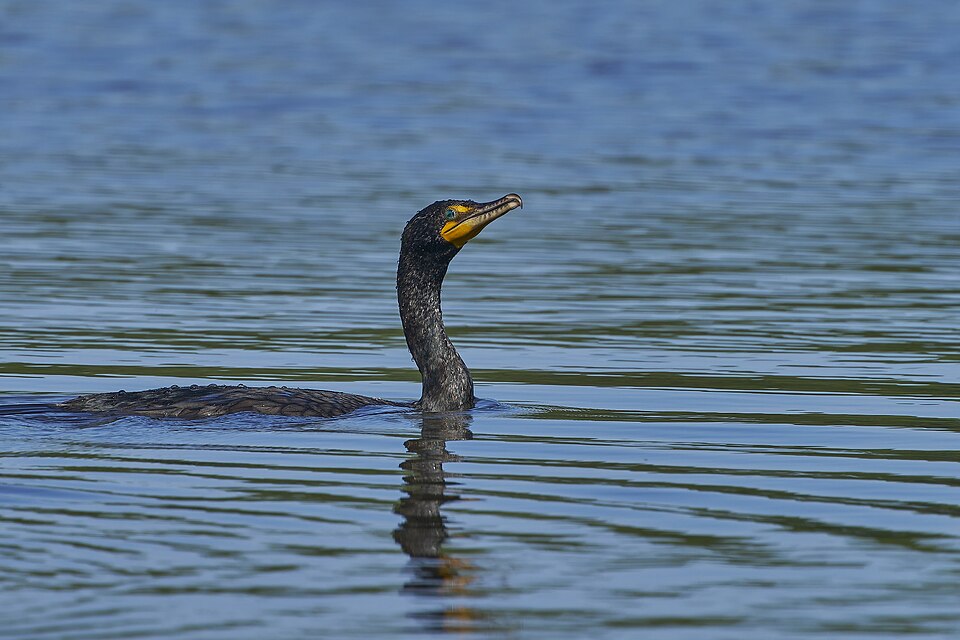
Double-crested Cormorants are active divers. They swim low in the water, often with only their neck and head visible, and use their webbed feet for propulsion. They can dive to depths of 1.5–7.5 meters (4–24 feet) for 30–70 seconds to catch prey. A 2024 study in Journal of Comparative Physiology B confirms that these birds rely on enhanced muscle oxygen stores rather than blood oxygen capacity to sustain these dives, highlighting the physiological adaptations that allow them to forage effectively in both marine and freshwater environments.
A key behavioral trait is the need to dry their feathers. Unlike ducks, cormorant feathers are not fully waterproof, which aids in diving but requires drying time. After foraging, they often stand on rocks or branches with wings outstretched. In flight, they fly low over the water with their bills tilted slightly upward, sometimes in long, single-file lines.
Their diet consists primarily of fish, caught by diving in marine, freshwater lakes, and rivers. They may also consume amphibians, crustaceans, and insects. Smaller fish are often eaten underwater, while larger prey is brought to the surface. Biologists can study their diet by dissecting regurgitated pellets containing undigested bones and parts.
These are gregarious, colonial birds that nest in coastal areas and near inland waters. They build stick nests in trees, on cliff edges, or on the ground on suitable islands. Colonies often include other aquatic birds. The call is a deep, guttural grunt, particularly audible in breeding colonies.
The Double-crested Cormorant is listed as Least Concern (LC) in the AviList v2026 checklist. Historically, the species was threatened by the use of DDT, but populations have increased markedly in recent years. It is now considered a common and widespread species across its range.
To observe this species ethically, look for the following cues:
When observing colonies, maintain a respectful distance to avoid disturbing nesting birds. Use binoculars or a telephoto lens to view details without approaching the nest sites.


