
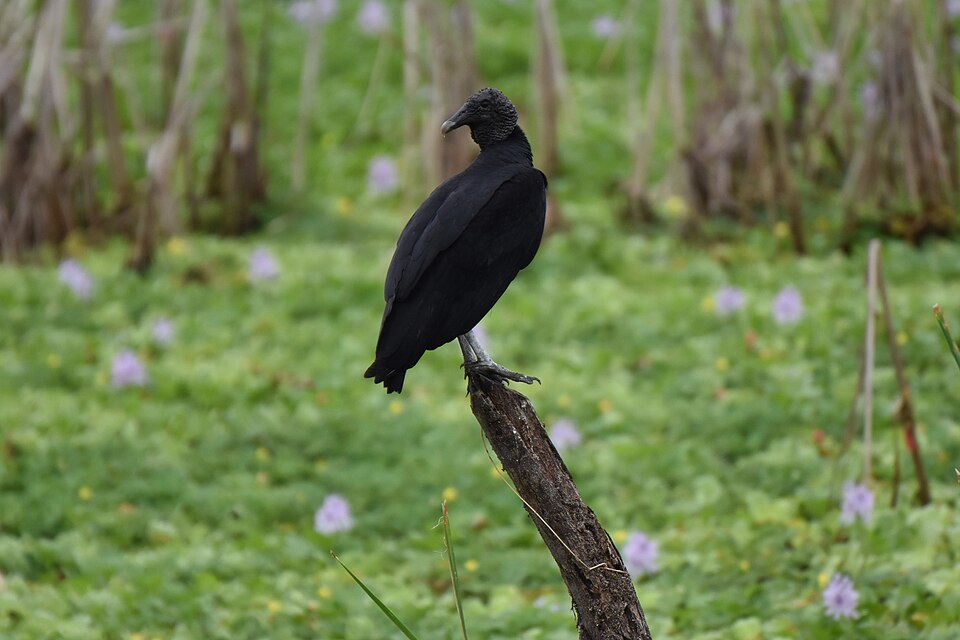
The Black Vulture (Coragyps atratus) is a large, all-black New World vulture with a wrinkled, bare head. In flight, it is distinguished from the similar Turkey Vulture by its short, square tail and a prominent white patch on the underside of the wing at the base of the primaries. It prefers open habitats such as fields, deserts, and urban areas, and is known for its aggressive foraging behavior and sight-based hunting.
Learn to identify
Adult Black Vulture standing on bare ground at Agua Blanca, Ecuador.
Learning lesson · openly licensed photographs, labelled by BirdBot; labels checked against the cited sources and approved by AI

Bare, wrinkled grey head: featherless dark grey skin on head and neck. Glossy black plumage: mainly black; stocky with broad wings. Greyish-white legs: pale legs below the black body. In flight, look for whitish patches near the wingtips.
Young Turkey Vultures also have dark heads; check shape.
Sources: Audubon Guide to North American Birds: Black Vulture · Wikipedia: Black vulture (revision 1381887016)
Photo: Arabsalam, CC BY-SA 4.0, via Wikimedia Commons; labels added by BirdBot.
Identifying a Black Vulture in the field relies on a few distinctive visual features, particularly when compared to its close relative, the Turkey Vulture. Both are large, dark vultures, but the Black Vulture has a completely black head and neck, whereas the Turkey Vulture has a red or carmine head. The most reliable field mark for the Black Vulture is the large white patch on the underside of the wing, visible at the base of the primaries during flight; this patch is a key diagnostic feature for the species. Additionally, the Black Vulture has a short, square tail. On the ground, the Black Vulture's feet are yellowish and stretch past its short tail, a feature that can help distinguish it from other scavengers.
Black Vultures are highly adaptable and prefer open habitats, avoiding dense forests. They are commonly found in lowlands with adjacent highlands, open fields, desert terrain, and urban or rural centers. Their range extends from the southern and southeastern United States southward through Middle America to central Chile and Argentina, with vagrant records in the West Indies. This broad distribution reflects their ability to thrive in a variety of environments, including human-modified landscapes.
Unlike Turkey Vultures, which locate carrion by smell, Black Vultures hunt by sight. They typically soar higher and later in the day than Turkey Vultures, riding thermals to cover large areas efficiently. When they find a carcass, they are more aggressive and will often drive other scavengers, including Turkey Vultures, away from the food source. Black Vultures are highly social, forming flocks to forage and roosting in large aggregations. They also form family units with immediate kin and extended relatives. When startled, a Black Vulture may regurgitate food to lighten its load for a quick takeoff. Their adaptability to urban environments, such as garbage dumps and rural centers, further supports their success in varied landscapes.
Black Vultures are opportunistic scavengers, feeding primarily on carrion, road kill, and garbage. They also consume small mammals, birds, eggs, and fruit. Their diet is highly variable, and they are known to kill baby herons on nesting colonies and feed on domestic ducks, newborn calves, and young turtles. This opportunistic feeding strategy allows them to exploit a wide range of food sources, contributing to their success in both natural and urban environments.
Black Vultures are monogamous and lay one brood per breeding season. They do not build nests with materials but instead lay their eggs in hollow bases of trees or stumps, on the floor of shallow caves, in abandoned farm buildings, on cliff edges, or in crevices in city buildings. Usually, two eggs are laid, which are pale grey-green or pale blue with brown spots or blotches. Both parents incubate the eggs for 32 to 41 days, and the young fledge at 63 to 70 days old. Natural hybrids between Turkey Vultures and Black Vultures have been observed in captivity, but this is rare in the wild.
Black Vultures are usually silent, but they may hiss, grunt, or utter low barking sounds when fighting over food sources. These vocalizations are not as common or varied as those of other bird species, but they can be a useful field cue when observing groups of vultures at a carcass.
The Black Vulture is currently listed as Least Concern (LC) in the IUCN Red List, as recorded in AviList v2026. Historically, the species faced threats such as a decrease in suitable tree cavities for nesting due to forest fire control and eggshell thinning from pesticides like DDT. While some historical sources from the 1980s described the species as common or a pest in urban areas, its current status reflects its widespread distribution and adaptability to human-modified landscapes.
When observing Black Vultures, it is important to maintain a respectful distance to avoid disturbing their natural behavior. Since they forage later in the day than Turkey Vultures, look for them during this later period when they are often soaring or feeding. Use binoculars or a spotting scope to observe their flight patterns and feeding behavior without causing stress. Avoid approaching nesting sites or carcasses where vultures are feeding, as this can disrupt their activities and potentially harm the birds. For a quick field confirmation, look for the white wing patch during their later-day activity in open fields to distinguish it from the similar Turkey Vulture.


